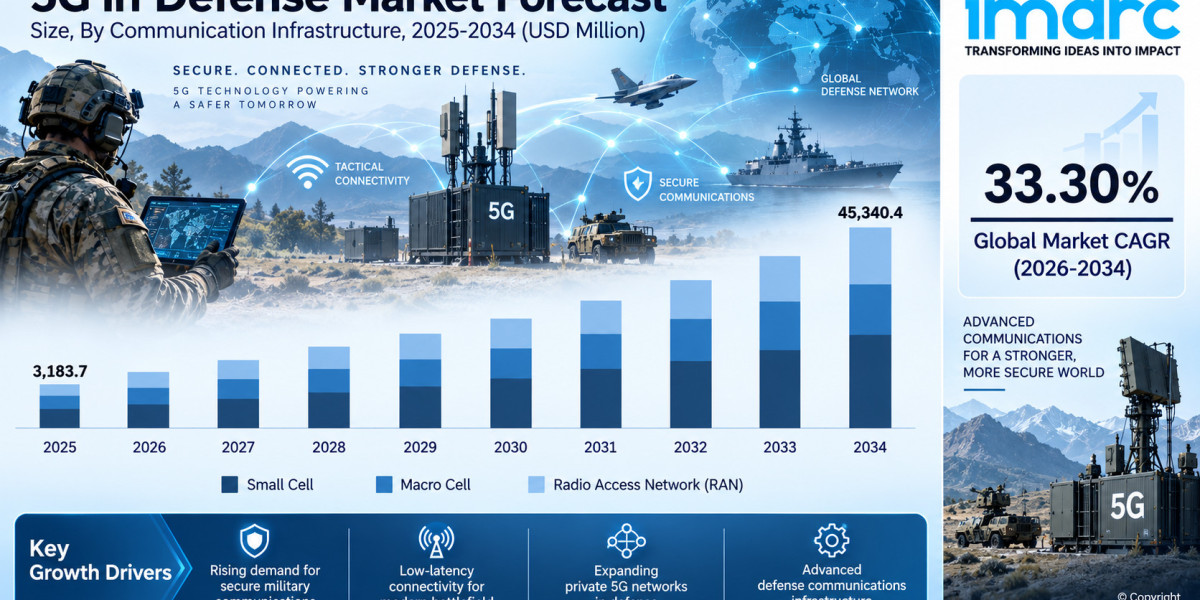

The global 5G in defense market size reached USD 3,183.7 Million in 2025. Looking forward, the market is expected to reach USD 45,340.4 Million by 2034, exhibiting a growth rate (CAGR) of 33.30% during 2026-2034. 5G technology is increasingly being adopted across the defense sector to enhance intelligence, surveillance, and reconnaissance (ISR) systems, streamline logistics operations, enable advanced command and control (C2), and facilitate rapid transmission of videos and images for real-time battlefield applications. The growing adoption of autonomous defense vehicles and robots, increasing use of 5G-enabled radars, rising cross-border and territorial conflicts, technological advancements in the Internet of Things (IoT), growing adoption of augmented reality (AR), defense infrastructure upgrades, and government initiatives supporting 5G technology are some of the factors driving market growth.
Market Size & Growth: The global 5G in defense market share reached USD 3,183.7 Million in 2025 and is expected to reach USD 45,340.4 Million by 2034, registering a CAGR of 33.30% during 2026–2034.
Major Market Drivers: The widespread adoption of autonomous defense vehicles and robots, increasing use of 5G in radars, rising cross-border and territorial conflicts, and rapid upgrades in defense infrastructure are supporting market growth.
Key Market Trends: Growing integration of 5G with IoT, increasing adoption of augmented reality (AR) for military maintenance and training, rising use of 5G-enabled radar systems, and government initiatives supporting 5G deployment are shaping the market.
Communication Infrastructure: The market is segmented into small cell, macro cell, and radio access network (RAN).
Core Network Technology: Key segments include software-defined networking (SDN), fog computing (FC), mobile edge computing (MEC), and network functions virtualization (NFV).
Network Type: The market includes enhanced mobile broadband (eMBB), ultra-reliable low-latency communications (URLLC), and massive machine type communications (mMTC).
Chipset: Major chipset categories include application-specific integrated circuit (ASIC), radio frequency integrated circuit (RFIC), and millimeter wave (mmWave) chipsets.
Platform: The market covers land, naval, and airborne platforms.
Competitive Landscape: Major companies include General Dynamics Information Technology, Lockheed Martin Corporation, Nokia Corporation, Samsung Electronics Co., Ltd., Sierra Wireless (Semtech Corporation), Telefonaktiebolaget LM Ericsson, Thales Group, and Wind River Systems, Inc.
Request for a Sample Report for Detailed Evaluation: https://www.imarcgroup.com/5g-in-defense-market/requestsample
What Is Driving 5G in Defense Market Growth in 2026?
Growing Adoption of Autonomous Defense Vehicles and Robots
The widespread adoption of autonomous defense vehicles and robots is one of the key factors driving the 5G in defense market. Modern defense operations increasingly require connected platforms capable of collecting, processing, and transmitting large volumes of information with minimal delay.
5G technology offers high-speed data connectivity, enhanced network capacity, ultra-low latency, and increased reliability, making it suitable for supporting communication between autonomous platforms and connected defense systems. The growing use of autonomous vehicles and robots across defense applications is therefore creating increasing demand for advanced wireless communication infrastructure.
Increasing Use of 5G in Radar Systems
The rising use of 5G technology in radar systems is another factor supporting market growth. Defense radar systems are required to detect and track multiple targets efficiently, particularly in complex operational environments.
The enhanced connectivity and high-speed data transmission capabilities associated with 5G can support the communication requirements of advanced radar applications. The increasing need for improved detection and tracking capabilities is consequently encouraging the integration of 5G technologies into defense communication systems.
Rising Cross-Border and Territorial Conflicts
The surging number of cross-border and territorial conflicts is also contributing to market expansion. Modern defense operations increasingly depend on rapid access to reliable information and real-time communication across geographically dispersed and challenging environments.
5G networks can facilitate the faster transmission of videos, images, and operational information, enabling defense personnel to receive and process information more rapidly. The need for enhanced situational awareness and responsive communication is consequently supporting the adoption of 5G technology in defense applications.
5G in Defense Market Trends
Integration of Internet of Things (IoT)
The integration of the Internet of Things (IoT) is emerging as a significant trend in the 5G in defense market. IoT enables communication between multiple sensors and connected devices while supporting high-speed data connectivity.
The combination of 5G and IoT can facilitate the connection of numerous defense assets and sensors, enabling faster information exchange and improved operational coordination. As defense organizations increasingly adopt connected systems, the integration of IoT with 5G is expected to remain an important market trend.
Increasing Adoption of Augmented Reality (AR)
5G services are rapidly being adopted in augmented reality (AR) applications for military maintenance and training. AR can support defense personnel in maintaining gadgets, vehicles, and equipment while also facilitating training activities.
The high-speed connectivity and low latency offered by 5G can support AR applications requiring rapid transmission of information. This is creating opportunities for defense organizations to enhance training and maintenance processes through connected and immersive technologies.
Rapid Upgradation of Defense Infrastructure
The rapid upgrading of defense infrastructure is contributing to the positive outlook for the market. Defense organizations are increasingly investing in advanced communication capabilities to support modern operational requirements.
The deployment of 5G networks can provide enhanced network capacity, high-speed data connectivity, ultra-low latency, and improved reliability, making the technology relevant to the modernization of defense infrastructure.
Government Initiatives Supporting 5G Technology
The implementation of government initiatives to support 5G technology is further strengthening market prospects. Governments are encouraging the development and adoption of advanced wireless communication infrastructure, creating an environment conducive to 5G deployment across strategic applications.
As defense organizations seek to modernize communication networks and improve connectivity, supportive government initiatives are expected to contribute to the continued adoption of 5G technology in defense.
5G in Defense Market Segmentation Analysis
IMARC Group provides an analysis of the key trends in each sub-segment of the global 5G in defense market, along with forecasts at the global, regional, and country levels from 2026-2034. The market has been categorized based on communication infrastructure, core network technology, network type, chipset, and platform.
By Communication Infrastructure
Small Cell
Macro Cell
Radio Access Network (RAN)
The communication infrastructure segment comprises small cells, macro cells, and radio access networks (RAN). These infrastructure components support the deployment and operation of 5G connectivity across defense environments.
Small Cell
Small cells support localized 5G connectivity and can be deployed in areas requiring enhanced network coverage and capacity. Their application can support connected defense devices and systems operating within defined environments.
Macro Cell
Macro cells provide broader network coverage and support communication across larger geographical areas. Their deployment can contribute to maintaining connectivity across extensive defense operating environments.
Radio Access Network (RAN)
Radio access networks represent an important component of 5G communication infrastructure, enabling wireless devices and defense platforms to connect with the broader network. The increasing deployment of 5G infrastructure is supporting demand for advanced RAN technologies.
By Core Network Technology
Software-Defined Networking (SDN)
Fog Computing (FC)
Mobile Edge Computing (MEC)
Network Functions Virtualization (NFV)
The market is segmented by core network technology into software-defined networking, fog computing, mobile edge computing, and network functions virtualization.
Software-Defined Networking (SDN)
SDN enables greater flexibility in managing network resources and connectivity. Its application in defense can support the management of increasingly complex communication requirements associated with connected devices and systems.
Fog Computing (FC)
Fog computing can facilitate the processing and management of data closer to connected devices and users. This can be relevant to defense environments where rapid access to operational information is important.
Mobile Edge Computing (MEC)
Mobile edge computing supports data processing closer to the point where data is generated, helping address the requirements of applications that depend on rapid data transmission and low latency.
Network Functions Virtualization (NFV)
Network functions virtualization enables network functions to be delivered through software-based infrastructure. Its integration with 5G networks can provide flexibility in managing communication services across defense applications.
By Network Type
Enhanced Mobile Broadband (eMBB)
Ultra-Reliable Low-Latency Communications (URLLC)
Massive Machine Type Communications (mMTC)
The network type segment includes enhanced mobile broadband (eMBB), ultra-reliable low-latency communications (URLLC), and massive machine type communications (mMTC).
Enhanced Mobile Broadband (eMBB)
eMBB provides high-speed wireless connectivity and supports applications requiring substantial data transmission. In defense environments, it can facilitate the transmission of videos, images, and other data-intensive information.
Ultra-Reliable Low-Latency Communications (URLLC)
URLLC provides ultra-low latency and increased reliability, making it relevant to defense applications requiring rapid and dependable communication. Such capabilities can support time-sensitive battlefield and command-and-control operations.
Massive Machine Type Communications (mMTC)
mMTC enables connectivity among large numbers of devices. Its capabilities can support defense environments involving multiple connected sensors, machines, and other networked assets.
By Chipset
Application-Specific Integrated Circuit (ASIC) Chipset
Radio Frequency Integrated Circuit (RFIC) Chipset
Millimeter Wave (mmWave) Chipset
The chipset segment comprises ASIC chipsets, RFIC chipsets, and mmWave chipsets.
Application-Specific Integrated Circuit (ASIC) Chipset
ASIC chipsets are designed for specific applications and can support specialized processing and connectivity requirements in 5G-enabled defense systems.
Radio Frequency Integrated Circuit (RFIC) Chipset
RFIC chipsets are associated with radio frequency communication systems and support the transmission and reception functions required for wireless connectivity.
Millimeter Wave (mmWave) Chipset
mmWave chipsets support high-frequency wireless communication and can facilitate high-speed data transmission. Their capabilities are relevant to 5G networks requiring high bandwidth and rapid connectivity.
By Platform
Land
Naval
Airborne
The platform segment includes land, naval, and airborne applications.
Land
Land-based defense platforms can use 5G connectivity to support communication among vehicles, personnel, sensors, and other connected assets. The technology can facilitate rapid data exchange and improve connectivity across land-based operations.
Naval
Naval platforms can benefit from advanced wireless communication technologies for connecting systems and transmitting operational information. The increasing modernization of defense infrastructure is supporting the relevance of 5G technologies across naval applications.
Airborne
Airborne platforms require reliable communication and rapid transmission of information during operations. 5G technology can support connectivity and data exchange requirements across connected airborne defense systems.
By Region
North America: United States, Canada
Asia Pacific: China, Japan, India, South Korea, Australia, Indonesia, Others
Europe: Germany, France, United Kingdom, Italy, Spain, Russia, Others
Latin America: Brazil, Mexico, Others
Middle East and Africa
The global 5G in defense market covers North America, Asia Pacific, Europe, Latin America, and the Middle East and Africa, with detailed analysis available across major countries in each region.
North America represents an important market for 5G in defense, supported by advanced defense infrastructure and the increasing adoption of modern communication technologies. The region's focus on developing connected and technologically advanced defense capabilities is supporting the deployment of 5G solutions.
Asia Pacific is supported by growing defense modernization activities and the increasing adoption of advanced wireless communication technologies. Countries such as China, Japan, India, South Korea, Australia, and Indonesia represent important markets within the region.
Europe is witnessing increasing demand for advanced defense communication systems as countries across the region continue to modernize their defense infrastructure. The adoption of connected technologies and growing focus on advanced military capabilities are supporting market development.
Latin America is also adopting advanced communication technologies across defense applications, supported by modernization requirements and the growing need for improved connectivity.
The Middle East and Africa represent emerging markets where defense modernization and increasing requirements for advanced communication capabilities are creating opportunities for 5G technology adoption.
Key Regional Insight: North America's Advanced Defense Technology Landscape
North America's strong defense technology ecosystem and focus on advanced communication infrastructure provide a favorable environment for 5G adoption in defense applications. The increasing need for connected defense platforms, high-speed data transmission, and reliable communication is encouraging the integration of next-generation wireless technologies.
The region's emphasis on modernizing defense infrastructure and adopting advanced technologies is expected to support continued development of the 5G in defense market.
Competitive Landscape in the 5G in Defense Industry
Leading companies in the global 5G in defense market are focusing on technological development, advanced communication infrastructure, network solutions, and strategic capabilities to strengthen their market positions.
The competitive landscape includes major technology and defense companies involved in developing communication systems, networking technologies, defense solutions, and 5G-related infrastructure. Companies are focusing on advanced wireless connectivity, high-speed data transmission, network reliability, and low-latency communication to address the evolving requirements of defense organizations.
The increasing adoption of autonomous defense systems, IoT-connected devices, radar technologies, AR applications, and modern command-and-control systems is creating opportunities for market participants to develop integrated 5G solutions for defense applications.
Key 5G in Defense Market Players Include
General Dynamics Information Technology
Lockheed Martin Corporation
Nokia Corporation
Samsung Electronics Co., Ltd.
Sierra Wireless (Semtech Corporation)
Telefonaktiebolaget LM Ericsson
Thales Group
Wind River Systems, Inc.
Market Drivers, Challenges & Opportunities
Major Market Drivers
Adoption of Autonomous Defense Vehicles and Robots: The growing deployment of autonomous defense vehicles and robots is increasing the need for reliable, high-speed, and low-latency communication.
Increasing Use of 5G in Radars: The growing application of 5G technologies in radar systems for detecting and tracking multiple targets is supporting market growth.
Rising Cross-Border and Territorial Conflicts: Increasing operational requirements associated with cross-border and territorial conflicts are creating demand for rapid and reliable communication.
Integration of IoT: The combination of 5G and IoT enables communication between multiple sensors and connected devices while facilitating high-speed data connectivity.
Growing Adoption of AR: The increasing use of augmented reality for military maintenance and training is creating additional demand for high-speed, low-latency connectivity.
Defense Infrastructure Modernization: Rapid upgrades in defense infrastructure are encouraging the adoption of advanced wireless communication technologies.
Government Initiatives: Government initiatives supporting 5G technology are contributing to the expansion of 5G applications across defense environments.
Key Market Capabilities
5G technology provides several capabilities that are relevant to defense applications, including ultra-low latency, enhanced network capacity, high-speed data transmission, increased reliability, and uniform user experience. These characteristics support applications requiring real-time communication and rapid information exchange.
Emerging Opportunities
Connected Autonomous Systems: Increasing deployment of autonomous vehicles and robots is creating opportunities for 5G-enabled connectivity.
Real-Time Battlefield Communications: The ability to transmit videos, images, and operational information rapidly is supporting new applications in battlefield environments.
IoT-Enabled Defense Networks: Growing numbers of connected sensors and devices are creating opportunities for integrated 5G and IoT solutions.
AR-Based Military Applications: Increasing use of AR for equipment maintenance and military training is creating new opportunities for 5G connectivity.
Defense Modernization: Continued upgrades to defense infrastructure are creating demand for advanced communication networks and technologies.
5G in Defense Market FAQs
1. What is the current size of the 5G in defense market?
The global 5G in defense market reached USD 3,183.7 Million in 2025 and is expected to reach USD 45,340.4 Million by 2034, exhibiting a CAGR of 33.30% during 2026-2034.
2. What is driving the growth of the 5G in defense market?
The market is primarily driven by the adoption of autonomous defense vehicles and robots, increasing use of 5G in radar systems, rising cross-border and territorial conflicts, IoT integration, growing AR applications, defense infrastructure upgrades, and government initiatives supporting 5G technology.
3. What are the major applications of 5G in defense?
5G is used to enhance intelligence, surveillance, and reconnaissance (ISR) systems, streamline logistics, support command and control (C2), facilitate rapid transmission of videos and images, connect autonomous systems, support radar applications, and enable military maintenance and training through AR.
4. What are the major communication infrastructure segments in the 5G in defense market?
The communication infrastructure segment includes small cell, macro cell, and radio access network (RAN).
5. What are the major core network technologies in the 5G in defense market?
The major core network technology segments include software-defined networking (SDN), fog computing (FC), mobile edge computing (MEC), and network functions virtualization (NFV).
6. What are the major network types used in 5G in defense?
The market includes enhanced mobile broadband (eMBB), ultra-reliable low-latency communications (URLLC), and massive machine type communications (mMTC).
7. Who are the key players in the 5G in defense market?
Major companies include General Dynamics Information Technology, Lockheed Martin Corporation, Nokia Corporation, Samsung Electronics Co., Ltd., Sierra Wireless (Semtech Corporation), Telefonaktiebolaget LM Ericsson, Thales Group, and Wind River Systems, Inc.
Conclusion: 5G in Defense Market Outlook to 2034
The global 5G in defense market is poised for significant expansion through 2034, supported by the rapid adoption of next-generation wireless communication technologies across military applications. The market is expected to grow from USD 3,183.7 Million in 2025 to USD 45,340.4 Million by 2034, registering a CAGR of 33.30% during 2026-2034.
The growing deployment of autonomous defense vehicles and robots, increasing use of 5G-enabled radar systems, rising cross-border and territorial conflicts, integration of IoT, growing adoption of AR for military maintenance and training, and rapid defense infrastructure modernization are creating a favorable market environment.
Furthermore, the ability of 5G to deliver ultra-low latency, enhanced network capacity, high-speed data transmission, and increased reliability makes it suitable for real-time defense communication and connected military applications. Government initiatives supporting 5G technology are also contributing to market development.
As defense organizations continue to modernize their infrastructure and adopt increasingly connected, autonomous, and data-intensive systems, 5G technology is expected to play an increasingly important role in supporting advanced defense operations through 2034.
About the Author
IMARC Group is a leading global market research company providing data-driven insights and strategic consulting services across diverse industries. The company delivers comprehensive research reports covering automotive, technology, healthcare, chemicals, packaging, food & beverages, consumer goods, and industrial sectors, helping organizations make informed business decisions and identify emerging growth opportunities.
Media & Sales Contact
IMARC Group
United States: +1-201-971-6302
India: +91-120-433-0800
United Kingdom: +44-753-714-6104