
Global Active Seat Belt System Market Outlook to 2026-2034
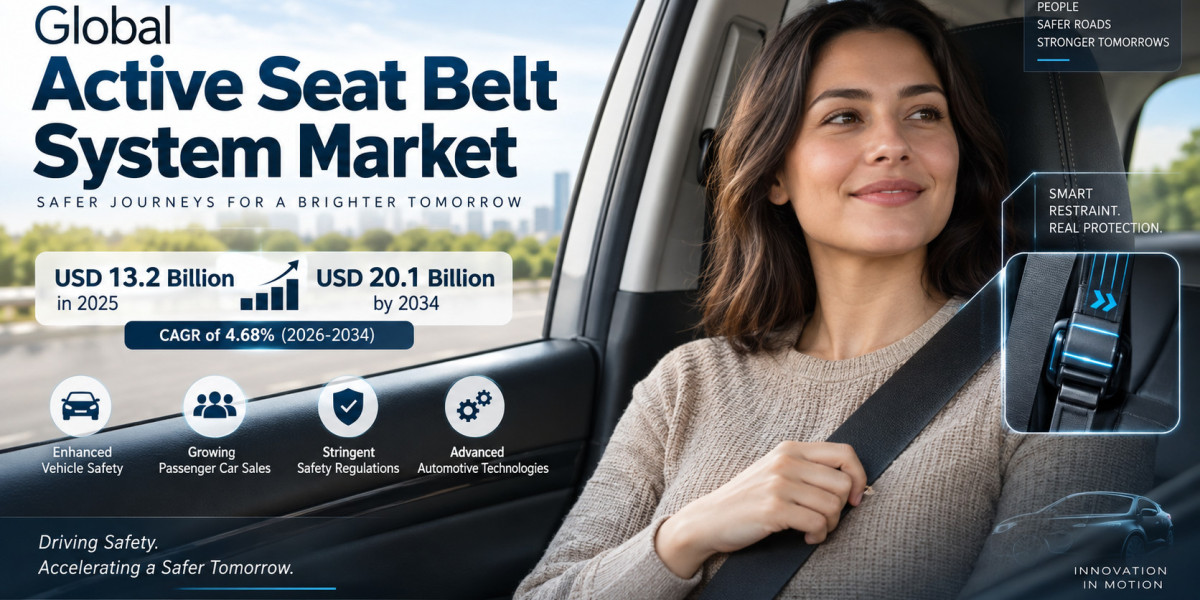
The global active seat belt system market size reached USD 13.2 Billion in 2025. Looking forward, the market is expected to reach USD 20.1 Billion by 2034, exhibiting a growth rate (CAGR) of 4.68% during 2026-2034. The heightened awareness about the essential aspect of maintaining the safety of cars to reduce the occurrence of road accidents, increasing implementation of government policies and standards for maintaining vehicular safety, and rising purchase of passenger cars to travel comfortably are some of the factors propelling the market growth.
Market Size & Growth: The global active seat belt system market reached USD 13.2 Billion in 2025 and is expected to reach USD 20.1 Billion by 2034, exhibiting a CAGR of 4.68% during 2026-2034.
Major Market Drivers: Increasing purchase of passenger cars, rising improvements in automotive safety technologies, heightened awareness regarding vehicular safety, and stringent government regulations and safety standards are supporting market growth.
Key Market Trends: Growing focus on integrating advanced safety measures, technological advancements in active seat belt systems, increasing awareness about vehicle safety, and the adoption of advanced restraint technologies are shaping the market.
Regional Leadership: Asia Pacific represents the largest regional market, driven by increasing passenger car purchases, stringent vehicular safety standards, rising vehicle safety awareness, and growing adoption of electric vehicles (EVs).
Leading Component: Pretensioners account for the majority of the market share due to their role in reducing occupant movement during collisions and improving restraint effectiveness.
Leading Application: Passenger cars hold the largest market share, supported by rising production volumes, greater penetration of safety technologies, and increasing consumer focus on vehicle safety.
Leading Sales Channel: OEMs represent the leading market segment due to the integration of advanced safety systems during vehicle manufacturing and the need to comply with safety regulations.
Key Challenges: High production costs and integration complexities can hinder market growth.
Emerging Opportunities: Increasing awareness about vehicular safety, technological advancements, and the integration of advanced safety systems into new vehicles are expected to create growth opportunities.
Request for a Sample Report for Detailed Evaluation: https://www.imarcgroup.com/active-seat-belt-system-market/requestsample
What Is Driving Active Seat Belt System Market Growth in 2026?
Advancements in Automotive Safety Technologies
Automotive safety features are being constantly upgraded, which is rapidly supporting market expansion. Technological advancements such as pre-tensioners, load limiters, and the integration of advanced driver-assistance systems (ADAS) with seat belts offer optimal restraint during collisions, improving occupant protection when these systems are activated.
For instance, Hyundai Motor India Ltd announced a range of futuristic technology and advanced safety features in the new 2024 Creta. These additions serve to enhance passenger safety while also helping meet new safety restrictions established by governments and automotive safety organizations. As automakers work to comply with these regulations and improve safety scores, the use of advanced active seat belt systems is increasing.
This trend is further supported by consumer demand for safer vehicles, leading to a steady rise in the incorporation of advanced safety features as standard or optional offerings in new vehicle models. These developments are creating a favorable outlook for the active seat belt system market.
Increasing Awareness and Demand for Vehicle Safety
Increasing awareness surrounding automobile safety is becoming a crucial factor supporting market growth due to the proliferation of information through various media channels and the efforts of safety advocacy groups. Greater awareness is translating into stronger demand for vehicles equipped with the latest safety technologies, including active seat belt systems.
Consumers are increasingly learning about the advantages of advanced vehicle safety technologies and seeking such equipment when purchasing new vehicles. Safety considerations also influence insurance prices and resale value, encouraging the adoption of proactive safety features and contributing to market expansion.
In January 2024, ZF Passive Safety Systems unveiled its new seat belt system designed to help reduce the consequences of collisions, further highlighting the continued development of advanced restraint technologies.
Government Regulations and Safety Standards
Government regulations and safety standards represent a key factor supporting market growth. Stringent safety norms implemented by regulatory bodies across different geographies are necessitating the deployment of advanced restraint systems in vehicles.
These regulations are designed to make road travel safer and reduce fatalities and severe injuries caused by road crashes. As automotive manufacturers are required to meet these standards, the integration of active seat belt systems into vehicles is increasing to comply with regulatory requirements.
For instance, the Ministry of Road Transport & Highways introduced the Bharat New Car Assessment Programme (BNCAP) in India to maintain the safety of passenger cars. It further stated that from October 2023, manufacturers or importers of motor vehicles would submit an application in FORM 70A to have their vehicles examined and assessed for star ratings in accordance with AIS:197.
Active Seat Belt System Market Segmentation Analysis
IMARC Group provides an analysis of the key trends in each segment of the market, along with forecasts at the global, regional, and country levels for 2026-2034. The report has categorized the market based on component, application, and sales channel.
By Component
Retractors
Pretensioners
Buckle Lifters
Pretensioners Account for the Majority of the Market Share
The report has provided a detailed breakup and analysis of the market based on component. This includes retractors, pretensioners, and buckle lifters. According to the active seat belt system market report, pretensioners represented the largest segment.
Pretensioners hold the biggest market segment as these components are designed to tighten seat belts instantly when an accident is detected, preventing forward movement of vehicle occupants and improving the overall effectiveness of the restraint system.
Pretensioners provide significant safety benefits during crashes by reducing occupant movement and consequently lowering the risk of injuries. Their widespread adoption is driven by proven safety benefits, technological advancements that improve responsiveness, and regulatory requirements that mandate their inclusion in new vehicles. Consequently, pretensioners are becoming increasingly common in contemporary cars.
By Application
Passenger Cars
Light Commercial Vehicles
Heavy Commercial Vehicles
Passenger Cars Hold the Largest Share of the Industry
A detailed breakup and analysis of the market based on application has also been provided in the report. This includes passenger cars, light commercial vehicles, and heavy commercial vehicles. According to the report, passenger cars accounted for the largest market share.
The passenger car segment holds the biggest market share, supported by rising production volumes and high penetration of safety technologies in passenger vehicles. Growing awareness regarding vehicle safety, regulatory requirements, and the increasing deployment of advanced standard safety features in new models are expected to support demand for active seat belt systems.
As consumers increasingly prioritize safety when purchasing vehicles, manufacturers are incentivized to equip passenger cars with advanced restraint systems. For example, in 2023, Maruti models planned to offer electronic stability control (ESC) and seat belt reminders for all seats.
By Sales Channel
OEMs
Aftermarket
OEMs Represent the Leading Market Segment
The report has provided a detailed breakup and analysis of the market based on sales channel, including OEMs and aftermarket. According to the report, OEMs represented the largest segment.
Original equipment manufacturers (OEMs) hold the biggest market share, driven by the integration of advanced safety systems into new vehicles during the manufacturing process. OEMs play a crucial role in ensuring that seat belt systems comply with the latest safety standards and regulatory requirements while incorporating advanced technologies to enhance occupant protection.
The focus on providing comprehensive safety packages as standard or optional equipment in new vehicles is propelling demand for active seat belt systems through OEM channels. Additionally, OEMs benefit from economies of scale, enabling them to incorporate these systems cost-effectively across a wide range of vehicle models.
The emphasis on vehicle safety as a key selling point, coupled with stringent safety regulations, is expected to support OEM demand and contribute to active seat belt system market revenue.
By Region
North America
United States
Canada
Asia Pacific
China
Japan
India
South Korea
Australia
Indonesia
Others
Europe
Germany
France
United Kingdom
Italy
Spain
Russia
Others
Latin America
Brazil
Mexico
Others
Middle East and Africa
Asia Pacific Leads the Market, Accounting for the Largest Active Seat Belt System Market Share
The report has provided a comprehensive analysis of the major regional markets, including North America, Asia Pacific, Europe, Latin America, and the Middle East and Africa. According to the report, Asia Pacific represents the largest regional market for active seat belt systems.
The Asia Pacific market is driven by the increasing purchase of passenger cars among consumers seeking comfortable transportation without the challenges associated with public transportation. Moreover, the implementation of stringent government regulations and safety standards is encouraging manufacturers to integrate active seat belt systems into new vehicles to enhance occupant protection and comply with safety mandates.
Rising awareness about vehicle safety is also a crucial driver, as buyers increasingly prioritize safety technologies when making purchasing decisions. Additionally, the growing adoption of electric vehicles (EVs) in the region is contributing to market growth as EV manufacturers incorporate advanced safety systems to differentiate their offerings.
According to the "Global EV Outlook 2024" presented by the International Energy Agency (IEA), in 2023, under 60% of new electric car registrations were in China, and more than one in three new car registrations in China were electric in the same year.
Competitive Landscape
Leading companies are investing heavily in research operations to innovate and refine active seat belt systems. This includes integrating advanced sensors and artificial intelligence (AI) to improve system responsiveness and effectiveness during collisions.
Technological improvements include pre-tensioners with faster activation times and load limiters that adapt to different crash scenarios. Market players are also actively pursuing strategic partnerships and acquisitions to strengthen their product offerings and expand their market reach.
Collaborations with automotive manufacturers enable the seamless integration of active seat belt systems into new vehicle models while supporting regulatory compliance and consumer appeal. Acquisitions of smaller technology firms and complementary businesses allow key players to broaden their technological capabilities and strengthen their market presence.
Key Active Seat Belt System Market Players Include
Ashimori Industry Co., Ltd
Autoliv Inc.
Far Europe Inc.
Joyson Safety Systems
Tokai Rika Co. Ltd
ZF Airbag Germany GmbH
Recent Developments
May 2024: Hyundai Mobis agreed to invest US$90 billion to build a plant in Ulsan for the manufacturing of modules for battery electric vehicles (BEVs).
February 2024: ZF Friedrichshafen AG announced the opening of its first zero-emission factory in Klášterec, Czech Republic, where the heating systems primarily work without fossil fuels.
Market Drivers, Challenges & Opportunities
Major Market Drivers
Increasing Purchase of Passenger Cars: Rising passenger car purchases among consumers seeking comfortable transportation are supporting demand for advanced vehicle safety systems.
Advancements in Automotive Safety Technologies: Continuous improvements in active seat belt technologies, including pre-tensioners, load limiters, sensors, and ADAS integration, are strengthening market growth.
Growing Vehicle Safety Awareness: Increasing consumer awareness regarding the importance of vehicle safety is encouraging demand for vehicles equipped with advanced restraint technologies.
Government Regulations and Safety Standards: Stringent vehicular safety regulations are encouraging manufacturers to integrate active seat belt systems into new vehicles.
Growing Electric Vehicle Adoption: The increasing adoption of EVs is supporting demand for advanced safety systems as manufacturers seek to differentiate their vehicle offerings.
Key Challenges
High Production Costs: High production costs associated with active seat belt systems can create challenges for manufacturers and limit adoption.
Integration Complexities: Integrating active seat belt systems with modern vehicle architectures and other advanced safety technologies can create technical and manufacturing complexities.
Emerging Opportunities
Increasing Safety Awareness: Growing awareness among consumers about the importance of maintaining vehicular safety is expected to create additional demand.
Advanced Sensor and AI Integration: The integration of advanced sensors and AI can improve the responsiveness and effectiveness of active seat belt systems.
Technological Innovation: Continued development of faster-activating pre-tensioners, adaptive load limiters, and other advanced technologies offers opportunities for market participants.
Growing EV Production: Increasing EV production is creating opportunities for the integration of advanced active restraint systems into new vehicle platforms.
Active Seat Belt System Market FAQs
1. What is the current size of the active seat belt system market?
The global active seat belt system market reached USD 13.2 Billion in 2025.
2. What is the projected active seat belt system market size by 2034?
The market is expected to reach USD 20.1 Billion by 2034, exhibiting a CAGR of 4.68% during 2026-2034.
3. What are the major factors driving the active seat belt system market?
Major factors include increasing passenger car purchases, rising awareness about vehicle safety, advancements in automotive safety technologies, increasing implementation of government safety standards, and growing adoption of electric vehicles.
4. Which component dominates the active seat belt system market?
Pretensioners represent the largest component segment due to their ability to tighten seat belts rapidly during collision events and reduce occupant movement.
5. Which application accounts for the largest market share?
Passenger cars account for the largest market share, supported by rising production volumes, greater penetration of safety technologies, regulatory requirements, and increasing consumer focus on vehicle safety.
6. Which sales channel dominates the active seat belt system market?
OEMs represent the leading sales channel, primarily due to the integration of advanced safety systems during vehicle manufacturing and the need to meet safety standards and regulations.
7. Which region leads the active seat belt system market?
Asia Pacific represents the largest regional market, supported by increasing passenger car purchases, stringent vehicle safety standards, growing consumer awareness, and rising EV adoption.
Conclusion: Active Seat Belt System Market Outlook to 2034
The global active seat belt system market is poised for steady growth through 2034, supported by increasing awareness about vehicle safety, rising passenger car purchases, advancements in automotive safety technologies, stringent government regulations, and the growing adoption of electric vehicles.
The increasing integration of advanced restraint technologies such as pre-tensioners, load limiters, sensors, and ADAS is further enhancing the effectiveness of active seat belt systems. At the same time, automakers are increasingly focusing on comprehensive safety packages to comply with regulations and meet growing consumer expectations.
Although high production costs and integration complexities remain key challenges, technological innovation, increasing safety awareness, and the continued development of advanced automotive safety systems are creating new opportunities for market participants.
Asia Pacific is expected to maintain its leading position, supported by rising vehicle purchases, stringent safety standards, increasing awareness about vehicular safety, and growing EV adoption. Meanwhile, continued investments in research and development, strategic partnerships, and advanced safety technologies are expected to shape the competitive landscape of the global active seat belt system market through 2034.
About the Author
IMARC Group is a leading global market research company providing data-driven insights and strategic consulting services across diverse industries. The company delivers comprehensive research reports covering automotive, technology, healthcare, chemicals, packaging, food & beverages, consumer goods, and industrial sectors, helping organizations make informed business decisions and identify emerging growth opportunities.
Media & Sales Contact
IMARC Group
United States: +1-201-971-6302
India: +91-120-433-0800
United Kingdom: +44-753-714-6104