
Market Overview
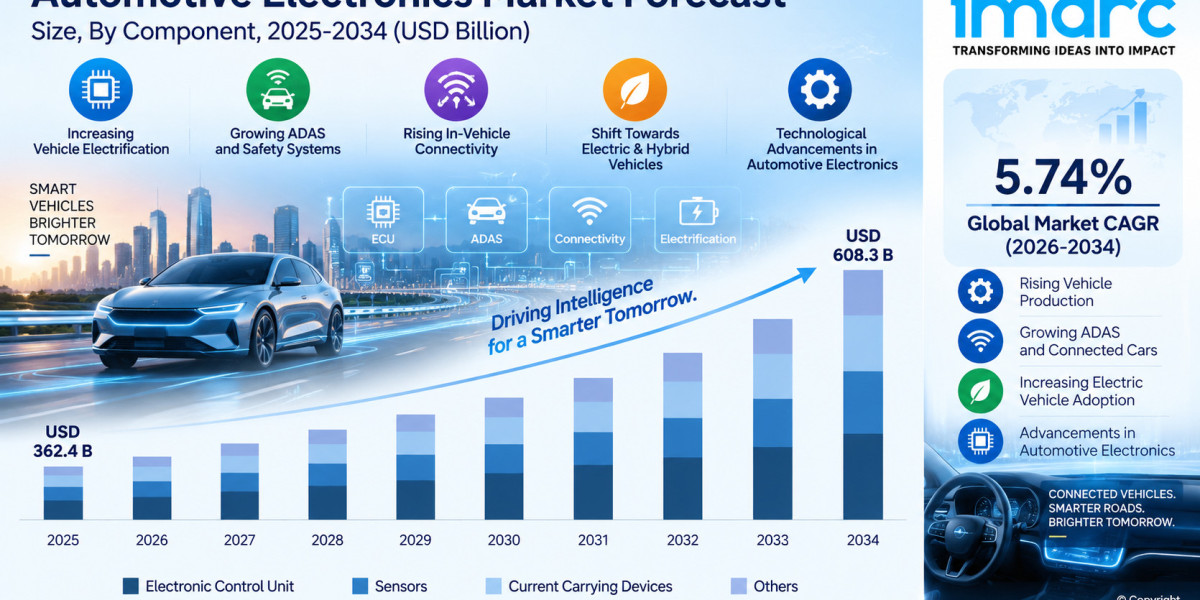
According to a research report by IMARC Group, the global automotive electronics market size reached USD 362.4 Billion in 2025. Looking forward, IMARC Group expects the market to reach USD 608.3 Billion by 2034, exhibiting a growth rate (CAGR) of 5.74% during 2026-2034. Asia Pacific currently dominates the regional landscape, accounting for over 41.7% of the market share in 2025, supported by a robust automotive manufacturing base, technological advancements, and increasing adoption of electric vehicles and advanced driver assistance systems. Growth in the market is chiefly attributed to rising demand for vehicle safety, electrification, connectivity, automation, and infotainment, along with the increasing integration of sensors, electronic control units, and current-carrying devices in modern vehicles.
Automotive Electronics Market Key At a Glance
Base Year: 2025
Historical Period: 2020–2025
Forecast Period: 2026–2034
Market Size (2025): USD 362.4 Billion
Market Forecast (2034): USD 608.3 Billion
CAGR (2026–2034): 5.74%
Leading Region: Asia Pacific
Regional Market Share (2025): Over 41.7%
Dominant Vehicle Type: Passenger Vehicles
Dominant Distribution Channel: OEM
Leading Application: Infotainment
Request for a Sample Report for Detailed Evaluation: https://www.imarcgroup.com/automotive-electronics-market/requestsample
Automotive Electronics Market Report: Key Highlights
Market Size & Growth: The global automotive electronics market reached USD 362.4 Billion in 2025 and is projected to reach USD 608.3 Billion by 2034, registering a CAGR of 5.74% during 2026–2034, according to IMARC Group.
Regional Leadership: Asia Pacific represents the largest regional market, accounting for over 41.7% of the market share in 2025, supported by its strong automotive manufacturing base, technological advancements, supportive government policies, and increasing EV adoption.
By Component: The market is segmented into electronic control units, sensors, current-carrying devices, and others. Electronic control units play a critical role in managing vehicle performance, efficiency, safety, and entertainment functions.
By Vehicle Type: The market covers light commercial vehicles, passenger vehicles, heavy commercial vehicles, and others, with passenger vehicles representing the largest segment.
By Distribution Channel: The market comprises OEM and aftermarket channels, with OEM accounting for the largest share.
By Application: The market includes ADAS, infotainment, body electronics, safety systems, and powertrain, with infotainment holding the leading position.
Key Market Drivers: Growing demand for electric vehicles and advanced driver assistance systems, rising focus on vehicle safety, and increasing adoption of automation, connectivity, and infotainment technologies.
Key Market Trends: Increasing integration of sensors and current-carrying devices, proliferation of connected vehicles and IoT, development of advanced safety systems, and growing adoption of electric and hybrid vehicles.
Key Market Challenges: Increasing technological complexity and the need for seamless integration of sophisticated electronic systems across evolving vehicle architectures.
Key Players: Leading players in the global automotive electronics market include Aptiv PLC, Continental AG, Denso Electronics Corporation, Infineon Technologies AG, Lear Corporation, Magna International Inc., Robert Bosch GmbH, Valeo, ZF Friedrichshafen AG, and others.
What Is Driving Automotive Electronics Market Growth in 2026?
Rising Demand for Advanced Driver Assistance Systems
Growing demand for advanced driver assistance systems (ADAS) is one of the major factors driving the global automotive electronics market. Increasing concerns regarding road safety are encouraging automobile manufacturers to integrate sophisticated electronic technologies capable of detecting potential hazards and assisting drivers in critical situations. Collision avoidance systems, automatic emergency braking, blind-spot detection, lane-keeping assistance, adaptive cruise control, and forward collision warning systems are increasingly being incorporated into modern vehicles. This trend is also supporting growth in the automotive electrical segment, as vehicles increasingly rely on advanced electrical and electronic architectures.
The growing adoption of autonomous driving technologies is further increasing demand for sensors, electronic control units, cameras, radar, and other electronic components, thereby creating significant opportunities across the automotive software market. For instance, the Morris Garage Gloster 2021 was equipped with several ADAS-based features, including automatic emergency braking, auto parking assist, blind-spot detection, forward collision warning, and lane departure warning. Similarly, the MG Astor introduced in 2021 featured Level-2 ADAS capabilities, including adaptive cruise control, automatic emergency braking, blind-spot detection, lane-keeping assist, and lane departure warning. The increasing integration of these technologies is expected to influence the competitive landscape and automotive electronics market share of leading manufacturers and suppliers.
Rise of Electric and Hybrid Vehicles
The shift toward electric and hybrid vehicles is substantially supporting the automotive electronics market. As automakers transition from conventional internal combustion engines toward electric powertrains, vehicles increasingly rely on sophisticated electronic systems for power management, battery monitoring, charging, propulsion, and vehicle control.
Government authorities across various countries are also introducing subsidies, incentives, and other initiatives to promote the production and adoption of EVs. The increasing penetration of electric and hybrid vehicles is consequently creating significant demand for electronic control units and other advanced automotive electronic components. According to an industry report, sales of new light-duty chargeable EVs in the United States increased from 308,000 in 2020 to 608,000 in 2021, with more than 73% of the total comprising battery electric vehicles.
Proliferation of Connected Vehicles and IoT
The proliferation of connected vehicles and Internet of Things (IoT) technologies is another major factor bolstering automotive electronics market growth. Automotive manufacturers are increasingly introducing vehicles with advanced connectivity, smart cockpit, navigation, infotainment, and digital services to enhance convenience and the overall driving experience.
Various technology companies and automotive manufacturers are entering strategic collaborations to accelerate the development of connected vehicle solutions. For instance, in June 2022, PATEO Corporation and Qualcomm Technologies, Inc. expanded their relationship to develop solutions supporting vehicle intelligence, smart car connectivity, service-oriented architecture, intelligent cockpits, and multi-domain fusion based on central controllers.
In addition, STMicroelectronics collaborated with Microsoft in May 2022 to streamline the development of highly secure IoT devices. Such partnerships are supporting the integration of vehicles into broader digital ecosystems and strengthening demand for sophisticated automotive electronic systems.
Increasing Consumer Demand for Safety, Convenience, and Entertainment
Changing consumer preferences are encouraging automakers to integrate advanced electronic systems that combine safety, convenience, connectivity, and entertainment. Modern vehicle buyers increasingly expect sophisticated infotainment systems, navigation technologies, connected services, digital cockpits, and advanced safety features.
For instance, on 25 April 2024, Mercedes-Benz partnered with Tencent and Electronic Arts to bring the Need for Speed™: Assemble video game series to its vehicles in China by the end of 2024. Powered by the MBUX third-generation operating system, the game was designed to be accessible through an over-the-air update, with Bluetooth controllers available when the vehicle is stationary. Such developments demonstrate the expanding role of electronics in creating advanced in-car entertainment experiences.
Automotive Electronics Market Segmentation Analysis
By Component
Electronic Control Unit
Sensors
Current Carrying Devices
Others
Electronic control units (ECUs) are critical for managing various vehicle functions, including performance, efficiency, safety, and entertainment. The growing adoption of autonomous driving technologies is increasing demand for advanced sensors, including LiDAR, radar, and cameras, which facilitate navigation, vehicle automation, and safety features.
Sensors play a crucial role in enabling collision avoidance, adaptive cruise control, lane-keeping assistance, and other ADAS functions. They also facilitate real-time data collection for diagnostics and predictive maintenance, helping improve vehicle reliability and longevity. Technological advancements are resulting in sensors with higher sensitivity and faster response times, supporting improved fuel efficiency and reduced emissions.
Current-carrying devices are integral to the operation of ADAS, infotainment, and other electronic systems. These components support varying voltage levels and are particularly important in electric and hybrid vehicles. The trend toward miniaturization is also encouraging the development of compact and lightweight wires and connectors, while advancements in materials are enhancing their durability and performance.
By Vehicle Type
Light Commercial Vehicles
Passenger Vehicles
Heavy Commercial Vehicles
Others
Passenger vehicles represent the largest vehicle type segment. Rising population and urbanization are increasing the need for personal mobility, supporting demand for passenger vehicles. Over the past several years, manufacturers have increasingly equipped passenger vehicles with advanced safety, comfort, entertainment, and vehicle-management features.
Changing consumer preferences and government legislation aimed at improving vehicle safety are encouraging the integration of advanced automotive electronics. OEMs, Tier-I suppliers, and Tier-II suppliers are also increasingly deploying new technologies in mass-produced passenger vehicles, further supporting the segment.
The growing focus on vehicle safety is encouraging the incorporation of electronic systems such as airbags and anti-lock braking systems, while increasing demand for connectivity and convenience is supporting additional electronic content within passenger vehicles.
By Distribution Channel
OEM
Aftermarket
OEM represents the largest distribution channel. OEMs have a distinct advantage in integrating automotive electronics directly into vehicles during the manufacturing process. Increasing partnerships between automobile manufacturers and technology companies are also supporting the incorporation of connected vehicle features into new models.
For instance, Ford Motors and Google entered into a strategic partnership for the development of connected car service applications, supporting Ford's connected vehicle business. Furthermore, stringent safety and emission regulations are requiring sophisticated electronic systems to be integrated into vehicles from the outset. Strong relationships between OEMs and component suppliers also provide manufacturers with access to advanced technologies and facilitate efficient procurement.
By Application
ADAS
Infotainment
Body Electronics
Safety Systems
Powertrain
Infotainment leads the market by application. Changing consumer preferences are driving demand for a seamless combination of entertainment, connectivity, navigation, and digital services inside vehicles. Automotive manufacturers and technology providers are increasingly collaborating to develop advanced infotainment platforms.
For instance, Toyota and Google Cloud expanded their partnership to include Toyota and Lexus next-generation audio multimedia systems and Google Cloud's AI-based speech services. Similarly, Mercedes-Benz AG and Qualcomm Technologies, Inc. joined forces to utilize Snapdragon Digital Chassis solutions for advanced digital capabilities in future Mercedes-Benz vehicles.
The progression toward autonomous vehicles is also increasing the importance of infotainment systems as a means of passenger engagement, while advanced system architectures are enabling manufacturers to integrate entertainment with safety and connectivity features.
By Region
North America
Asia Pacific
Europe
Latin America
Middle East and Africa
Asia Pacific holds the largest regional share in the global automotive electronics market, accounting for over 41.7% in 2025. The region's dominance is supported by its strong automotive manufacturing base, particularly across China, Japan, and South Korea, which generates substantial demand for electronic components across different vehicle categories.
Technological advancements in China, including developments in artificial intelligence, big data analytics, and 5G infrastructure, are supporting the development of advanced navigation and connectivity systems. Supportive government policies and investments in research and development are further contributing to innovation across the automotive electronics industry.
Collaborations between regional automotive manufacturers and global technology companies are also facilitating knowledge transfer and accelerating technological advancements. For instance, what3words announced a collaboration with Alpine Marketing Co., Ltd. to support the company's automobile navigation system, "big x connect," allowing users in Japan to navigate to specific locations using three words.
Key Regional Insight: Asia Pacific's Strategic Position
Asia Pacific's leading position in the global automotive electronics market is anchored in its robust automotive manufacturing ecosystem and the rapid adoption of advanced vehicle technologies. China, Japan, South Korea, and India represent important automotive markets where rising disposable incomes, urbanization, infrastructure development, and technological innovation are supporting demand.
The region's increasing focus on electric mobility and advanced driver assistance systems is further strengthening demand for electronic control units, sensors, power-management systems, connectivity solutions, and infotainment technologies. Continued government support for EV adoption and investments in research and development are expected to maintain Asia Pacific's position at the center of the global automotive electronics industry.
Key Regional Takeaways
United States Automotive Electronics Market Analysis
The United States automotive electronics market is being supported by technological advancements, strategic partnerships, and the rapidly growing adoption of electric vehicles. Increasing consumer demand for enhanced vehicle performance, safety, connectivity, and entertainment is encouraging automakers to integrate advanced infotainment, navigation, lighting, and safety technologies.
The increasing adoption of EVs and hybrid vehicles is also creating demand for battery management systems, power-management technologies, advanced infotainment systems, and safety features. Sales of new light-duty chargeable EVs in the United States increased from 308,000 in 2020 to 608,000 in 2021, demonstrating the rapid expansion of electric mobility and its associated demand for automotive electronics.
Growing concerns regarding road safety are further supporting ADAS adoption. According to the U.S. Department of Transportation, roadway fatalities peaked at 43,230 in 2021, including 7,388 pedestrian deaths. Fatalities subsequently decreased to 42,514 in 2022 and an estimated 40,990 in 2023. The continuing focus on reducing road accidents is supporting demand for advanced electronic safety systems.
Europe Automotive Electronics Market Analysis
The Europe automotive electronics market is expected to remain growth-oriented, supported by increasing EV adoption and automobile production. According to ACEA, BEV and PHEV sales in Europe increased from 559.81 thousand units in Q2 2022 to 757.83 thousand units in Q3 2023. The growing adoption of electric vehicles is generating significant demand for advanced electronic systems, particularly those associated with power management and vehicle control.
Increasing automobile production is also supporting demand for automotive electronics. According to OICA statistics, France produced approximately 1.5 Million motor vehicles in 2023, of which 68.2% were passenger cars. The growth in vehicle production is consequently contributing to demand for infotainment, safety, connectivity, and battery-management technologies.
Asia Pacific Automotive Electronics Market Analysis
The Asia Pacific automotive electronics market is expanding rapidly, supported by advancements in vehicle technologies and government support for electric mobility. In March 2023, Hyundai Motor India announced the launch of the Hyundai Verna equipped with a Level-2 ADAS system. The vehicle featured more than 65 advanced safety features, including radar-powered automated sensing technology, cameras, and sensors designed to identify obstacles and suggest corrective actions.
Government policies are further supporting regional growth. Japan has set a target for EVs to account for 50% of new car sales by 2030 and is offering tax incentives, subsidies, and regulatory measures to encourage EV adoption. China, Japan, South Korea, and India also represent major automotive markets where increasing disposable incomes, urbanization, infrastructure development, and technological advancements are strengthening demand for automotive electronics.
Latin America Automotive Electronics Market Analysis
The Latin America automotive electronics market is witnessing growth supported by increasing vehicle production and expanding automotive demand. According to the Associação Nacional dos Fabricantes de Veículos Automotores (ANFAVEA), vehicle production in Brazil, excluding CKD production, totaled 259,613 units in August 2024, representing a 14.4% increase compared with August 2023.
The increase in vehicle production is supporting demand for automotive electronic systems, as modern vehicles increasingly depend on advanced technologies for safety, performance, connectivity, and entertainment. Rising consumer demand, higher disposable incomes, and the development of the automotive industry in key Latin American markets are further creating opportunities for automotive electronics suppliers.
Middle East and Africa Automotive Electronics Market Analysis
The automotive electronics market in the Middle East and Africa is being supported by the rising adoption of hybrid and electric vehicles and growing government investment in EV infrastructure. Electric vehicle adoption in the United Arab Emirates increased to 4% in 2023 from 2% in 2022, reflecting rising demand for sustainable transportation.
Government initiatives are further strengthening the regional outlook. Saudi Arabia invested USD 6 Billion in 2022 to improve mineral mining capabilities with potential applications in electric vehicle batteries and to support the development of an EV supply chain. In May 2022, Abu Dhabi introduced a regulatory policy covering EV charging infrastructure, establishing requirements and procedures related to the ownership, installation, and management of charging stations.
These developments are expected to support demand for battery management systems, infotainment technologies, electric powertrains, and other advanced automotive electronic components.
Competitive Landscape in the Automotive Electronics Industry
The competitive landscape of the global automotive electronics market is characterized by dynamic interactions driven by technological advancements, changing consumer preferences, and the increasing integration of electronics into vehicles. Collaboration between automotive manufacturers and electronics suppliers remains an important strategy for developing and integrating advanced vehicle systems.
Leading companies are focusing on innovation, strategic partnerships, advanced electronic components, connectivity, electrification, and safety technologies to strengthen their market positions. New entrants are also focusing on specialized applications and niche technologies, contributing to market diversification.
As the automotive industry increasingly focuses on sustainability, companies are also investing in energy-efficient electronic components and materials. The ability to adapt to evolving vehicle architectures, consumer preferences, electrification trends, and technological developments remains important for companies seeking to strengthen their position in the competitive automotive electronics industry.
Key Automotive Electronics Market Players Include:
Aptiv PLC
Continental AG
Delta Electronics, Inc.
Denso Electronics Corporation
Infineon Technologies AG
Lear Corporation
Magna International Inc.
Microchip Technology Inc.
Omron Corporation
Panasonic Industry Co., Ltd.
Robert Bosch GmbH
Texas Instruments Incorporated
Valeo
ZF Friedrichshafen AG
and others
Recent Developments:
March 2024: Richard Electronics, a major distributor of semiconductors and electrical components, announced the expansion of Arteris' automotive solutions for Armv9 architecture CPUs. The partnership between Arm and Arteris is aimed at accelerating the development of automotive electronics and addressing design challenges associated with next-generation vehicle electronics.
October 2023: Samsung Electronics hosted Samsung Foundry Forum (SFF) and unveiled its automotive process solutions spanning advanced 2-nanometer technology through the 8-inch legacy process. The development highlights the increasing importance of advanced semiconductor technologies in the automotive electronics industry.
March 2023: Infineon Technologies AG deepened its collaboration with Delta Electronics to expand innovation activities in the growing electric vehicle market. The collaboration focuses on more efficient and higher-density solutions for EV drivetrain onboard chargers, DC-DC converters, and traction inverters, covering components including low-voltage and high-voltage microcontrollers, discrete components, and modules.
Market Drivers, Challenges & Opportunities
Major Market Drivers:
Growing EV and Hybrid Vehicle Adoption: The global shift toward electrification is increasing demand for battery management, power-management, electronic control, and electric powertrain technologies.
Rising ADAS Adoption: Increasing focus on road safety is encouraging the integration of sensors, cameras, radar, ECUs, and other electronic technologies.
Connected Vehicle Proliferation: Increasing integration of IoT, connectivity, smart cockpits, and digital services is expanding the electronic content of modern vehicles.
Consumer Demand for Advanced Features: Growing expectations for safety, convenience, connectivity, navigation, and entertainment are supporting demand for sophisticated automotive electronics.
Technological Advancements: Developments in automation, artificial intelligence, sensors, semiconductors, and infotainment are supporting continued market innovation.
Key Challenges:
Increasing System Complexity: The integration of multiple electronic systems, sensors, processors, and connectivity technologies is increasing the complexity of vehicle architectures.
Rapid Technological Evolution: Automotive electronics manufacturers need to continuously innovate to keep pace with rapidly evolving vehicle technologies and consumer expectations.
Integration Requirements: Seamless coordination among different electronic systems and components remains important as vehicles become increasingly connected and software-driven.
Emerging Opportunities:
Advanced Driver Assistance Systems: Continued development of autonomous and semi-autonomous driving technologies is creating opportunities for sensor, ECU, radar, camera, and semiconductor suppliers.
Electric Vehicle Electronics: The expansion of EVs is creating opportunities in battery management systems, power electronics, charging technologies, and electric powertrains.
Connected and Smart Vehicles: Increasing integration of IoT, connected services, intelligent cockpits, and digital platforms is opening new avenues for automotive electronics companies.
Advanced Infotainment: Rising consumer demand for in-car entertainment, AI-powered voice services, navigation, and digital experiences is supporting opportunities for infotainment technology providers.
Automotive Electronics Market FAQs
1. What is the current size of the automotive electronics market?
The global automotive electronics market reached USD 362.4 Billion in 2025 and is expected to grow at a CAGR of 5.74% during 2026-2034, reaching USD 608.3 Billion by 2034.
2. What is driving the growth of the automotive electronics market?
The market is driven by increasing demand for electric vehicles and advanced driver assistance systems, rising focus on safety and sustainability, technological advancements in automation and connectivity, growing adoption of infotainment systems, and the increasing integration of sensors and electronic control units.
3. Which region dominates the automotive electronics market?
Asia Pacific leads the global automotive electronics market, accounting for over 41.7% of the market share in 2025. Its dominance is supported by a strong automotive manufacturing base, technological advancements, EV adoption, supportive government policies, and investments in research and development.
4. Which segment holds the largest share in the automotive electronics market?
Passenger vehicles represent the largest vehicle type segment, OEM accounts for the largest distribution channel share, and infotainment represents the leading application segment in 2025.
5. What are the key trends in the automotive electronics market?
Key trends include the increasing adoption of electric and hybrid vehicles, growing demand for ADAS, proliferation of connected vehicles and IoT, increasing integration of sensors and ECUs, advancements in infotainment and smart cockpit technologies, and continued development of autonomous driving systems.
Conclusion: Automotive Electronics Market Outlook to 2034
The global automotive electronics market is set for steady growth through 2034, underpinned by increasing adoption of electric and hybrid vehicles, rising demand for advanced driver assistance systems, technological advancements in connectivity and automation, and growing consumer expectations for safety, convenience, and in-car entertainment.
While increasing system complexity and the rapid pace of technological development present ongoing challenges, continued innovation across sensors, electronic control units, power electronics, connectivity systems, and infotainment technologies is creating significant opportunities for market participants.
With Asia Pacific maintaining its position as the leading regional market and North America, Europe, Latin America, and the Middle East and Africa offering further growth avenues, the outlook through 2034 remains positive. Companies investing in EV technologies, ADAS, connected vehicles, advanced infotainment, and next-generation electronic architectures will be well positioned to capture value as the automotive industry continues its transition toward safer, more connected, electrified, and technologically advanced vehicles.
About the Author:
IMARC Group is a leading global market research company providing data-driven insights and expert consulting services to businesses seeking to achieve their strategic objectives. With a multi-disciplinary team of industry experts, IMARC delivers thorough, reliable market intelligence across sectors including Energy and Mining, Construction and Manufacturing, Automotive, Chemicals and Materials, and more.
Media & Sales Contact:
IMARC Group
United States: +1-201-971-6302
India: +91-120-433-0800
United Kingdom: +44-753-714-6104