
Market Overview
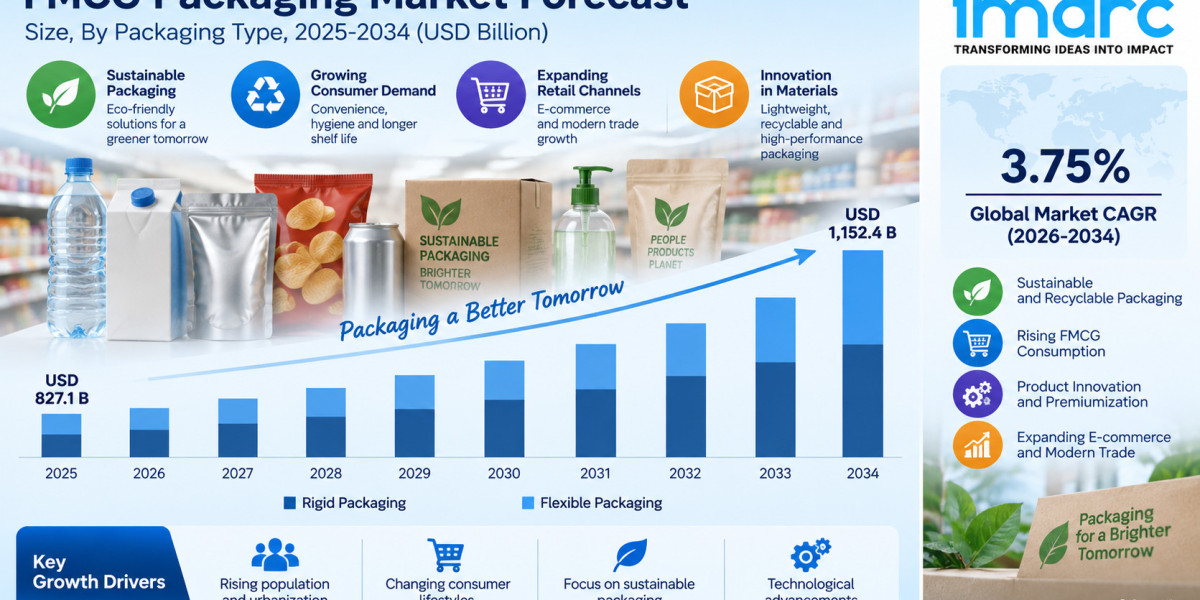
According to a research report by IMARC Group, the global FMCG packaging market size reached USD 827.1 Billion in 2025. Looking forward, IMARC Group expects the market to reach USD 1,152.4 Billion by 2034, exhibiting a growth rate (CAGR) of 3.75% during 2026-2034. Asia Pacific currently leads the regional landscape, accounting for a market share of 36.5% in 2025, supported by increasing packaged goods usage, advancements in packaging technologies, rising consumer demand for convenience, and growing sustainability initiatives across the region.
FMCG Packaging Market Key At a Glance
Base Year: 2025
Historical Period: 2020–2025
Forecast Period: 2026–2034
Market Size (2025): USD 827.1 Billion
Market Forecast (2034): USD 1,152.4 Billion
CAGR (2026–2034): 3.75%
Leading Region: Asia Pacific
Leading Packaging Type: Rigid Packaging
Dominant Material: Plastic
Largest End Use Industry: Food and Beverages
Request for a Sample Report for Detailed Evaluation: https://www.imarcgroup.com/fmcg-packaging-market/requestsample
FMCG Packaging Market Report: Key Highlights
Market Size & Growth: The global FMCG packaging market reached USD 827.1 Billion in 2025 and is projected to reach USD 1,152.4 Billion by 2034, registering a CAGR of 3.75% during 2026–2034, according to IMARC Group.
Regional Leadership: Asia Pacific represents the largest regional market, accounting for 36.5% of the market share in 2025, supported by increasing packaged goods usage, rising consumer demand, advancements in packaging technologies, and sustainability initiatives.
By Packaging Type: The market is segmented into flexible and rigid packaging, with rigid packaging accounting for the largest share of 62.8% in 2025.
By Material: The market covers paper, plastic, metal, glass, and others, with plastic representing the largest segment at 43.4% in 2025.
By End Use Industry: The market spans food and beverages, cosmetic and personal care, and others, with food and beverages holding the largest share of 41.6% in 2025.
Key Market Drivers: Rising consumer demand for convenience and portability, broadening e-commerce and online retail channels, increasing packaged goods consumption, and growing focus on sustainable packaging materials.
Key Market Trends: Increasing adoption of resealable and single-serve formats, lightweight and compact packaging designs, smart and active packaging technologies, and recyclable, biodegradable, and compostable materials.
Key Market Challenges: Meeting increasingly stringent packaging regulations while balancing sustainability, product protection, cost efficiency, and supply chain requirements.
Key Market Opportunities: Development of eco-friendly materials, smart packaging technologies, innovative flexible packaging formats, and packaging solutions designed for expanding e-commerce channels.
What Is Driving FMCG Packaging Market Growth in 2026?
Rising Consumer Demand for Convenience and Portability
The increasing demand for convenient and portable packaging solutions represents one of the key factors positively influencing the FMCG packaging market. Modern consumers, particularly those living in urban areas, increasingly prefer easy-to-use, resealable, lightweight, and travel-friendly packaging that accommodates fast-paced lifestyles. Ready-to-eat (RTE) food items, beverages, and personal care products are increasingly available in single-serve and portable formats, enhancing usability and convenience.
Flexible packaging formats, including pouches, sachets, and squeezable containers, are gaining popularity because of their convenience and efficient storage characteristics. According to IMARC Group, the global RTE food market size reached USD 189.1 Billion in 2024. The increasing preference for packaging that maintains product freshness while offering easy handling and disposal is encouraging FMCG manufacturers to develop solutions that combine functionality, convenience, and attractive designs.
Broadening of E-commerce and Online Retail Channels
The expansion of e-commerce and online retail platforms is positively influencing the FMCG packaging market. Rising online purchases of food, beverages, personal care products, and household goods are increasing the need for packaging that protects products during transportation and storage. E-commerce-oriented packaging requires durability, tamper resistance, lightweight construction, and space efficiency to minimize product damage and optimize logistics.
The rise of subscription-based delivery services and digital grocery platforms is further supporting demand for cost-effective and environmentally responsible packaging materials. Brands are increasingly adopting compact and lightweight designs to optimize shipping expenses and improve supply chain efficiency. In addition, personalized and branded packaging can enhance the customer experience and strengthen brand recognition as online retail continues to expand.
Growing Focus on Sustainable and Eco-Friendly Packaging Materials
Increasing sustainability concerns and regulatory pressures are significantly shaping the FMCG packaging industry. Consumers and governments are encouraging manufacturers to reduce dependence on conventional plastics and adopt recyclable, biodegradable, compostable, reusable, and paper-based alternatives. Companies are increasingly investing in lightweight designs and reduced material usage to minimize environmental impact while maintaining product safety and quality.
Initiatives such as plastic restrictions and extended producer responsibility (EPR) policies are encouraging manufacturers to transition toward more sustainable packaging solutions. In November 2025, the government of New South Wales (NSW) in Australia introduced actions addressing single-use plastics. The NSW Plastics Plan 2.0 included measures concerning difficult-to-recycle products and promoted reusable and recyclable alternatives. The growing association between sustainable packaging, brand responsibility, and consumer trust is consequently encouraging continued innovation across the market.
Increasing Adoption of Lightweight and Space-Efficient Packaging
Companies are increasingly prioritizing lightweight and compact packaging designs to reduce shipping expenses, improve supply chain efficiency, and minimize material consumption. Such packaging formats can help manufacturers optimize storage and transportation while maintaining product protection and quality.
The increasing emphasis on efficient logistics, particularly with the expansion of e-commerce and online retail, is further supporting demand for packaging solutions that occupy less space and reduce transportation requirements. These developments are encouraging FMCG manufacturers to explore innovative structures and materials that combine durability, functionality, and resource efficiency.
Advancements in Packaging Technologies
Continuous advancements in packaging technologies are creating a positive outlook for the FMCG packaging market. Smart and active packaging solutions are being developed to improve product safety, freshness, traceability, and supply chain visibility. Technologies such as freshness indicators, quick response (QR) codes, intelligent labels, and temperature-monitoring systems are increasingly being incorporated into packaging.
These technologies can provide consumers and companies with additional information regarding product quality and movement through the supply chain. Increasing investments in digital printing and smart packaging are also enabling brands to introduce personalized designs, enhance product differentiation, and improve consumer engagement.
FMCG Packaging Market Segmentation Analysis
By Packaging Type
Flexible Packaging
Rigid Packaging
Rigid packaging leads the market by packaging type, accounting for 62.8% of the market share in 2025. The segment's leading position is attributed to its durability, product protection, and suitability across a wide range of applications. Rigid packaging is extensively used in food and beverages, personal care, and pharmaceutical applications due to its ability to prevent contamination, preserve freshness, and extend product shelf life.
Materials such as glass, metal, and hard plastics provide a robust structure that can withstand transportation and storage conditions. Advancements in packaging technologies are also enabling the development of tamper-proof and resealable formats that enhance consumer convenience and safety. In addition, rigid packaging can support premium product presentation and brand differentiation, while its recyclability and adaptability to innovative designs align with increasing sustainability requirements.
By Material
Paper
Plastic
Metal
Glass
Others
Plastic leads the market by material, accounting for 43.4% of the market share in 2025. Its lightweight characteristics, versatility, and cost-effectiveness make it widely applicable across food and beverages, personal care, household products, and other FMCG categories.
Plastic packaging provides barrier protection against moisture, air, and contaminants and can be manufactured in a variety of shapes and formats. Its adaptability enables manufacturers to develop resealable, portion-controlled, and other convenient packaging designs. In addition, its lightweight nature supports efficient transportation and supply chain operations.
Advancements in recyclable and biodegradable plastics are also helping manufacturers address environmental concerns while maintaining functionality. The compatibility of plastic with various printing and labeling techniques further supports attractive branding and product differentiation, strengthening its position as the largest material segment.
By End Use Industry
Food and Beverages
Cosmetic and Personal Care
Others
Food and beverages lead the market by end use industry, accounting for 41.6% of the market share in 2025. Packaging plays a critical role in this sector by preserving product quality, ensuring safety, preventing contamination, extending shelf life, and maintaining freshness.
The increasing popularity of resealable packs, single-serve portions, ready-to-eat meal containers, and other convenient formats is supporting demand for innovative packaging solutions. Flexible plastics, paperboard, and glass are widely utilized to meet varying product requirements.
Food-grade packaging featuring tamper-evident seals and sustainable materials is also gaining popularity. Furthermore, smart packaging technologies that monitor freshness and improve traceability are supporting product safety and compliance requirements. The growing consumer emphasis on convenience, sustainability, and product quality is expected to continue supporting the food and beverages segment.
By Region
North America
United States
Canada
Asia Pacific
China
Japan
India
South Korea
Australia
Indonesia
Others
Europe
Germany
France
United Kingdom
Italy
Spain
Russia
Others
Latin America
Brazil
Mexico
Others
Middle East and Africa
Asia Pacific accounted for the largest market share of 36.5% in 2025. The region's leading position is supported by a rapidly growing consumer base and increasing demand for packaged goods across industries such as food and beverages and personal care.
The regional market is benefiting from the adoption of innovative packaging solutions designed to meet evolving consumer preferences for convenience, safety, and sustainability. Companies across Asia Pacific are investing in lightweight, cost-efficient, and eco-friendly packaging materials to address environmental regulations and changing consumer expectations.
Advancements in smart and active packaging technologies are further enhancing product shelf life and traceability. The strong presence of manufacturing hubs and established distribution networks is supporting the widespread availability of packaged goods across the region.
In 2024, Pakka launched a new range of flexible compostable packaging solutions tailored for the food and beverage industry. The offerings included paper-based and non-metalized structures with barrier properties, heat sealability, and compostability certifications, addressing sustainability requirements in India's flexible packaging market.
Key Regional Insight: Asia Pacific's Strategic Position
Asia Pacific's leadership in the global FMCG packaging market is anchored in increasing packaged goods consumption, rapid urbanization, and a growing consumer base. Rising demand for food, beverages, cosmetics, personal care products, and household goods is creating sustained requirements for diverse packaging formats.
Manufacturers across the region are increasingly investing in lightweight, cost-efficient, recyclable, and eco-friendly materials. At the same time, advancements in smart and active packaging are improving product shelf life and traceability. Continued expansion of manufacturing capacity, retail networks, and e-commerce infrastructure is expected to keep Asia Pacific at the center of global FMCG packaging demand through 2034.
North America FMCG Packaging Market Analysis
The North America FMCG packaging market is driven by evolving consumer behavior, sustainability preferences, and continued innovations in packaging technologies. Rising demand for packaged food, ready-to-eat meals, beverages, personal care products, and household goods is encouraging FMCG companies to adopt packaging formats offering portability, resealability, product protection, and extended shelf life.
Increasing environmental awareness is supporting the adoption of recyclable plastics, biodegradable materials, lightweight structures, and circular packaging solutions. The expansion of e-commerce and quick-commerce ecosystems is also increasing demand for protective, durable, tamper-evident, and delivery-oriented packaging formats.
The region's packaging industry is further benefiting from premiumization trends and increasing spending on personal care and household products. Automation and digital printing technologies are enabling personalized, small-batch, and visually differentiated packaging. Furthermore, labeling regulations, food safety standards, and traceability requirements are encouraging companies to integrate smart packaging and tracking technologies.
According to IMARC Group, the Canada e-commerce logistics market size reached USD 14.80 Billion in 2024. The continued development of e-commerce and online delivery infrastructure is expected to further support demand for efficient and protective FMCG packaging solutions.
United States FMCG Packaging Market Analysis
The United States holds 77.80% of the North American market share. The market is supported by strong consumer demand for convenience, safety, sustainability, and premium packaging across food, beverage, personal care, and household product categories.
Rising consumption of packaged snacks, frozen food, ready meals, and beverages is encouraging manufacturers to adopt packaging materials offering high barrier protection, shelf stability, and freshness retention. The rapid expansion of e-commerce, same-day delivery platforms, and subscription services is increasing the need for durable, protective, and tamper-resistant packaging.
Sustainability remains an important factor, with growing interest in recyclable plastics, compostable films, paper-based solutions, and packaging designs that reduce material usage. Brands are also adopting digital printing, intelligent labeling, and smart tracking technologies to support supply chain monitoring, product authentication, personalization, and consumer communication.
Premiumization in cosmetics, personal care, and specialty food products is further supporting demand for high-quality and aesthetically appealing packaging. Increasing attention to hygiene, transparency, and clean labeling is encouraging packaging upgrades emphasizing safety, product information, and modern design.
Europe FMCG Packaging Market Analysis
The Europe FMCG packaging market is driven by sustainability commitments, environmental regulations, and increasing consumer preference for recyclable and eco-friendly materials. The region's focus on circular economy principles is encouraging manufacturers to explore paper-based packaging, bio-based plastics, reusable formats, and reduced-material designs.
Growing consumption of organic foods, premium beverages, and high-end personal care products is also supporting demand for visually appealing and high-performance packaging. According to IMARC Group, the UK organic food market size reached USD 3.1 Billion in 2024.
The expansion of e-commerce and home-delivery services is increasing demand for lightweight, durable, and tamper-evident packaging that can protect products throughout transportation. European consumers also place significant emphasis on transparency, hygiene, responsible sourcing, and traceability, encouraging brands to adopt QR codes and smart identifiers.
Furthermore, rising competition among FMCG manufacturers is driving investments in digital printing, innovative shapes, sustainable materials, and designs that improve shelf visibility. Increasing urbanization and fast-paced lifestyles are also supporting demand for single-serve, on-the-go, and resealable packaging formats.
Asia-Pacific FMCG Packaging Market Analysis
The FMCG packaging market in the Asia-Pacific region is fueled by rapid urbanization, an expanding middle-class population, and increasing demand for packaged food, beverages, cosmetics, personal care products, and household goods.
According to SBI Research, India's urban population, which represented 31.1% of the total population in Census 2011, is anticipated to reach 35-37% in Census 2024, reflecting continued urbanization. Expanding retail networks, e-commerce platforms, and digital marketplaces are increasing demand for durable, protective, cost-efficient, and logistics-friendly packaging formats.
Rising consumer preferences for convenience, single-serve packs, and hygienic packaging are further strengthening market demand. Sustainability is also gaining momentum, encouraging manufacturers to adopt recyclable and lightweight materials across major economies.
Local and international brands are investing in visually attractive designs, smart labeling, and flexible packaging formats such as pouches and sachets to serve diverse consumer groups. The presence of established manufacturing hubs and expanding distribution networks is further supporting regional market growth.
Latin America FMCG Packaging Market Analysis
The Latin America FMCG packaging market is driven by increasing consumption of packaged food, snacks, beverages, and personal care products, supported by expanding urban populations and retail modernization. The development of e-commerce and home-delivery services is increasing demand for cost-efficient, durable, and protective packaging.
Flexible packaging formats, including pouches and sachets, are gaining traction due to their affordability, portability, and convenience. Growing focus on sustainability and recycling is encouraging manufacturers to explore lightweight materials and more environmentally responsible packaging solutions.
Brands are also adopting attractive designs and localized messaging to improve consumer engagement and product differentiation. Continued development of retail and digital commerce channels is expected to support demand for innovative FMCG packaging across the region.
Middle East and Africa FMCG Packaging Market Analysis
The FMCG packaging market in the Middle East and Africa is supported by population growth, expanding urban centers, and increasing demand for packaged food, beverages, personal care products, and household goods.
The growing penetration of modern retail, e-commerce, and convenience stores is encouraging the adoption of durable, attractive, and efficient packaging formats. Climatic conditions across several markets also increase the importance of high-barrier materials capable of helping preserve product freshness and stability.
Growing awareness of hygiene and product safety is supporting demand for sealed and tamper-proof packaging. Sustainability trends and interest in recyclable materials are gradually influencing packaging choices, while brands continue to invest in premium and visually appealing designs to strengthen product differentiation.
Competitive Landscape in the FMCG Packaging Industry
Leading companies in the global FMCG packaging market are focusing on innovation, sustainability, strategic expansion, and advanced packaging technologies to strengthen their market positions. Manufacturers are investing in lightweight, durable, recyclable, biodegradable, and reusable materials to meet changing consumer preferences and regulatory requirements.
Companies are also incorporating digital printing and smart packaging technologies to improve product differentiation, traceability, and consumer engagement. Strategic collaborations, mergers, acquisitions, and capacity expansions are being pursued to broaden geographical presence and strengthen production capabilities.
In July 2024, DS Smith announced PackRight 2.0, a hybrid experience incorporating interactive workshops aimed at enhancing sustainability in packaging across FMCG, e-commerce, and other industries. The centers use DS Smith's Circular Design Metrics and advanced visual content platforms to streamline packaging designs while reducing environmental impact.
Key FMCG Packaging Market Players Include:
Amcor plc
Ball Corporation
Berry Global Inc.
Constantia Flexibles
Crown Holdings, Inc.
DS Smith
Graham Packaging
Mondi
Sealed Air
Sonoco Products Company
Tetra Pak International S.A.
Toyo Seikan Group Holdings, Ltd.
and others
Note: The above represents a partial list of companies covered in the report. The complete competitive landscape is provided in the full report.
Recent Developments:
In June 2025, UFlex announced the introduction of an FSSAI-compliant single-pellet solution for incorporating recycled PET into food and beverage packaging. The packages produced from this resin exhibited high clarity, durability, and reduced acetaldehyde levels.
In November 2024, Ball Corporation acquired Alucan, a European company specializing in extruded aluminum aerosol and bottle technology. The acquisition added manufacturing facilities in Barcelona, Spain, and Lummen, Belgium, to Ball Corporation's operations.
In November 2024, AptarGroup held a groundbreaking ceremony for a new pharmaceutical plant in Taloja, near Mumbai. The facility is intended to expand the company's capabilities in the pharmaceutical sector and its global packaging solutions portfolio.
In September 2024, Marico's family office, Sharrp Ventures, partnered with Re Sustainability for a plastic circularity initiative. The joint venture plans to recycle plastic waste and upgrade polymer quality for the FMCG industry in line with Plastic Waste Management rules. The project is expected to process 32,000 tons of waste per year.
In June 2024, Sonoco Products Company announced an agreement to acquire Eviosys, a European metal packaging manufacturer, for USD 3.9 Billion. The transaction was expected to generate more than USD 100 Million in anticipated synergies within 24 months and support Sonoco's portfolio transformation strategy.
In January 2024, Simon Ellis, former client services director at Brandon, launched a new FMCG packaging design agency named 'Into The Light' in the UK. The agency began collaborating with Nomad Foods and Symington's on product launches, with a focus on design-to-print services for the FMCG packaging industry.
Market Drivers, Challenges & Opportunities
Major Market Drivers:
Rising Consumer Demand for Convenience: Increasing preference for portable, resealable, lightweight, and easy-to-use packaging formats is supporting market growth.
Broadening E-commerce Channels: Expanding online retail and home delivery services are increasing demand for durable, lightweight, tamper-resistant, and space-efficient packaging.
Growing Sustainability Focus: Consumer expectations and regulatory initiatives are encouraging manufacturers to adopt recyclable, biodegradable, compostable, and reusable materials.
Advancements in Packaging Technology: Smart packaging, digital printing, freshness indicators, QR codes, and temperature-monitoring systems are creating new opportunities for innovation.
Increasing Packaged Goods Consumption: Growing demand for packaged food, beverages, personal care products, and household goods is expanding the addressable market for FMCG packaging.
Key Challenges:
Balancing Sustainability and Performance: Manufacturers need to develop environmentally responsible packaging while maintaining product safety, durability, shelf life, and cost efficiency.
Regulatory Compliance: Increasingly diverse laws and standards related to packaging safety, recyclability, sustainable materials, and labeling are adding complexity for manufacturers serving multiple markets.
Supply Chain Requirements: The expansion of e-commerce is increasing the need for packaging that can withstand transportation and handling while minimizing material and shipping costs.
Emerging Opportunities:
Eco-Friendly Packaging Materials: Growing demand for recyclable, biodegradable, compostable, reusable, and paper-based materials is creating opportunities for material innovation.
Smart and Active Packaging: Increasing adoption of freshness indicators, QR codes, tracking systems, and other intelligent packaging technologies is opening new avenues for manufacturers.
E-commerce-Oriented Packaging: Expanding online retail is creating opportunities for compact, lightweight, durable, protective, and cost-efficient packaging formats.
Flexible Packaging Innovation: Continued demand for pouches, sachets, resealable packs, and single-serve formats is supporting product development in flexible packaging.
Sustainable Circular Packaging: Increasing corporate sustainability commitments and regulatory initiatives are encouraging investment in circular packaging models and recycled materials.
FMCG Packaging Market FAQs
1. What is the current size of the FMCG packaging market?
The global FMCG packaging market reached USD 827.1 Billion in 2025 and is expected to grow at a CAGR of 3.75% during 2026-2034, reaching USD 1,152.4 Billion by 2034.
2. What is driving the growth of the FMCG packaging market?
The market is driven by rising consumer demand for convenient and portable packaging, expanding e-commerce and online retail channels, growing focus on sustainable materials, increasing packaged goods consumption, and continued advancements in packaging technologies.
3. Which region dominates the FMCG packaging market?
Asia Pacific leads the global FMCG packaging market, accounting for 36.5% of the market share in 2025. The region's growth is supported by increasing packaged goods usage, a growing consumer base, advancements in packaging technologies, and sustainability initiatives.
4. Which segment holds the largest share in the FMCG packaging market?
Rigid packaging leads by packaging type with a 62.8% market share in 2025. Plastic leads by material with 43.4%, while food and beverages represent the largest end-use industry with 41.6% of the market share.
5. What are the key trends in the FMCG packaging market?
Key trends include increasing demand for convenient and portable packaging, expanding e-commerce-oriented packaging solutions, growing adoption of recyclable and compostable materials, lightweight and compact packaging designs, and increasing integration of smart and active packaging technologies.
Conclusion: FMCG Packaging Market Outlook to 2034
The global FMCG packaging market is set for steady growth through 2034, underpinned by rising consumer demand for convenient and portable packaging, expanding e-commerce channels, increasing packaged goods consumption, and growing emphasis on sustainability. Continued advancements in packaging technologies, including smart and active packaging, are further creating opportunities for market participants.
While rigid packaging, plastic, and food and beverages currently represent the leading segments, manufacturers are increasingly investing in flexible formats, sustainable materials, intelligent technologies, and lightweight designs to address evolving consumer and regulatory requirements.
With Asia Pacific maintaining its position as the leading regional market and North America, Europe, Latin America, and the Middle East and Africa offering further growth avenues, the outlook through 2034 remains positive. Companies that invest in recyclable and sustainable materials, innovative packaging formats, smart technologies, and e-commerce-oriented solutions will be well positioned to respond to the evolving requirements of the FMCG packaging industry.
About the Author:
IMARC Group is a leading global market research company providing data-driven insights and expert consulting services to businesses seeking to achieve their strategic objectives. With a multi-disciplinary team of industry experts, IMARC delivers thorough, reliable market intelligence across sectors including Energy and Mining, Construction and Manufacturing, Automotive, Chemicals and Materials, and more.
Media & Sales Contact:
IMARC Group
United States: +1-201-971-6302
India: +91-120-433-0800
United Kingdom: +44-753-714-6104
Related Industry Insight:
- Explore: Automotive Lead-Acid Battery Manufacturing: Transforming the Battery Market
- Discover: Key developments shaping automotive battery manufacturing and the evolving battery market.
- Read the Full Industry Insight
For future articles, I can keep this short, professional, and relevant to the article, rather than making the promotion look like an advertisement.