
Markret Overview
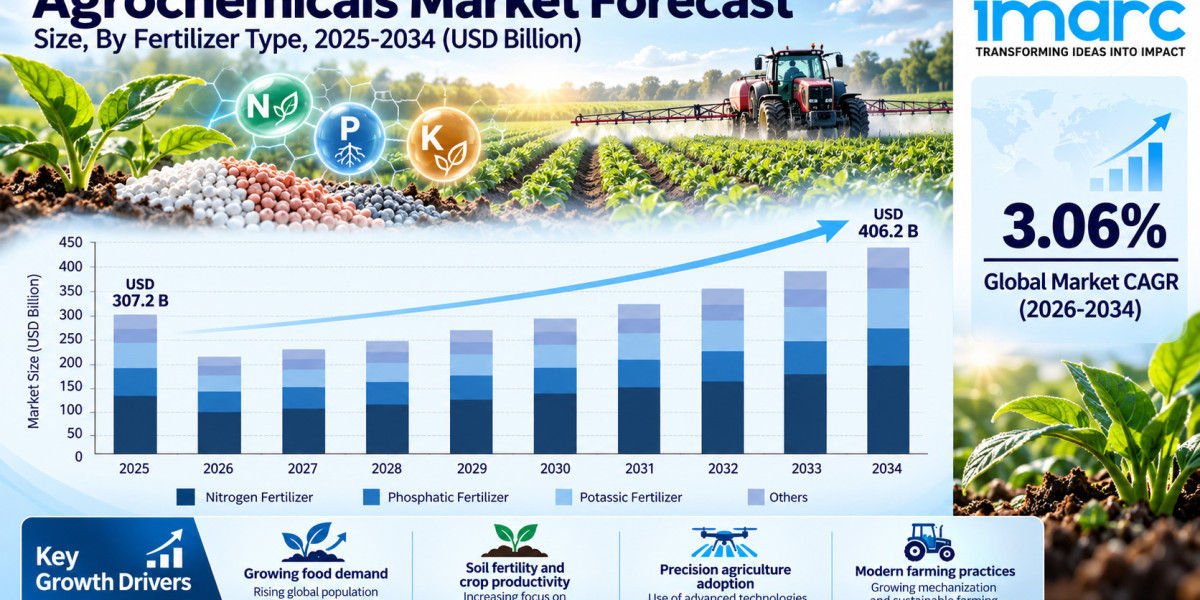
The global agrochemicals market size is experiencing steady growth as the demand for food production increases alongside rising global population, changing agricultural practices, and the need to improve crop productivity. The market reached USD 307.2 Billion in 2025 and is estimated at USD 319.3 Billion in 2026. According to IMARC Group, the market is projected to reach USD 406.2 Billion by 2034, expanding at a CAGR of 3.06% during 2026–2034. Asia Pacific dominated the market in 2025, accounting for 43.2% of the global market share.
The industry is being influenced by growing food security concerns, the adoption of high-yielding crop varieties, technological advancements in agricultural inputs, and increasing demand for effective pest and disease management. Precision agriculture, improved fertilizer formulations, and the development of bio-based crop protection products are also creating opportunities for agrochemical manufacturers.
Agrochemicals Market Snapshot
- Base Year: 2025
- Historical Period: 2020–2025
- Forecast Period: 2026–2034
- Market Size (2025): USD 307.2 Billion
- Market Size (2026): USD 319.3 Billion
- Market Forecast (2034): USD 406.2 Billion
- CAGR (2026–2034): 3.06%
- Leading Region: Asia Pacific
- Leading Regional Market Share: 43.2% in 2025
- Dominant Fertilizer Type Segment: Nitrogen Fertilizer
- Dominant Pesticide Type Segment: Herbicides
- Leading Crop Type Segment: Cereals and Grains
- Cereals and Grains Market Share: 47.02% in 2025
Asia Pacific accounted for 43.2% of the global agrochemicals market in 2025, supported by extensive agricultural activities, increasing food requirements, and the adoption of advanced farming techniques to improve crop productivity.
Request a Sample Report: https://www.imarcgroup.com/agrochemicals-market/requestsample
What Is Driving Agrochemicals Market Growth?
Growing Food Security Concerns
The rising global population is increasing the demand for food, creating pressure on agricultural systems to produce higher yields while making efficient use of available farmland. Agrochemicals, including fertilizers, herbicides, insecticides, and fungicides, play an important role in supplying essential plant nutrients and protecting crops against weeds, pests, and diseases.
As urbanization and industrial development reduce the availability of agricultural land in certain areas, farmers are increasingly focusing on improving productivity through effective crop management. Fertilizers help address soil nutrient deficiencies, while crop protection chemicals reduce potential losses caused by harmful organisms.
Advancements in agrochemical formulations, including controlled-release fertilizers and biological pesticides, are also supporting improvements in agricultural efficiency. These products can help farmers optimize input use and address specific crop protection requirements.
Climate change is further influencing the market by altering pest populations, disease patterns, and growing conditions. These developments are encouraging farmers to adopt appropriate crop protection solutions and integrated pest management practices to maintain yields and protect food supplies.
Increasing Adoption of High-Yielding Crop Varieties
The growing need to improve agricultural output is encouraging farmers to adopt high-yielding crop varieties that can produce greater harvests from available farmland. These varieties are particularly important for meeting food requirements in regions experiencing population growth and increasing pressure on agricultural resources.
According to the American Council on Science and Health data cited in the supplied report, high-yielding crop varieties contributed to a 40% increase in crop production between 1965 and 2010. Their adoption has played an important role in agricultural intensification and the development of more productive farming systems.
However, high-yielding varieties may require carefully managed nutrient supplies and effective protection against pests and diseases to achieve their production potential. Fertilizers, herbicides, insecticides, and fungicides therefore remain important components of crop management programs.
The supplied report also highlights the release of 109 high-yielding, climate-resilient, and biofortified crop varieties covering 61 crops in India. These varieties included field crops and horticultural crops, reflecting efforts to improve productivity, resilience, and nutritional value.
As farmers continue to adopt improved seeds and modern cultivation techniques, demand for crop-specific fertilizer formulations and targeted crop protection products is expected to remain an important market driver.
Growing Need for Sustainable Farming Practices
Sustainability is becoming an increasingly important consideration in agricultural production. Farmers, manufacturers, and policymakers are exploring ways to improve yields while reducing unnecessary input use and minimizing environmental impacts.
The development of bio-based pesticides, organic fertilizers, and more efficient nutrient formulations is creating opportunities for agrochemical manufacturers to diversify their product portfolios. These solutions can complement conventional crop protection products and support integrated approaches to agricultural management.
The supplied report highlights Corteva's hybrid wheat technology, which is designed to improve yield potential while maintaining resource efficiency. It also notes that hybrid wheat varieties may offer improved performance under drought conditions, supporting agricultural resilience.
Government policies are further shaping product development and adoption. Sustainability initiatives, including the European Union's Green Deal, have encouraged attention toward reducing pesticide use and developing alternative crop protection solutions.
Precision agriculture technologies are also helping farmers apply agricultural inputs more selectively. By using crop monitoring, field data, and targeted application techniques, farmers can improve the efficiency of fertilizer and pesticide use while addressing specific production challenges.
These developments are encouraging the industry to focus on solutions that balance crop productivity, cost efficiency, and environmental considerations.
Agrochemicals Market Trends to Watch
Three major trends are shaping the global agrochemicals industry.
Food security and productivity enhancement: Growing food requirements are encouraging farmers to improve crop yields through effective nutrient management and crop protection. Fertilizers and pesticides continue to play an important role in agricultural production, particularly in regions with limited arable land and rapidly expanding populations.
High-yielding and climate-resilient crop varieties: The adoption of improved seeds is increasing the importance of specialized agricultural inputs. Farmers are seeking fertilizer formulations and crop protection solutions that support high productivity while addressing pests, diseases, and climate-related stresses.
Sustainable and precision agriculture: Biological crop protection products, improved fertilizer formulations, precision spraying, and integrated pest management are gaining importance. These approaches can help farmers optimize input use and respond to environmental concerns while maintaining agricultural productivity.
Another important development is the increasing use of digital technologies in farming. Precision agriculture systems, field monitoring, and data-driven application methods are helping farmers make more informed decisions about fertilizer and pesticide requirements.
The agrochemical industry is also investing in research and development to address resistance management, improve product performance, and develop formulations suited to different crops and climatic conditions.
Agrochemicals Market Segmentation
IMARC Group analyzes the global agrochemicals market by fertilizer type, pesticide type, crop type, and region, with forecasts covering 2026–2034.
By Fertilizer Type
- Nitrogen Fertilizer
- Phosphatic Fertilizer
- Potassic Fertilizer
- Others
Nitrogen fertilizer dominates the fertilizer type segment, supported by its essential role in plant growth, photosynthesis, and protein synthesis. Nitrogen is a critical nutrient for major crops, including wheat, maize, and rice, which are cultivated extensively to meet global food and animal feed requirements.
Nitrogen fertilizers such as urea, ammonium nitrate, and ammonium sulfate are widely used to address nutrient deficiencies and improve crop productivity. Their availability and established role in intensive agricultural systems contribute to the segment's leading position.
Farmers frequently prioritize nitrogen application to support crop development and achieve target yields. Government initiatives and fertilizer support programs in several agricultural economies also contribute to demand.
Technological developments are improving the efficiency of nitrogen-based products. Controlled-release formulations and other advanced fertilizer technologies are designed to improve nutrient availability and reduce avoidable nutrient losses.
As agricultural producers continue to focus on productivity and efficient resource use, nitrogen fertilizers are expected to remain an important component of crop nutrition programs.
By Pesticide Type
- Fungicides
- Herbicides
- Insecticides
- Others
Herbicides represent the largest pesticide type segment, primarily because of their role in controlling weeds that compete with crops for nutrients, water, sunlight, and growing space.
Herbicides are widely used across cereals, grains, oilseeds, and other crops. Effective weed management can help farmers reduce competition during critical growth stages and improve the consistency of agricultural output.
The segment benefits from the adoption of modern farming systems, including large-scale mechanized agriculture and herbicide-tolerant crop varieties. Herbicides can also reduce reliance on manual weed removal, helping farmers manage labor requirements and operating costs.
Product innovation is supporting the development of formulations designed for different weed species, crops, and climatic conditions. Precision spraying technologies are also helping farmers target applications more efficiently.
At the same time, weed resistance and environmental considerations are increasing the importance of integrated weed management. Combining appropriate chemical applications with other weed control methods can help farmers manage resistance and maintain effective crop protection.
By Crop Type
- Cereals and Grains
- Oilseeds and Pulses
- Fruits and Vegetables
- Others
Cereals and grains accounted for 47.02% of the agrochemicals market in 2025, reflecting their central role in global food security and agricultural production.
Crops such as wheat, rice, and maize are essential sources of food and animal feed. Their extensive cultivation creates substantial demand for fertilizers and crop protection products to maintain productivity and reduce losses.
Cereals and grains are vulnerable to weeds, insects, and fungal diseases that can affect both crop yields and product quality. Fertilizers help support nutrient requirements, while herbicides, insecticides, and fungicides address different crop protection challenges.
The segment is also benefiting from the adoption of high-yielding varieties, precision farming, and targeted crop management techniques. These developments are encouraging the use of agricultural inputs suited to specific crop requirements and growing conditions.
Government initiatives aimed at strengthening domestic food production are further supporting demand for crop productivity solutions. As the global need for staple foods continues to increase, cereals and grains are expected to remain a significant application area for agrochemicals.
Regional Agrochemicals Market Outlook
Asia Pacific
Asia Pacific accounted for 43.2% of the global agrochemicals market in 2025, making it the leading regional market. Its position is supported by extensive agricultural activities, high population density, and the importance of farming to food security and regional economies.
China, India, Indonesia, and other countries across the region are investing in agricultural modernization to improve productivity and meet rising food requirements. The cultivation of diverse crops across different climatic conditions creates demand for a broad range of fertilizers and crop protection products.
Urbanization and pressure on available farmland are encouraging farmers to increase yields through improved agricultural practices. Government policies, fertilizer support programs, and initiatives to strengthen domestic food production are also influencing agrochemical adoption.
The region is increasingly incorporating modern farming technologies, including precision application, crop monitoring, and improved irrigation systems. These developments are creating opportunities for manufacturers offering specialized formulations and efficient crop protection solutions.
The supplied report also highlights the establishment of an advanced technical manufacturing facility by Ratnakar India Ltd. in Dahej, Ankleshwar, in 2024. The investment was intended to strengthen agrochemical production and reduce reliance on imports, supporting India's domestic supply capabilities and access to international markets.
North America
North America represents an important agrochemicals market, supported by mechanized agriculture, established agricultural research infrastructure, and demand for high crop productivity.
The United States is a major contributor to the regional market, with farmers using fertilizers and crop protection products across extensive areas of cereal, grain, oilseed, fruit, and vegetable cultivation.
Research and development investments are supporting the introduction of improved formulations, pest-resistant technologies, and targeted crop protection solutions. Precision agriculture is also encouraging more efficient use of agricultural inputs.
The supplied report highlights the launch of Mevalone biofungicide by Sipcam Agro USA in 2024 across California and 16 other states. The product was developed to manage bunch rot and powdery mildew in grapes using naturally derived active ingredients.
Such developments illustrate the growing interest in crop protection products that can complement integrated disease management programs. Demand for solutions addressing fungal infections, pest resistance, and changing climatic conditions is creating opportunities for agrochemical manufacturers across North America.
Europe
Europe's agrochemicals market is influenced by agricultural productivity requirements, environmental regulations, and the growing emphasis on sustainable farming.
The European Union's Green Deal and related agricultural initiatives have increased attention toward reducing pesticide use and improving environmental performance. These priorities are encouraging research into biological pesticides, biofertilizers, and alternative crop protection technologies.
Farmers across Germany, France, the United Kingdom, Italy, Spain, and other European markets require agricultural inputs to protect crops and maintain yields under varying climatic conditions.
The adoption of integrated pest management and precision application methods is also supporting more targeted use of agrochemicals. These approaches help producers manage crop protection requirements while considering environmental and regulatory expectations.
Manufacturers are responding through product innovation and the development of solutions designed to improve application efficiency and support sustainable agricultural practices. Continued investment in research and development is expected to influence the region's agrochemical market.
Latin America
Latin America is an important agricultural region, with Brazil and Argentina contributing significantly to the production of cereals, grains, oilseeds, and other agricultural commodities.
Large-scale farming operations and demand for agricultural exports support the use of fertilizers, herbicides, insecticides, and fungicides. The region's varied climatic conditions also create crop protection requirements associated with pests, diseases, and weeds.
Brazil's substantial grain production contributes to demand for agricultural inputs that help maintain productivity and protect crops throughout the growing season.
Government initiatives, agricultural investment, and the development of new agrochemical formulations are supporting market activity. The approval and introduction of additional crop protection products can help farmers address evolving pest challenges and crop management requirements.
At the same time, sustainability and export quality considerations are encouraging interest in more efficient agricultural practices. Manufacturers that provide effective products, technical support, and solutions suited to regional farming conditions can benefit from opportunities across Latin America.
Middle East and Africa
The Middle East and Africa agrochemicals market is supported by efforts to improve food security, modernize agriculture, and increase domestic agricultural production.
Water scarcity, challenging climatic conditions, and limitations on arable land are encouraging investment in farming technologies and efficient crop management. Fertilizers and crop protection products can help address nutrient deficiencies and protect crops against pests and diseases when used appropriately.
Governments and agricultural organizations are investing in agricultural development, infrastructure, and food production initiatives. These efforts are creating opportunities for agrochemical suppliers to expand their presence and support local farming requirements.
The adoption of modern irrigation, improved seeds, and more efficient fertilizer application methods is also influencing demand. In addition, increasing awareness of sustainable farming practices is encouraging interest in products and technologies designed to improve agricultural efficiency.
As countries continue to strengthen domestic food production capabilities, the region offers opportunities for manufacturers providing suitable crop nutrition and crop protection solutions.
Key Regional Takeaways
United States Agrochemicals Market Analysis
In 2025, the United States accounted for 74.6% of the North American agrochemicals market, according to the supplied report. The country's market is supported by advanced agricultural technologies, established research infrastructure, and demand for improved crop productivity.
The extensive cultivation of cereals, grains, oilseeds, fruits, and vegetables creates demand for fertilizers and crop protection products. Research investments are also supporting the development of new formulations and targeted agricultural solutions.
Precision agriculture is encouraging more efficient application of agrochemicals through field monitoring, data analysis, and targeted spraying. These technologies can help farmers optimize input use according to crop requirements and field conditions.
The growing emphasis on environmental performance is encouraging manufacturers to explore bio-based products and improved formulations. Regulatory requirements and concerns about resistance management are also influencing product development.
The launch of Mevalone biofungicide by Sipcam Agro USA in 2024 illustrates the introduction of crop protection products designed for specific disease management requirements. Such innovations support the continuing evolution of the US agrochemicals market.
Europe Agrochemicals Market Analysis
Europe's agrochemicals market is shaped by agricultural productivity requirements and policies promoting environmental sustainability. The European Union's Green Deal has placed emphasis on reducing pesticide use and encouraging more sustainable agricultural practices.
The adoption of biological crop protection products and alternative fertilizer solutions is creating opportunities for manufacturers seeking to address changing regulatory and market requirements.
Countries such as Germany, France, and the United Kingdom maintain important agricultural markets, with demand influenced by crop production needs, pest management, and nutrient efficiency.
Precision agriculture and integrated pest management are also becoming important components of crop management. These methods support targeted applications and help farmers make informed decisions about agricultural inputs.
Research and development remain important to the introduction of improved formulations and technologies. Companies that can develop effective products while addressing environmental and regulatory considerations may strengthen their competitive position in the region.
Asia Pacific Agrochemicals Market Analysis
Asia Pacific is the leading regional market, accounting for 43.2% of global market share in 2025. China, India, and Indonesia are important contributors because of their extensive agricultural activities and the need to improve food production.
The region's growing population and demand for agricultural commodities are encouraging farmers to improve yields through fertilizer application, crop protection, and modern farming techniques.
India's agricultural sector also benefits from initiatives aimed at improving crop productivity, strengthening domestic manufacturing, and supporting agricultural exports. The expansion of agrochemical production facilities can improve supply availability and support distribution networks.
Precision agriculture, smart irrigation, crop monitoring, and improved seed varieties are creating opportunities for specialized agricultural inputs. The adoption of these technologies is encouraging farmers to focus on efficiency and crop-specific solutions.
As regional governments continue to prioritize food security and agricultural modernization, demand for fertilizers and crop protection products is expected to remain an important component of the market.
Latin America Agrochemicals Market Analysis
Latin America's agrochemicals market benefits from extensive agricultural production, strong demand for export crops, and the importance of farming to regional economies.
Brazil and Argentina are major agricultural producers, with large cultivation areas supporting demand for fertilizers and crop protection products. Tropical and subtropical conditions can create significant challenges involving weeds, insects, and fungal diseases.
Farmers rely on agricultural inputs to protect crops and maintain productivity across different growing seasons. Government approvals of new formulations and investment in agricultural infrastructure also influence product availability and adoption.
Sustainability and export requirements are encouraging producers to consider efficient application methods and improved crop management practices.
Manufacturers that provide regionally appropriate formulations, technical assistance, and effective resistance management solutions can find opportunities in this important agricultural market.
Middle East and Africa Agrochemicals Market Analysis
The Middle East and Africa agrochemicals market is developing as governments and agricultural organizations prioritize food security and agricultural modernization.
Limited water resources, changing climatic conditions, and pressure on agricultural land are increasing the importance of efficient crop production. Fertilizers and crop protection products can support these objectives when incorporated into suitable farming practices.
Investment in agricultural infrastructure, irrigation, and modern cultivation technologies is creating opportunities for agrochemical suppliers. Improved access to agricultural inputs and technical support can also help farmers address production challenges.
The growing interest in sustainable agriculture is encouraging demand for products that support nutrient efficiency and effective crop protection. As regional agricultural systems continue to modernize, the market offers opportunities for companies that can address local farming requirements.
Competitive Landscape
Companies in the global agrochemicals market are focusing on research and development, product innovation, strategic partnerships, and the expansion of distribution networks to strengthen their competitive positions.
Manufacturers are investing in formulations designed to address pest resistance, fungal diseases, weed management, and nutrient deficiencies. Digital technologies and precision agriculture are also influencing product development, application methods, and supply chain operations.
Sustainability is another important area of focus. Companies are developing biological crop protection products, improved fertilizer formulations, and other solutions intended to meet evolving environmental expectations and agricultural requirements.
Strategic partnerships, acquisitions, and manufacturing investments are helping companies expand their geographic reach and diversify their product portfolios. Technical support and farmer education also remain important for encouraging effective product use and building customer relationships.
The supplied report highlights an expansion by Ingevity Corporation involving its Capa caprolactone distribution network through a partnership with Ultrapolymers Group in Europe in July 2024. The agreement was intended to strengthen the distribution of Capa bioplastics and support applications across industries, including agrochemicals, adhesives, and coatings.
Major companies identified in the global agrochemicals market include:
- BASF SE
- Bayer AG
- Corteva Inc.
- Dow Inc.
- FMC Corporation
- Nufarm Ltd.
- Nutrien Ltd.
- Syngenta Group
- The Archer-Daniels-Midland Company
- Yara International ASA
Latest News and Developments
November 2024: Corteva announced developments in hybrid wheat technology designed to improve yield potential and drought resistance. These advancements may create opportunities for agricultural input manufacturers by supporting improved crop varieties and specialized crop nutrition and protection requirements.
October 2024: ASP Isotopes Inc. announced that its first isotope enrichment facility in South Africa would focus on enriching Carbon-14 for applications including healthcare and agrochemicals. The initiative formed part of the company's broader strategy to apply isotope enrichment technologies across multiple industries.
September 2024: AdvanSix received a USD 12 Million USDA grant to expand ammonium sulfate fertilizer production under the Sustainable US Sulfate to Accelerate Increased Nutrition (SUSTAIN) initiative. The planned expansion was expected to add 200,000 tons of granular ammonium sulfate annually, supporting domestic fertilizer availability and sulfur nutrition requirements in agriculture.
Where Are the Biggest Agrochemicals Market Opportunities?
The global agrochemicals industry presents opportunities across several areas:
- Advanced fertilizer formulations: Improved nutrient delivery and controlled-release products can help farmers optimize crop nutrition.
- Biological crop protection: Bio-based pesticides and other biological solutions offer opportunities to address changing environmental and agricultural requirements.
- Precision agriculture: Targeted spraying, crop monitoring, and data-driven application methods can improve input efficiency.
- High-yielding crop varieties: Improved seeds create demand for appropriate nutrient management and crop protection solutions.
- Integrated pest management: Combining chemical and nonchemical approaches can help manage pests and resistance while supporting effective crop protection.
- Emerging agricultural markets: Growing food requirements and agricultural modernization are creating opportunities in Asia Pacific, Latin America, and Africa.
- Climate-resilient farming: Products suited to changing pest patterns and challenging growing conditions can support agricultural resilience.
- Farmer support and distribution: Technical assistance, product education, and stronger distribution networks can improve access to agricultural inputs.
These opportunities are particularly relevant as farmers seek to improve productivity, manage input costs, and address environmental concerns. Companies that combine product innovation with effective technical support and region-specific solutions can strengthen their positions in the evolving agrochemicals industry.
Get Detailed Agrochemicals Market Intelligence
The headline market figures provide a useful overview of the industry's direction, but businesses evaluating market entry, product development, competitive positioning, regional expansion, or investment opportunities may require deeper market intelligence.
A comprehensive agrochemicals market report can provide insights into:
- Market size and forecasts
- Fertilizer type analysis
- Pesticide type segmentation
- Crop type assessment
- Regional and country-level markets
- Market trends and growth drivers
- Competitive landscape
- Key company profiles
- Technological developments
- Sustainable agricultural solutions
- Emerging market opportunities
- Industry developments
Detailed market intelligence can help businesses assess demand patterns, identify growth opportunities, evaluate competitive strategies, and make informed decisions about product portfolios and geographic expansion.
Request a Sample Report: https://www.imarcgroup.com/agrochemicals-market/requestsample
Agrochemicals Market FAQs
What is the current size of the global agrochemicals market?
The global agrochemicals market reached USD 307.2 Billion in 2025 and is estimated at USD 319.3 Billion in 2026. It is projected to reach USD 406.2 Billion by 2034.
What is the expected CAGR of the agrochemicals market?
The global agrochemicals market is expected to grow at a CAGR of 3.06% during 2026–2034.
Which region leads the agrochemicals market?
Asia Pacific is the leading regional market, accounting for 43.2% of global market share in 2025. Its extensive agricultural activities, growing food requirements, and adoption of modern farming techniques support its leading position.
Which fertilizer type dominates the agrochemicals market?
Nitrogen fertilizer dominates the fertilizer type segment because of its essential role in plant growth, nutrient management, and the production of major crops such as wheat, maize, and rice.
Which pesticide type represents the largest market segment?
Herbicides represent the largest pesticide type segment, supported by their widespread use in controlling weeds across cereals, grains, oilseeds, and other crops.
Which crop type accounts for the largest share of the agrochemicals market?
Cereals and grains accounted for 47.02% of the market in 2025, reflecting their importance in global food security and agricultural production.
What are the major trends in the agrochemicals market?
Key trends include rising food security concerns, the adoption of high-yielding crop varieties, precision agriculture, biological crop protection, improved fertilizer formulations, and sustainable farming practices.
Conclusion
The global agrochemicals market is evolving as agricultural producers seek to improve crop productivity, address food security challenges, and respond to changing environmental and farming requirements. Valued at USD 307.2 Billion in 2025, the market is estimated to reach USD 319.3 Billion in 2026 and is projected to grow to USD 406.2 Billion by 2034, registering a CAGR of 3.06% during 2026–2034.
Opportunities are emerging across advanced fertilizers, herbicides, biological crop protection, precision agriculture, and climate-resilient farming solutions. Asia Pacific maintains its leading position, while North America, Europe, and Latin America continue to offer opportunities through agricultural innovation and demand for effective crop management.
Companies that invest in research and development, improve input efficiency, expand distribution networks, and develop solutions aligned with changing agricultural requirements can strengthen their competitive positioning in the global agrochemicals industry.
About the Author
IMARC Group is a global market research company providing data-driven insights and expert consulting services to businesses seeking to achieve their strategic objectives. With a multidisciplinary team of industry experts, IMARC delivers market intelligence across sectors including agriculture, energy and mining, construction and manufacturing, automotive, chemicals and materials, and more.
Media & Sales Contact
IMARC Group
United States: +1-201-971-6302
India: +91-120-433-0800
United Kingdom: +44-753-714-6104