
Market Overview
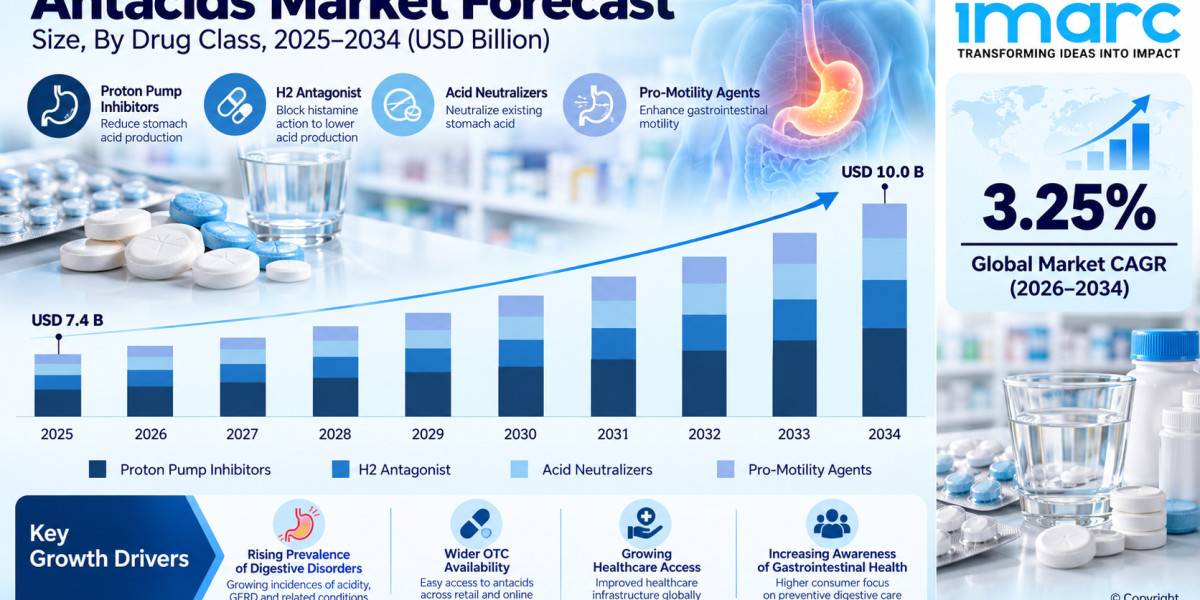
The global antacids market size is experiencing steady growth as the prevalence of gastrointestinal disorders increases and consumers seek convenient solutions for managing acidity, heartburn, and indigestion. The market reached USD 7.4 Billion in 2025 and is projected to reach USD 10.0 Billion by 2034, expanding at a CAGR of 3.25% during 2026–2034. Asia-Pacific dominated the market in 2025, accounting for 42.1% of the global market share.
The industry is being influenced by rising cases of gastroesophageal reflux disease (GERD), unhealthy dietary habits, sedentary lifestyles, an aging population, and growing awareness of digestive health. The increasing availability of over-the-counter (OTC) medicines through pharmacies, supermarkets, and online platforms is further supporting market growth.
What Is Driving Antacids Market Growth?
Rising Prevalence of Gastrointestinal Disorders
Increasing cases of acid reflux, indigestion, and heartburn are contributing to the expansion of the global antacids market. Unhealthy eating habits, frequent consumption of processed foods, caffeinated beverages, and high-fat meals are increasing the incidence of digestive discomfort among consumers.
Sedentary lifestyles, irregular meal patterns, and rising stress levels are further contributing to gastrointestinal problems. These factors are encouraging consumers to seek accessible remedies that provide relief from common acidity-related symptoms.
The aging population is another important factor supporting demand, as older adults are more likely to experience certain digestive conditions. Growing awareness of gastrointestinal health is also encouraging individuals to recognize symptoms earlier and explore appropriate treatment options.
Antacids remain an accessible option for managing occasional symptoms associated with excess stomach acid. Their availability in different formulations, including tablets, liquids, and powders, supports consumer convenience and contributes to market expansion.
Increasing Availability of Over-the-Counter Medicines
The expanding availability of OTC medicines is creating favorable conditions for the antacids market. Consumers can purchase many antacid products through retail pharmacies, supermarkets, grocery stores, and online platforms, making them readily accessible for common digestive complaints.
The growing preference for convenient healthcare solutions is encouraging consumers to consider non-prescription products for occasional heartburn, acidity, and indigestion. Increasing awareness of digestive health and the desire for prompt symptom relief are further supporting this trend.
Retail pharmacies play an important role by offering multiple brands and formulations while providing guidance on product selection. Meanwhile, e-commerce platforms are expanding consumer access to digestive health products, particularly in areas where physical retail access may be limited.
The broader OTC medicines industry is also creating opportunities for antacid manufacturers. According to the supplied market information, the global OTC drugs market is projected to reach USD 275.9 Billion by 2032, reflecting the growing importance of non-prescription healthcare products.
Growing Aging Population and Healthcare Awareness
Population aging is contributing to demand for products used to manage digestive discomfort. Older adults may experience changes in digestive function and may be more susceptible to certain gastrointestinal conditions, creating demand for convenient healthcare options.
According to the World Health Organization (WHO), cited in the supplied report, one in six people worldwide will be aged 60 years or older by 2030. The global population in this age group is projected to increase from 1.4 billion in 2020 to 2.1 billion by 2050.
This demographic shift is encouraging greater attention to age-related healthcare needs, including digestive health management. Manufacturers are responding to consumer preferences by offering antacid products in accessible formulations and convenient packaging.
At the same time, growing awareness of the effects of dietary habits, stress, and lifestyle choices on gastrointestinal health is encouraging consumers to pay greater attention to digestive symptoms. These developments are supporting demand for readily available antacid products across multiple consumer groups.
Request a Sample Report: https://www.imarcgroup.com/antacids-market/requestsample
Antacids Market Trends to Watch
Three major trends are shaping the future of the global antacids industry.
Rising prevalence of GERD: Increasing cases of gastroesophageal reflux disease are supporting demand for products used to manage associated symptoms, including heartburn and acid reflux. Changing dietary patterns, obesity, and sedentary lifestyles are among the factors associated with the growing burden of gastrointestinal conditions.
Growing geriatric population: The increasing number of older adults worldwide is creating demand for healthcare products addressing age-related conditions and digestive discomfort. Convenient formulations and accessible distribution channels are becoming increasingly important to this consumer group.
Increasing reliance on OTC medicines: Consumers are increasingly seeking convenient access to non-prescription healthcare products. The widespread availability of antacids through pharmacies, supermarkets, and online channels is improving product accessibility and supporting market development.
Product innovation is also contributing to industry growth. Manufacturers are offering chewable tablets, liquid formulations, flavored products, and convenient packaging to address different consumer preferences. These developments are helping companies differentiate their products while improving ease of use.
The expansion of digital retail and consumer health information is further influencing purchasing behavior. Online platforms provide greater access to product information and purchasing options, while established pharmacy networks continue to support product availability.
Antacids Market Segmentation
The global antacids market is analyzed by drug class, formulation type, and distribution channel. Each segment reflects different treatment approaches, consumer preferences, and purchasing behaviors.
By Drug Class
Proton Pump Inhibitors
H2 Antagonist
Acid Neutralizers
Pro-Motility Agents
Proton pump inhibitors accounted for approximately 32.0% of the market in 2025, making them the leading drug class segment in the supplied market assessment.
Proton pump inhibitors reduce stomach acid production by blocking the proton pump involved in the final stage of acid secretion. They are used in the management of acid-related conditions, including GERD and certain ulcer-related disorders, under appropriate medical guidance.
Their established role in treating acid-related conditions, along with their use in both short-term and longer-term treatment regimens where indicated, contributes to demand. Increasing awareness of gastrointestinal disorders and the availability of different treatment options are also influencing the segment.
Pharmaceutical companies continue to invest in product development and improvements in treatment options. For instance, Daewon Pharmaceutical introduced Escorten, a proton pump inhibitor medicine, in South Korea in 2022.
The availability of different formulations and treatment options supports the segment's position in the market. However, the appropriate choice of treatment depends on the underlying condition, individual circumstances, and healthcare professional guidance.
By Formulation Type
Tablet
Liquid
Powder
Others
Tablets represent the largest formulation segment, supported by their portability, ease of administration, convenient storage, and standardized dosage.
Tablet formulations are widely preferred because consumers can carry them easily and use them without additional preparation. Their comparatively long shelf life also makes them convenient for retailers and consumers.
Manufacturers are introducing different flavors, chewable options, and formulations designed to improve convenience and consumer acceptance. Advances in pharmaceutical formulation technology are also supporting the development of products designed to dissolve efficiently and provide relief from symptoms.
Liquid antacids remain an important alternative for consumers who prefer liquids or have difficulty swallowing tablets. Powder formulations and other product formats provide additional choices for different needs and preferences.
The availability of multiple formulations allows manufacturers to serve a broader consumer base and strengthens product accessibility across retail and online distribution channels.
By Distribution Channel
Hospital Pharmacies
Retail Pharmacies
Others
Retail pharmacies accounted for 43.9% of the antacids market in 2025, making them the leading distribution channel.
Retail pharmacies provide convenient access to OTC antacids and allow consumers to purchase products when symptoms occur. Their broad presence across urban and semi-urban areas supports product availability and visibility.
These outlets commonly stock multiple brands and formulations, enabling consumers to select products according to their preferences and familiarity. Pharmacists can also provide information on appropriate product selection, label directions, potential interactions, and when medical evaluation may be necessary.
The growing preference for self-care products is supporting demand through retail pharmacy networks. Some pharmacies also offer extended operating hours, improving access for consumers seeking immediate assistance with common symptoms.
Strategic expansion and consolidation within the pharmacy industry can further influence the distribution landscape. For example, Medly Pharmacy acquired Pharmaca in 2021 as part of efforts to expand pharmacy services.
Online channels and other retail outlets complement traditional pharmacies by improving access to non-prescription products. Nevertheless, retail pharmacies remain an important point of purchase because of their accessibility and the availability of pharmacist guidance.
Regional Antacids Market Outlook
Asia-Pacific
Asia-Pacific accounted for 42.1% of the global antacids market in 2025, making it the leading regional market. Its large population, changing dietary habits, increasing urbanization, and improving access to healthcare products are supporting demand.
Countries such as China, India, Indonesia, Japan, and South Korea represent important markets for digestive health products. Greater consumption of processed foods, irregular eating patterns, and increasing stress associated with modern lifestyles are contributing to demand for products used to manage acidity and indigestion.
The expansion of retail pharmacy networks and the growing availability of OTC medicines are improving access to antacids. Local and international pharmaceutical companies are also strengthening their presence across the region to serve a large and diverse consumer base.
Increasing healthcare awareness and demand for affordable treatments are further supporting market development. As digital retail channels expand, consumers are gaining additional ways to access digestive health products.
North America
North America represents a significant market for antacids, supported by widespread availability of OTC medicines, established pharmacy networks, and consumer awareness of digestive health.
The United States accounts for 84.9% of the North American antacids market, according to the supplied report. Demand is influenced by the prevalence of GERD, acid reflux, and heartburn, along with dietary habits, stress, and the healthcare needs of an aging population.
The broad availability of chewable tablets, liquid antacids, and other formulations supports consumer convenience. Pharmacies, supermarkets, and online retailers also help ensure that products are readily accessible.
The region's established OTC medicines industry and growing interest in convenient self-care solutions provide opportunities for manufacturers. Demand for products with different flavors, formats, and ingredient profiles is also influencing product development.
Europe
The European antacids market is supported by healthcare expenditure, established pharmaceutical distribution networks, and increasing attention to the management of gastrointestinal conditions.
Changing dietary habits, including the consumption of processed foods and high-fat meals, are contributing to digestive discomfort among some consumer groups. Greater awareness of conditions such as acid reflux and GERD is encouraging consumers to seek appropriate treatment options.
According to the supplied report, average healthcare expenditure in the European Union reached €3,685 per person in 2022, representing an increase of 38.6% compared with €2,658 in 2014.
The region's established pharmacy networks support access to OTC products, while digital health tools are providing consumers with additional ways to learn about and monitor their health. Manufacturers are also responding to preferences for different product formulations, including sugar-free options and products designed for specific dietary requirements.
Latin America
The Latin American antacids market is benefiting from growing healthcare awareness, expanding retail distribution, and increasing attention to digestive health.
As consumers become more aware of the relationship between dietary habits and gastrointestinal discomfort, demand for products used to manage occasional acidity and indigestion is creating opportunities for manufacturers.
The expansion of pharmacies and online retail channels is improving product availability across the region. Increasing internet penetration is also supporting digital commerce and making it easier for consumers to access product information and purchasing options.
According to the supplied report, Latin America recorded 67 million 5G internet connections in the third quarter of 2024, with growth of 19%. The continued development of digital infrastructure may provide additional opportunities for online distribution of consumer healthcare products.
Middle East and Africa
The Middle East and Africa antacids market is supported by improving healthcare infrastructure, expanding pharmacy networks, and growing access to consumer healthcare products.
Lifestyle changes, dietary habits, and increasing urbanization are influencing demand for products used to manage digestive discomfort. Wider access to pharmacies and the expansion of e-commerce platforms are also helping improve product availability.
Online retail is creating additional distribution opportunities, particularly in markets where digital purchasing is becoming more common. According to the supplied report, the Africa e-commerce market reached USD 317.0 Billion in 2024 and is projected to grow at a CAGR of 13.8% during 2025–2033.
These developments may support broader access to consumer healthcare products, including OTC antacids. Pharmaceutical companies that strengthen distribution partnerships and adapt products to regional consumer preferences can benefit from the evolving market landscape.
Key Regional Takeaways
United States Antacids Market Analysis
The United States accounted for 84.9% of the North American antacids market, according to the supplied report. Market growth is supported by the prevalence of gastrointestinal disorders, widespread availability of OTC medicines, and increasing consumer attention to digestive health.
The National Institutes of Health data cited in the report indicates that approximately 18.1% to 27.8% of individuals in the United States were affected by GERD as of 2018. The demand for accessible treatments is also influenced by dietary habits, sedentary lifestyles, and the healthcare needs of an aging population.
The US OTC drugs market was valued at USD 41.9 Billion in 2024 and is projected to reach USD 65.1 Billion by 2033, growing at a CAGR of 5.4% during 2025–2033, according to the supplied report.
The availability of chewable tablets, liquid formulations, and dissolvable powders is supporting consumer choice. Established retail pharmacies, supermarkets, and online platforms further improve product accessibility.
Interest in natural and herbal products is also influencing consumer preferences. Manufacturers are responding to demand for convenient formulations and differentiated product offerings, while pharmacies remain important sources of product information and purchasing guidance.
Europe Antacids Market Analysis
The European antacids market is expanding amid increasing healthcare expenditure, established pharmaceutical distribution, and greater attention to preventive health and symptom management.
The supplied report indicates that average healthcare expenditure in the European Union reached €3,685 per person in 2022, an increase of 38.6% compared with 2014. Greater attention to digestive health is supporting demand for products used to manage occasional heartburn, acid reflux, and indigestion.
Dietary habits, including the consumption of processed foods, alcohol, and high-fat meals, are among the factors associated with digestive discomfort. The availability of OTC medicines through established pharmacy networks helps consumers access products for appropriate self-care.
Digital health tools and applications are also influencing consumer engagement by providing information about health management. Additionally, demand for products with specific characteristics, such as sugar-free formulations, is encouraging manufacturers to diversify their offerings.
Asia-Pacific Antacids Market Analysis
The Asia-Pacific antacids market is benefiting from a large population, increasing urbanization, changing dietary patterns, and improving healthcare awareness.
According to the supplied report, Asia accounted for approximately 59.05% of the global population in 2024, with an estimated annual growth rate of 0.60%.
Changing consumption patterns in countries such as China and India, including increased consumption of processed foods and high-fat meals, are influencing the demand for digestive health products. Stress, irregular eating patterns, and sedentary lifestyles are additional factors associated with gastrointestinal discomfort.
The growing availability of OTC medicines is making antacids more accessible to consumers. Expanding retail pharmacy networks, online platforms, and the presence of domestic and international pharmaceutical manufacturers are further supporting market development.
Latin America Antacids Market Analysis
The Latin American antacids market is experiencing growth as awareness of digestive health increases and distribution channels expand.
Consumers are becoming more conscious of how diet and lifestyle choices can influence digestive comfort. This is supporting demand for products used to manage occasional acidity, heartburn, and indigestion.
The expansion of retail pharmacies and online purchasing platforms is improving access to consumer healthcare products. Greater digital connectivity is also creating opportunities for pharmaceutical companies to reach consumers through e-commerce channels and digital marketing.
As distribution infrastructure develops, manufacturers may benefit from improving product availability, offering convenient formulations, and adapting their strategies to local consumer preferences.
Middle East and Africa Antacids Market Analysis
The Middle East and Africa antacids market is developing alongside improvements in healthcare infrastructure, broader pharmacy access, and the expansion of digital commerce.
Changing lifestyles and dietary habits are influencing demand for products used to manage common digestive complaints. The growth of retail pharmacies and online platforms is making OTC healthcare products more accessible across a wider consumer base.
The expansion of e-commerce is particularly relevant as consumers increasingly use digital channels to explore and purchase healthcare products. According to the supplied report, the Africa e-commerce market reached USD 317.0 Billion in 2024 and is projected to expand at a CAGR of 13.8% during 2025–2033.
These developments create opportunities for manufacturers to strengthen distribution networks, improve product visibility, and serve consumers seeking convenient access to digestive health products.
Competitive Landscape
Companies in the global antacids market are competing through product innovation, brand development, distribution expansion, and the introduction of convenient formulations.
Manufacturers offer antacids in tablets, chewable formats, liquids, powders, and other formulations to accommodate different consumer preferences. Packaging improvements, product differentiation, and marketing initiatives are also helping companies strengthen brand recognition.
Distribution remains a critical competitive factor. Partnerships with pharmacies, supermarkets, and online retailers help manufacturers expand product availability and reach consumers across different regions.
Companies are also investing in consumer awareness initiatives related to digestive health and the appropriate use of OTC medicines. Product development and strategic collaborations are creating additional opportunities to improve market positioning.
For instance, in March 2024, Lil' Drug Store Products announced a collaboration with Procter & Gamble to distribute its Rolaids antacid brand to travel vendors. The collaboration aimed to strengthen product availability in travel-related retail channels.
Major companies operating in the global antacids market include:
Abbott Laboratories
AstraZeneca plc
Bayer AG
Boehringer Ingelheim International GmbH
Dr. Reddy's Laboratories Ltd.
GlaxoSmithKline plc
Johnson & Johnson
Pfizer Inc.
Procter & Gamble Company
Reckitt Benckiser Group PLC
Sanofi S.A.
Sun Pharmaceutical Industries Ltd.
Takeda Pharmaceutical Company Limited
Recent Industry Developments
January 2025: Haleon announced plans to invest USD 54 Million to enhance its research and development facility in Northside Richmond, Virginia. The planned improvements were intended to strengthen the company's R&D capabilities and support future product innovation.
August 2024: ENO, an OTC antacid brand owned by Haleon, introduced a new 3-in-1 antacid variant in India containing cumin, carom seeds, and black salt alongside its existing formulation. The product was positioned to address consumer demand for convenient relief from acidity and indigestion.
July 2024: The US Food and Drug Administration authorized vonoprazan, marketed as Voquezna, for the treatment of heartburn associated with GERD in adults. This development reflects continued innovation in the broader acid-related disorder treatment market.
June 2024: Akums introduced a chewable antacid tablet for reflux containing sodium alginate and potassium bicarbonate. The formulation was designed to help manage reflux symptoms by forming a barrier that limits stomach contents from reaching the esophagus.
Where Are the Biggest Antacids Market Opportunities?
The global antacids industry presents opportunities across several areas:
OTC product availability: Expanding access through pharmacies, supermarkets, and online platforms can improve convenience for consumers.
Product formulation innovation: Tablets, chewable products, liquids, and powders can serve different preferences and usage requirements.
Growing digestive health awareness: Consumer education about gastrointestinal symptoms can support demand for appropriate treatment options.
Aging population: The increasing number of older adults is creating greater demand for healthcare products addressing age-related needs.
Emerging-market expansion: Large populations, urbanization, and improving healthcare access create opportunities in Asia-Pacific and other developing markets.
Digital distribution: E-commerce and online pharmacy platforms can help manufacturers expand reach and improve product accessibility.
Retail pharmacy partnerships: Strong distribution relationships can enhance product visibility and support consumer access.
Product differentiation: Convenient packaging, varied flavors, and formulations designed for specific consumer preferences can help brands stand out in a competitive market.
These opportunities are particularly relevant as consumers increasingly seek convenient access to products for managing common digestive complaints. Companies that combine appropriate product development with strong distribution networks and responsible consumer communication can strengthen their competitive positions.
Get Detailed Antacids Market Intelligence
The headline market figures provide a useful overview of the industry's direction, but businesses evaluating market entry, product development, competitive positioning, or regional expansion may require more detailed market intelligence.
A comprehensive antacids market report can help businesses assess:
Market size and growth forecasts
Drug class analysis
Formulation-type segmentation
Distribution channel assessment
Regional and country-level market performance
Market drivers and emerging trends
Competitive landscape and company profiles
Consumer preferences and product innovations
Developments in OTC medicines
Emerging distribution and expansion opportunities
Detailed market intelligence can support strategic decisions involving product launches, portfolio development, distribution partnerships, and expansion into high-potential markets.
Request a Sample Report: https://www.imarcgroup.com/antacids-market/requestsample
Antacids Market FAQs
What is the current size of the global antacids market?
The global antacids market reached USD 7.4 Billion in 2025 and is projected to reach USD 10.0 Billion by 2034.
What is the expected CAGR of the antacids market?
The global antacids market is projected to grow at a CAGR of 3.25% during 2026–2034.
Which region leads the antacids market?
Asia-Pacific led the global antacids market in 2025, accounting for 42.1% of the market share. Its large population, changing dietary habits, growing healthcare awareness, and expanding access to OTC medicines support its leading position.
Which drug class dominates the antacids market?
Proton pump inhibitors accounted for approximately 32.0% of the market in 2025, making them the leading drug class segment in the supplied market assessment.
Which formulation type dominates the antacids market?
Tablets represent the largest formulation segment, supported by their portability, ease of use, convenient storage, and standardized dosage.
Which distribution channel leads the antacids market?
Retail pharmacies accounted for 43.9% of the market in 2025. Their accessibility, broad product selection, and availability of pharmacist guidance support their leading position.
What are the major trends in the antacids market?
Key trends include the rising prevalence of GERD, the growing geriatric population, increasing reliance on OTC medicines, product formulation innovation, and the expansion of retail and online distribution channels.
Who are the major companies in the antacids market?
Major companies include Abbott Laboratories, AstraZeneca, Bayer AG, Dr. Reddy's Laboratories, GlaxoSmithKline, Johnson & Johnson, Pfizer, Procter & Gamble, Reckitt Benckiser Group, Sanofi, Sun Pharmaceutical Industries, and Takeda Pharmaceutical Company.
Conclusion
The global antacids market is evolving as consumers increasingly seek convenient solutions for managing acidity, heartburn, and other common digestive complaints. Valued at USD 7.4 Billion in 2025, the market is projected to reach USD 10.0 Billion by 2034, registering a CAGR of 3.25% during 2026–2034.
Growth opportunities are emerging across OTC product availability, formulation innovation, retail pharmacy networks, and digital distribution channels. Asia-Pacific maintains its leading position, while North America and Europe continue to benefit from established pharmaceutical distribution systems and consumer awareness of digestive health.
Companies that focus on product quality, convenient formulations, responsible consumer communication, and broader distribution can strengthen their market positions in the evolving antacids industry.
About the Author
IMARC Group is a global market research company providing data-driven insights and expert consulting services to businesses seeking to achieve their strategic objectives. With a multidisciplinary team of industry experts, IMARC delivers market intelligence across sectors including healthcare, pharmaceuticals, energy and mining, construction and manufacturing, automotive, chemicals and materials, and more.
Media & Sales Contact
IMARC Group
United States: +1-201-971-6302
India: +91-120-433-0800
United Kingdom: +44-753-714-6104