
Market Overview
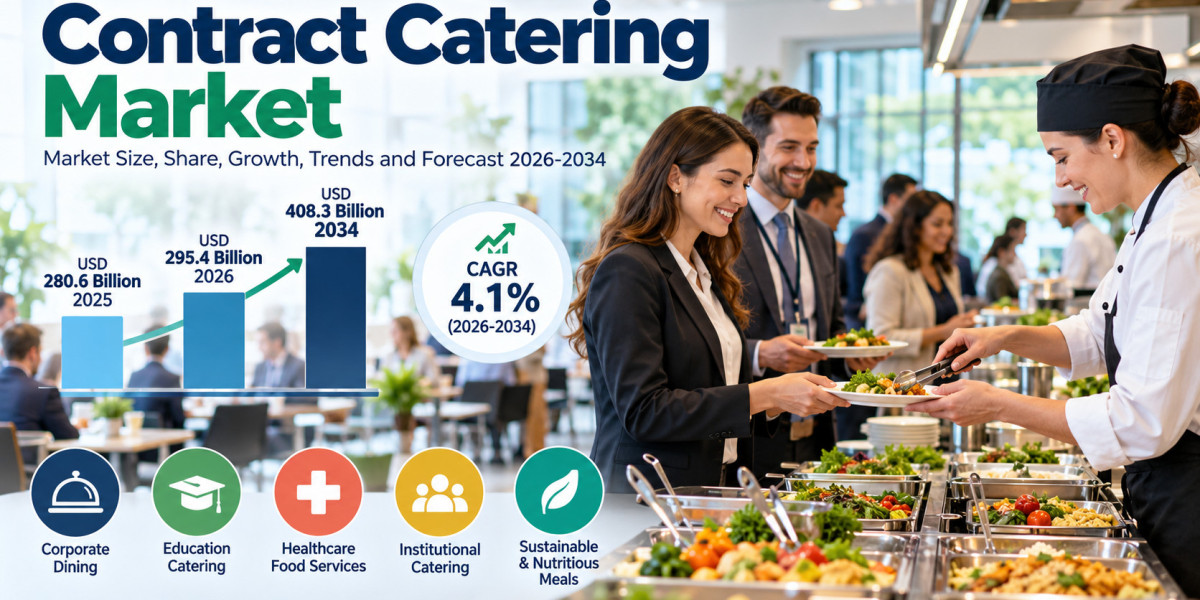
The global contract catering market size is experiencing steady growth as organizations increasingly outsource food service operations to specialized providers. The market increased from USD 280.6 Billion in 2025 to USD 295.4 Billion in 2026 and is projected to reach USD 408.3 Billion by 2034, exhibiting a CAGR of 4.1% during 2026–2034. Europe dominated the market in 2025, accounting for 35.8% of the global market share.
The industry is being influenced by rising corporate outsourcing, expanding institutional demand across education and healthcare, increasing preferences for nutritious and diverse meal options, and growing sustainability requirements. Technological advancements, digital ordering platforms, smart kitchen equipment, and responsible sourcing practices are also creating new opportunities for contract catering providers worldwide.
What Is Driving Contract Catering Market Growth?
Rising Outsourcing Across Corporate and Institutional Sectors
Organizations across corporate offices, educational institutions, healthcare facilities, and government establishments are increasingly outsourcing food service operations to specialized catering providers. This approach enables organizations to concentrate on their core activities while benefiting from professional menu planning, procurement, food preparation, and service management.
Managing food services internally can require substantial investments in kitchen infrastructure, trained personnel, inventory management, food safety systems, and operational technology. Outsourcing allows institutions to access established catering capabilities without managing every aspect of the food service process independently.
Contract catering companies can leverage centralized procurement, standardized operating procedures, established supplier relationships, and economies of scale to improve efficiency. These advantages are particularly important for multinational corporations and institutions operating across multiple locations.
The growing complexity of food service requirements, combined with pressure to control operating expenses, is strengthening demand for long-term catering agreements. As organizations increasingly prioritize operational efficiency and professional food service management, outsourcing is expected to remain an important driver of market growth.
Growing Demand for Nutritious and Diverse Menus
Increasing health awareness is influencing food preferences across workplaces, schools, universities, hospitals, and other institutional settings. Consumers are showing greater interest in balanced meals, plant-based alternatives, allergen-transparent menus, and food options that accommodate different dietary requirements.
Contract catering providers are responding by expanding menu variety, improving nutritional planning, and incorporating healthier ingredients into their offerings. Healthcare institutions require specialized meals that address patient nutrition and dietary restrictions, while corporate clients increasingly seek dining programs that support employee wellness.
Educational institutions also represent an important demand segment, as schools and universities require meals that combine nutritional value, affordability, and broad consumer appeal.
The ability to provide diverse menus while maintaining consistent quality, food safety, and cost efficiency is becoming a competitive advantage. Catering companies that respond effectively to evolving dietary preferences may strengthen client relationships and improve contract retention.
Sustainability and Responsible Sourcing Mandates
Sustainability is becoming an important consideration in contract catering procurement and service delivery. Corporate clients increasingly expect catering partners to demonstrate responsible sourcing, reduce food waste, minimize packaging, and improve the environmental performance of their operations.
These expectations are encouraging providers to work with local suppliers, explore seasonal ingredients, introduce plant-forward menus, and implement waste management systems. Sustainable packaging and improved inventory planning are also helping catering companies reduce their environmental footprint.
Large organizations with environmental, social, and governance (ESG) commitments may incorporate sustainability performance into supplier evaluations and contractual requirements. Catering providers that can demonstrate measurable improvements in sourcing, waste reduction, and resource efficiency may gain a competitive advantage when bidding for institutional contracts.
Digital Transformation in Food Service Operations
Technology is transforming contract catering by improving menu planning, procurement, kitchen management, and customer engagement. Digital ordering platforms, cashless payments, artificial intelligence (AI), and connected kitchen equipment are helping providers streamline operations across multiple client locations.
AI-powered planning tools can analyze consumption patterns, dietary preferences, ingredient availability, and operating costs to improve forecasting and reduce unnecessary food preparation. Digital ordering systems also help manage demand during peak periods, improve service speed, and generate insights into consumer preferences.
Smart kitchen technologies support real-time monitoring of equipment, temperature controls, and operational processes. These systems can improve consistency, support food safety compliance, and help catering companies manage resources more effectively.
As contract catering providers seek to improve service quality while controlling operating costs, technology adoption is becoming an increasingly important source of operational efficiency and differentiation.
Request a Sample Report for Detailed Evaluation: https://www.imarcgroup.com/contract-catering-market/requestsample
Contract Catering Market Trends to Watch
Several major trends are shaping the future of the global contract catering industry.
Plant-Based and Flexitarian Menu Integration: Catering providers are expanding plant-based proteins, vegan meals, and flexitarian options to accommodate changing dietary preferences and sustainability objectives. Compass Group, for example, has expanded plant-forward offerings as part of its efforts to address demand for healthier and lower-carbon food choices.
Smart Kitchen Technology and Automation: Connected kitchen equipment, real-time monitoring, and automated operational systems are helping catering providers improve efficiency, maintain consistent quality, and manage food waste. Smart technologies also support better control of energy consumption and kitchen processes.
Digital Ordering and Cashless Payments: Mobile ordering, QR-code menus, pre-ordering platforms, and contactless payments are becoming increasingly important across corporate and institutional dining environments. These technologies can reduce queues, improve convenience, and provide valuable data for demand forecasting.
Personalized Nutrition and Allergen Management: Catering providers are increasingly using digital dietary management systems to accommodate allergen restrictions, therapeutic diets, and individual nutrition requirements. These capabilities are particularly relevant to healthcare facilities and organizations that prioritize employee wellness.
Sustainability Reporting Integration: Environmental performance is becoming more visible in catering contracts, with clients increasingly interested in food waste reduction, carbon emissions, and responsible sourcing. Digital reporting tools can help providers measure performance and demonstrate progress toward client sustainability objectives.
Together, these trends are encouraging catering companies to move beyond conventional meal preparation toward more integrated, technology-enabled, and sustainability-focused food service models.
Contract Catering Market Segmentation
The global contract catering market is analyzed by contract type, mode of contract, end user, and region. Each segment reflects different purchasing priorities, operational requirements, and food service management preferences.
By Contract Type
Fixed Price Contracts
Cost Plus Contracts
Fixed Price Contracts dominated the contract type segment in 2025, accounting for approximately 74.5% of the market. Their leading position reflects institutional clients’ preference for predictable pricing, transparent budgeting, and financial planning over the duration of service agreements.
Under fixed-price arrangements, catering providers agree to deliver services at predetermined prices, subject to the terms of the contract. These agreements help clients establish clearer food service budgets and simplify expenditure planning across corporate offices, educational institutions, and healthcare facilities.
For catering companies, fixed-price contracts can provide stable revenue and stronger visibility into future business. However, they also require effective procurement, inventory management, and cost control because increases in food and labor expenses can place pressure on operating margins.
Large catering providers may benefit from centralized purchasing, established supplier relationships, and operational scale when managing these risks.
Cost Plus Contracts accounted for approximately 25.5% of the market in 2025. These agreements are relevant in environments where ingredient prices, service requirements, or operating conditions are more variable. They can be particularly useful for specialized catering operations where flexibility and quality requirements are important considerations.
Cost-plus arrangements allow costs to be managed according to agreed contractual mechanisms, although they may provide clients with less certainty over total expenditure than fixed-price agreements.
By Mode of Contract
Outsourced
Self-Operated
Outsourced catering dominated the market in 2025, accounting for approximately 78.5% of global revenue. Its leading position reflects the growing preference among organizations for specialist food service providers that can deliver professional catering operations, procurement expertise, and standardized service quality.
Outsourcing enables companies, hospitals, universities, and government institutions to access trained personnel, established supply chains, and operational technologies without independently managing all food service activities.
Specialized catering providers can also support multiple locations through centralized menu planning, standardized food safety procedures, and coordinated purchasing systems. These capabilities can help large organizations maintain consistent service standards while managing operational complexity.
Self-operated catering accounted for approximately 21.5% of the market in 2025. This model remains relevant for organizations that prefer direct control over food preparation, staffing, menu decisions, and operating procedures.
Self-operated services may be preferred in certain secure facilities, specialized corporate environments, or institutions with distinctive cultural and dietary requirements. However, maintaining internal catering operations requires ongoing investment in staff, infrastructure, equipment, and compliance systems.
By End User
Business and Industry
Education
Healthcare
Defence
Airports
Sports and Leisure
Others
Business and Industry represented the largest end-user segment in 2025, accounting for approximately 42.5% of the market. Demand is supported by corporate cafeterias, employee dining facilities, industrial workplaces, and organizations seeking reliable food services for their workforces.
As businesses focus on employee experience, workplace convenience, and operational efficiency, professional catering providers are increasingly delivering services that combine nutritional variety with convenient ordering and dining arrangements.
Corporate catering requirements can range from everyday cafeteria meals to premium workplace dining, executive catering, and event services. Providers that offer flexible menus, digital ordering, and reliable service across multiple sites may be well positioned to secure long-term contracts.
Education and healthcare are also important end-user segments. Schools and universities require dependable food services that accommodate diverse dietary preferences and institutional budgets, while hospitals and senior care facilities require specialized nutrition planning and stringent food safety procedures.
Defence facilities, airports, sports venues, and remote industrial locations provide additional opportunities for catering operators with the capacity to manage complex service environments.
Regional Contract Catering Market Outlook
Europe
Europe accounted for 35.8% of the global contract catering market in 2025, making it the leading regional market. Growth is supported by established corporate catering operations, mature institutional food service infrastructure, extensive outsourcing adoption, and stringent food safety requirements.
The United Kingdom, France, and Germany are important markets within the region. The UK has a well-developed contract catering industry, France is home to major food service operators such as Sodexo, and Germany benefits from substantial corporate and industrial food service demand.
Organizations across Europe increasingly rely on specialized catering providers to manage workplace dining, educational meals, healthcare food services, and other institutional requirements.
The region’s established regulatory environment also encourages investment in food safety, allergen management, traceability, and service quality. Sustainability initiatives are gaining importance as clients seek to reduce food waste, improve sourcing practices, and measure environmental performance.
Technology adoption, including digital ordering, automated kitchen systems, and sustainability reporting, is further supporting the development of Europe’s contract catering industry.
North America
North America accounted for 27.6% of the global contract catering market in 2025. Demand is supported by large corporate dining programs, university food services, healthcare outsourcing, and institutional catering requirements across the United States and Canada.
The region has a substantial market for workplace dining, with employers increasingly using food services as part of employee engagement and workplace experience initiatives. Technology campuses and large corporate offices also provide opportunities for premium dining services and digital food ordering.
Healthcare facilities and universities represent additional sources of demand, requiring catering providers to manage specialized menus, large-scale meal preparation, and strict operational standards.
Leading providers benefit from established supplier networks, extensive service portfolios, and the ability to deliver food services across multiple locations. Investments in digital ordering, menu personalization, and operational analytics are helping companies improve service quality and efficiency.
At the same time, labor shortages and fluctuations in food costs continue to create operational challenges, encouraging providers to invest in workforce management, procurement efficiency, and technology-enabled processes.
Asia Pacific
Asia Pacific accounted for 22.4% of the global contract catering market in 2025 and is identified as the fastest-growing regional market. Growth is supported by rapid urbanization, expanding corporate employment, industrial development, and rising expectations for institutional food service quality.
China, India, Indonesia, Vietnam, and other regional markets offer opportunities as businesses, educational institutions, healthcare facilities, and government programs increase demand for organized meal services.
India is an important market because of its large workforce, expanding corporate sector, and established institutional feeding programs. The PM-POSHAN program, cited in the supplied report, serves approximately 120 million children daily, illustrating the scale of institutional meal provision.
Growing Tier-2 business centers, industrial facilities, and corporate offices are also creating demand for outsourced food services. As organizations expand, specialized catering providers can help manage food procurement, meal preparation, hygiene, and service delivery at scale.
The adoption of digital ordering platforms, improved kitchen infrastructure, and more standardized food safety procedures is further supporting the development of the regional market.
Latin America
Latin America accounted for 7.1% of the global contract catering market in 2025. Demand is supported by corporate sector development, institutional food programs, and growing requirements for organized meal services across Brazil, Mexico, and other regional markets.
As businesses and institutions seek greater operational efficiency, contract catering providers can benefit from opportunities in workplace dining, education, healthcare, and industrial facilities.
The region also presents opportunities for providers that can offer affordable menus, reliable sourcing, and flexible services tailored to local dietary preferences. Expanding urban centers and the development of formal workplace environments may further support demand.
Catering operators that combine cost control with nutritional variety and consistent food safety standards can strengthen their position as institutional food service requirements evolve.
Middle East and Africa
The Middle East and Africa accounted for 7.1% of the global contract catering market in 2025. Demand is supported by infrastructure development, industrial activity, remote-site operations, and growing institutional food service requirements.
The Gulf Cooperation Council (GCC) markets offer opportunities in construction projects, oil and gas operations, mining, industrial facilities, and other locations requiring large-scale workforce catering.
Saudi Arabia’s Vision 2030 development initiatives are creating demand for food services associated with infrastructure projects and expanding commercial activities. Remote-site catering can be particularly important where workers require reliable meals, accommodation support, and consistent service delivery.
Across Africa, opportunities include corporate catering, educational institutions, healthcare facilities, and industrial operations. Providers with strong procurement networks and the ability to operate in geographically challenging environments may be well positioned to serve these markets.
Food safety compliance, workforce availability, logistics, and ingredient sourcing remain important considerations for catering companies operating across the region.
Competitive Landscape
The global contract catering market includes a combination of large international operators and regional specialists. Competition is shaped by procurement capabilities, service quality, geographic coverage, technological investment, client relationships, and the ability to manage costs under long-term agreements.
Leading companies are expanding their portfolios through contract wins, acquisitions, premium dining concepts, and investments in digital platforms. Many operators are also integrating catering with facilities management and other support services to provide broader solutions to institutional clients.
Sustainability, nutrition, food safety, and personalized dining are becoming increasingly important competitive differentiators. Providers are investing in plant-forward menus, food waste reduction systems, responsible sourcing, and operational analytics to meet client expectations.
Major companies operating in the global contract catering market include:
Compass Group PLC
Sodexo S.A.
Aramark Corporation
Elior Group S.A.
ISS A/S
BaxterStorey Ltd.
LSG Group
Eurest
Genuine Dining Co.
Key Company Profiles
Compass Group PLC
Compass Group is a leading global contract catering provider headquartered in Chertsey, United Kingdom. The company serves clients across corporate workplaces, healthcare, education, sports and leisure, and defence-related environments.
Its portfolio includes Eurest for corporate dining, Restaurant Associates for premium dining, Chartwells for education, Morrison Healthcare, Levy for sports and entertainment, and Canteen for vending and micro-markets.
The company focuses on large-scale food service outsourcing, procurement efficiency, premium culinary offerings, operational technology, and geographic expansion. In January 2024, Compass Group agreed to acquire CH&CO for approximately £475 million. The acquisition was completed in April 2024, adding brands including Gather & Gather, Vacherin, and Company of Cooks.
Sodexo S.A.
Sodexo is headquartered in Issy-les-Moulineaux, France, and provides food services and facilities management across international markets. Its service portfolio includes corporate dining, healthcare and senior living meals, education catering, and integrated workplace services.
The company focuses on service integration, nutrition, sustainability, and technology-enabled operations. Its WasteWatch analytics program supports efforts to measure and reduce food waste, while digital tools help improve procurement and operational efficiency.
Sodexo completed the spin-off of its Pluxee benefits and rewards business in February 2024, allowing the company to focus more closely on its food services and facilities management operations.
Aramark Corporation
Aramark is headquartered in Philadelphia, United States, and provides food and facilities services across healthcare, education, business, sports, and other institutional environments.
Its portfolio includes workplace dining, collegiate dining, healthcare food services, sports and entertainment catering, corrections food services, and international food services.
Aramark focuses on workplace dining innovation, campus dining modernization, digital ordering, and sustainability. The company completed the spin-off of its Uniform Services business into Vestis in October 2023, allowing it to concentrate on food and facilities management.
Elior Group S.A.
Elior Group is an important contract catering operator with a strong presence in Europe. Its activities include corporate dining, education catering, healthcare food services, and senior care meals.
The company focuses on service quality, menu innovation, operational efficiency, and meeting the specific nutritional requirements of institutional clients.
ISS A/S
ISS A/S provides integrated facilities management and food services across multiple markets. Its catering operations complement its broader workplace service offerings.
The company’s competitive strengths include integrated service delivery, established client relationships, and experience managing complex corporate and institutional environments.
Recent Industry Developments
January 2024: Compass Group agreed to acquire CH&CO for approximately £475 million. The transaction was completed in April 2024 and expanded Compass Group’s premium catering capabilities through brands including Gather & Gather, Vacherin, and Company of Cooks.
February 2024: Sodexo completed the spin-off of Pluxee, its benefits and rewards business, enabling the company to focus more closely on food services and facilities management.
October 2023: Aramark completed the spin-off of its Uniform Services business into Vestis, allowing it to concentrate on its food and facilities management operations.
These developments illustrate how leading operators are refining their business portfolios and expanding capabilities to strengthen their positions in the contract catering industry.
Where Are the Biggest Contract Catering Market Opportunities?
The global contract catering industry presents opportunities across several areas:
Outsourced food service expansion: Organizations increasingly seek specialized providers to improve efficiency and reduce the complexity of managing internal catering operations.
Healthcare and senior care catering: Aging populations and growing demand for specialized nutrition create opportunities in hospitals, care homes, and senior living facilities.
Emerging-market growth: Rapid urbanization, workforce expansion, and institutional feeding programs are supporting demand across Asia Pacific and other developing markets.
Technology-enabled dining: Digital ordering, AI-based menu planning, smart kitchens, and cashless payments can improve operational efficiency and customer convenience.
Sustainable food service: Responsible sourcing, plant-forward menus, food waste reduction, and sustainable packaging can help providers meet client environmental objectives.
Personalized nutrition: Specialized menus, allergen management, and therapeutic meal planning can differentiate catering services, particularly in healthcare and corporate wellness environments.
Remote-site catering: Infrastructure, energy, mining, and industrial projects create demand for reliable food services in geographically challenging locations.
Premium workplace dining: Employers seeking to improve employee experience can create opportunities for differentiated corporate catering and flexible dining programs.
Education and institutional feeding: Schools, universities, and public-sector institutions require consistent meal provision, nutritional planning, and reliable service delivery.
Healthcare and senior care catering represents an important long-term opportunity as institutions require meals tailored to changing nutritional needs. The supplied report also identifies Asia Pacific as a particularly attractive growth region, supported by corporate expansion, urbanization, and institutional food service development.
Providers that combine operational scale with food safety, menu flexibility, technology, and sustainability may be well positioned to capture new contracts.
Get Detailed Contract Catering Market Intelligence
The headline market figures provide a useful overview of the industry’s direction, but businesses evaluating market entry, service expansion, investment opportunities, or competitive positioning may require more detailed market intelligence.
A comprehensive contract catering market report can help businesses assess:
Market size and growth forecasts
Contract type analysis
Outsourced and self-operated catering models
End-user segmentation
Regional and country-level market performance
Market drivers, restraints, and challenges
Competitive landscape and key company profiles
Food service technology and digital transformation
Sustainability initiatives and responsible sourcing
Healthcare, education, and corporate dining opportunities
Industry developments and investment trends
Access to detailed market insights can support strategic decisions involving contract bidding, operational improvements, geographic expansion, procurement planning, and the development of new food service offerings.
Request a Sample Report: https://www.imarcgroup.com/contract-catering-market/requestsample
Contract Catering Market FAQs
What is the current size of the global contract catering market?
The global contract catering market reached USD 280.6 Billion in 2025 and increased to USD 295.4 Billion in 2026. It is projected to reach USD 408.3 Billion by 2034.
What is the expected CAGR of the contract catering market?
The global contract catering market is projected to grow at a CAGR of 4.1% during 2026–2034.
Which region leads the contract catering market?
Europe led the global contract catering market in 2025, accounting for 35.8% of the market share. Its mature corporate catering industry, established institutional food service infrastructure, and high outsourcing adoption support its leading position.
Which contract type dominates the market?
Fixed Price Contracts represented the largest contract type segment in 2025, accounting for approximately 74.5% of the market. Their popularity reflects clients’ preference for predictable pricing and budget control.
Which mode of contract leads the contract catering market?
Outsourced catering dominated the market in 2025, accounting for approximately 78.5% of global revenue. Organizations increasingly rely on specialized providers to manage food services and improve operational efficiency.
Which end-user segment accounts for the largest market share?
Business and Industry was the leading end-user segment in 2025, representing approximately 42.5% of the market. Demand is supported by corporate cafeterias, workplace dining programs, and food services for industrial employees.
What are the major trends in the contract catering market?
Key trends include plant-based menus, smart kitchen technologies, digital ordering, cashless payments, personalized nutrition, allergen management, and sustainability reporting.
Who are the major companies in the contract catering market?
Major companies include Compass Group PLC, Sodexo S.A., Aramark Corporation, Elior Group S.A., ISS A/S, BaxterStorey Ltd., and LSG Group. These companies compete through service quality, operational scale, technology, procurement capabilities, and geographic expansion.
Conclusion
The global contract catering market is evolving as organizations increasingly outsource food services to specialized providers that can deliver operational efficiency, consistent quality, and diverse meal options. Valued at USD 280.6 Billion in 2025, the market increased to USD 295.4 Billion in 2026 and is projected to reach USD 408.3 Billion by 2034, registering a CAGR of 4.1% during 2026–2034.
Fixed Price Contracts and the Outsourced mode of contract remain the dominant segments, reflecting demand for predictable budgets and professional food service management. Europe maintains its leading regional position, while Asia Pacific offers significant growth opportunities through urbanization, workforce expansion, and institutional feeding programs.
Technology adoption, sustainability requirements, healthcare catering, and personalized nutrition are creating new opportunities across the industry. Companies that combine efficient procurement, strong food safety systems, flexible menus, and digital innovation can strengthen their competitive positioning in the evolving contract catering market.
About the Author
IMARC Group is a global market research company providing data-driven insights and expert consulting services to businesses seeking to achieve their strategic objectives. With a multidisciplinary team of industry experts, IMARC delivers market intelligence across sectors including hospitality, food services, energy and mining, construction and manufacturing, automotive, chemicals and materials, and more.
Media & Sales Contact
IMARC Group
United States: +1-201-971-6302
India: +91-120-433-0800
United Kingdom: +44-753-714-6104