
Market Overview
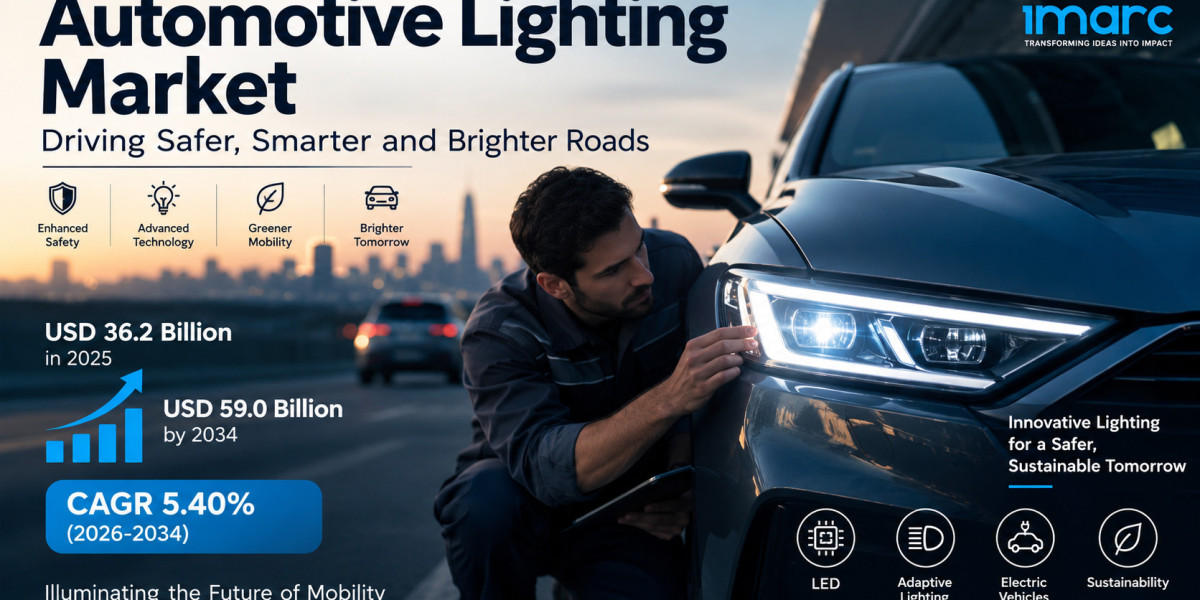
According to a research report by IMARC Group, the global automotive lighting market size reached USD 36.2 Billion in 2025. Looking forward, IMARC Group expects the market to reach USD 59.0 Billion by 2034, exhibiting a growth rate (CAGR) of 5.40% during 2026-2034. The increasing awareness among individuals regarding road safety measures, the rising utilization of new lighting technologies, the growing demand for electric vehicles (EVs), and the escalating environmental consciousness among individuals are some of the major factors positively influencing the market.
Market Size & Growth: The global automotive lighting market reached USD 36.2 Billion in 2025 and is projected to reach USD 59.0 Billion by 2034, registering a CAGR of 5.40% during 2026–2034, according to IMARC Group.
Regional Leadership: Asia Pacific represents the largest regional market, supported by expanding vehicle production, rising disposable incomes, rapid urbanization, growing middle-class populations, increasing vehicle ownership, and ongoing infrastructure development.
By Technology: The market is segmented into halogen, xenon/HID, and LED, with LED representing the largest segment.
By Vehicle Type: The market covers passenger vehicles and commercial vehicles, with passenger vehicles accounting for the largest share.
By Sales Channel: The market comprises original equipment manufacturers and aftermarket, with original equipment manufacturers holding the largest market share.
By Application: The market includes front lighting/headlamps, rear lighting, side lighting, and interior lighting, with front lighting/headlamps representing the largest segment.
Key Market Drivers: Increasing vehicle production and sales, rapid advancements in LED, laser, and OLED lighting technologies, growing awareness regarding road safety, and rising demand for energy-efficient lighting solutions.
Key Market Trends: Increasing adoption of adaptive lighting systems, growing utilization of LED technology, rising demand for advanced cabin lighting, and increasing integration of innovative lighting technologies into electric and modern vehicles.
Key Market Challenges: Navigating stringent regulatory requirements related to safety and efficiency and continuously innovating in response to evolving consumer preferences and technological advancements.
Key Market Opportunities: Growing demand for energy-efficient lighting solutions, integration of advanced LED and OLED technologies, and increasing potential for customization and personalization of automotive lighting designs.
Request for a Sample Report for Detailed Evaluation: https://www.imarcgroup.com/automotive-lighting-market/requestsample
What Is Driving Automotive Lighting Market Growth in 2026?
Expanding Automotive Industry
The increasing production and sales of passenger and commercial vehicles on account of inflating disposable incomes of consumers, increasing businesses, and rising preference for convenient modes of transportation represent some of the key factors positively influencing the automotive lighting market. The expanding automotive industry is creating sustained demand for lighting solutions required across new vehicles.
Emerging trends such as electric vehicles (EVs) and autonomous driving are further supporting this demand, as these vehicles require specialized lighting technologies for safety, efficiency, and aesthetics. According to IMARC, the global electric vehicle market size reached 25.6 Million Units in 2023 and is expected to reach 381.3 Million Units by 2032, exhibiting a CAGR of 34% during 2024-2032. As the automotive sector continues to expand, the parallel requirement for innovative lighting solutions is strengthening the overall market outlook.
Escalating Demand for Enhanced Cabin Amenities and Luxury Attributes
The increasing demand for premium vehicle features and enhanced cabin amenities is creating a positive outlook for automotive lighting manufacturers. Cabin lights are widely used for reading purposes as well as to provide an aesthetic appeal to vehicle interiors. As electric vehicle manufacturers and other automakers introduce new models with premium interiors, advanced interior lighting is becoming an increasingly important feature.
For instance, in September 2020, Lucid Motors launched Lucid Air, a luxury electric sedan offering a full-size luxury-class interior based on the company's exclusive space concept philosophy. Similarly, in April 2024, ams OSRAM joined forces with DOMINANT Opto Technologies to advance automotive ambient lighting. Such developments are supporting innovation in automotive interior lighting and catering to the growing preference for luxury attributes in vehicles.
Rapid Technological Advancements
Rapid technological advancements in the automotive sector are driving the adoption of advanced lighting systems. LED technology offers several benefits over traditional lighting technologies, including improved energy efficiency, longer lifespan, compact size, and greater design flexibility. These characteristics are encouraging automobile manufacturers to incorporate LED lighting into increasingly sophisticated vehicle designs.
Various leading market players are investing in research and development activities to introduce technologically advanced automotive lighting solutions. For instance, at the April 2021 Shanghai Auto Show, Valeo announced the development of a 360° lighting solution that surrounds a vehicle with a band of light and projects clear indications visible to nearby road users, including cyclists and scooter users.
Similarly, in June 2021, Hyundai Mobis developed its 'lighting grille' technology, which integrates an LED lighting function into the front grille of a vehicle. The technology can use the entire front grille as a lighting device and implement different scenarios, including autonomous driving mode, EV charging mode, welcome lighting, sound beat display, and emergency warning light display.
Rising Awareness Regarding Road Safety
The increasing awareness among individuals regarding road safety measures is strengthening demand for advanced automotive lighting systems. Front lighting and headlamps play a critical role in improving visibility during nighttime driving and adverse weather conditions, while innovative lighting technologies can enhance communication between vehicles and other road users.
The increasing focus of automobile manufacturers on improving vehicle safety is encouraging the development of advanced lighting systems with enhanced illumination, adaptive functionality, and improved visibility. This focus on road safety is consequently supporting continued innovation across the automotive lighting industry.
Growing Demand for Energy-Efficient Lighting Solutions
The rising demand for energy-efficient automotive components is also contributing to market growth. LEDs consume less energy than traditional lighting technologies while offering longer operating lifespans and design flexibility. The increasing emphasis on energy efficiency, together with growing environmental consciousness among individuals, is encouraging the adoption of advanced automotive lighting technologies.
The transition toward EVs is further creating opportunities for energy-efficient lighting solutions, as manufacturers seek to optimize vehicle systems and incorporate advanced technologies into next-generation automobiles.
Automotive Lighting Market Segmentation Analysis
By Technology
Halogen
Xenon/HID
LED
LED dominates the market by technology. LED lighting offers numerous advantages, including high energy efficiency, longer lifespan, compact size, and design flexibility. It provides superior illumination and improved visibility while supporting dynamic lighting features and innovative vehicle designs.
The increasing focus of the automotive industry on energy efficiency, advanced lighting technologies, safety, and aesthetics is supporting the widespread adoption of LED lighting. LED technology also enables manufacturers to develop customizable lighting effects and innovative designs that enhance the overall appearance of vehicles.
Various key market players are introducing advanced LED automotive lighting solutions. For instance, Volkswagen partnered with Hella to develop IQ.LIGHT LED headlamps, with the luxury-class Touareg SUV using IQ.LIGHT-LED Matrix Headlamps featuring 256 LEDs.
By Vehicle Type
Passenger Vehicle
Commercial Vehicle
Passenger vehicles account for the largest share of the market. Increasing sales of passenger vehicles, supported by rising spending capacities, elevating standards of living, and growing preferences for convenient modes of transportation, are contributing to segment growth.
The growing number of passenger vehicles worldwide is creating continued demand for innovative and advanced automotive lighting solutions. Consumers increasingly value safety, aesthetics, and enhanced driving experiences, encouraging the adoption of LED headlights, adaptive lighting systems, and dynamic lighting features.
By Sales Channel
Original Equipment Manufacturers
Aftermarket
Original equipment manufacturers represent the largest sales channel in the automotive lighting market. OEMs integrate lighting systems into new vehicles during the manufacturing process, and increasing vehicle production and sales are consequently supporting demand through this channel.
When selecting automotive lighting systems, OEMs prioritize factors such as quality, performance, design compatibility, and regulatory compliance. Collaborations and partnerships between vehicle manufacturers and automotive lighting companies are further supporting market growth by facilitating the integration of advanced lighting technologies into new vehicle models.
By Application
Front Lighting/Headlamps
Rear Lighting
Side Lighting
Interior Lighting
Front lighting/headlamps account for the largest share of the market. These systems are critical for ensuring driver visibility and road safety during nighttime driving and adverse weather conditions.
The increasing demand for advanced front lighting systems, including LED and adaptive lighting technologies, is being supported by their superior performance, energy efficiency, and design flexibility. As vehicle manufacturers continue to incorporate innovative lighting solutions to improve driver visibility, safety, and vehicle aesthetics, front lighting/headlamps remain an important area of market development.
By Region
North America
United States
Canada
Asia Pacific
China
Japan
India
South Korea
Australia
Indonesia
Others
Europe
Germany
France
United Kingdom
Italy
Spain
Russia
Others
Latin America
Brazil
Mexico
Others
Middle East and Africa
Asia Pacific holds the largest share of the global automotive lighting market. The region's dominance is primarily driven by expanding vehicle production, rising disposable incomes, increasing urbanization, and the growing middle-class population. Ongoing infrastructure development and increasing vehicle ownership rates are further supporting the automotive lighting market across the region.
According to OICA, automotive production in the region reached 50,020,793 units in 2022, increasing by 7% from 46,768,800 units produced in 2021. China was the largest producer in 2022, followed by Japan, India, and South Korea.
Furthermore, Indian passenger car sales remained strong during the first nine months of 2022, with new car registrations increasing by around 20.2% to reach 2.8 million units. Government initiatives such as "Aatma Nirbhar Bharat" and "Make in India" are also supporting the country's automotive industry.
North America and Europe represent other important regional markets, while Latin America and the Middle East and Africa offer additional opportunities supported by automotive industry development and increasing vehicle ownership.
Key Regional Insight: Asia Pacific's Strategic Position
Asia Pacific's leading position in the global automotive lighting market is anchored in expanding vehicle production, rising disposable incomes, rapid urbanization, and the growing middle-class population. Increasing vehicle ownership and infrastructure development are further supporting the demand for automotive lighting solutions.
The region's strong automotive manufacturing base, particularly across China, Japan, India, and South Korea, provides a substantial customer base for lighting manufacturers. The increasing adoption of advanced vehicle technologies, EVs, and premium vehicle features is also creating opportunities for innovative lighting solutions across the region.
Competitive Landscape in the Automotive Lighting Industry
Leading companies in the global automotive lighting market are investing heavily in research and development activities to introduce advanced lighting solutions offering improved performance, energy efficiency, safety, and aesthetics. Manufacturers are focusing on LED lighting systems, adaptive lighting technologies, and innovative lighting designs that enhance visibility while reducing energy consumption.
Companies are also actively collaborating with automobile manufacturers to integrate lighting systems into new vehicle models. Strong partnerships and supply chain relationships enable lighting manufacturers to secure contracts with major automakers and strengthen their positions within the automotive industry.
Furthermore, leading companies are expanding their global footprint by establishing production facilities and distribution networks across key markets. They are increasingly targeting emerging markets, particularly in Asia Pacific, to capitalize on the expanding automotive industry and rising demand for automotive lighting.
Marketing and branding activities also remain important competitive strategies. Leading companies participate in industry events, showcase products at trade shows, and conduct promotional campaigns to increase awareness of their lighting solutions and strengthen their brand presence.
Key Automotive Lighting Market Players Include:
Continental AG
HELLA GmbH & Co. KGaA (Faurecia SE)
Hyundai Mobis (Hyundai Motor Group)
Koito Manufacturing Co. Ltd.
Koninklijke Philips N.V.
LG Electronics Inc.
Lumax Industries Limited
Marelli Holdings Co. Ltd.
Osram Licht AG (ams AG)
Robert Bosch GmbH
Samsung Electronics Co. Ltd.
Stanley Electric Co. Ltd.
Valeo
and others
Note: The above represents a partial list of companies covered in the report. The complete list has been provided in the full report.
Recent Developments:
In April 2024, the European Bank for Reconstruction and Development (EBRD) lent €15 Million to Serbian automotive lighting producer Feka Automotive to support its expansion. The company intends to use the funds to improve overall efficiency and increase the availability of reliable lighting devices to customers around the world.
In March 2024, Marelli developed an innovative automotive lighting domain control unit platform in China. The platform is designed to manage a vehicle's front and rear lights while introducing new 360° lighting features.
In January 2024, US-based OLED lighting developer OLEDWorks announced Atala, a separate brand for automotive OLED lighting. The brand is designed to support a line of automotive-qualified OLED lighting products developed specifically for Tier 1 suppliers and original equipment manufacturers (OEMs).
Market Drivers, Challenges & Opportunities
Major Market Drivers:
Expanding Automotive Industry: Increasing production and sales of passenger and commercial vehicles are driving demand for automotive lighting systems.
Rapid Technological Advancements: Developments in LED, laser, OLED, adaptive lighting, and other advanced technologies are supporting market growth.
Growing Road Safety Awareness: Increasing awareness regarding road safety is encouraging the adoption of lighting technologies that improve visibility and driving safety.
Rising Demand for Energy Efficiency: Growing preference for energy-efficient solutions is supporting the adoption of LED and other advanced lighting technologies.
Increasing EV Adoption: The expanding electric vehicle industry is creating demand for specialized lighting systems that support safety, efficiency, functionality, and aesthetics.
Key Challenges:
Stringent Regulatory Requirements: Automotive lighting manufacturers need to comply with increasingly stringent safety and efficiency requirements across different markets.
Continuous Technology Innovation: Rapid technological advancements require companies to continuously invest in research and development to keep pace with evolving technologies and consumer preferences.
Emerging Opportunities:
Energy-Efficient Lighting Solutions: Rising demand for energy-efficient technologies is creating opportunities for manufacturers developing advanced LED and other efficient lighting systems.
Advanced LED and OLED Technologies: The integration of LED and OLED technologies is creating opportunities for innovative, flexible, and aesthetically differentiated lighting solutions.
Adaptive Lighting Systems: Increasing adoption of adaptive lighting technologies is opening new avenues for manufacturers focused on enhanced visibility and vehicle safety.
Customization and Personalization: Growing interest in customized lighting designs is creating opportunities to enhance vehicle aesthetics, interior experiences, and functionality.
Electric Vehicle Lighting: The continued expansion of EV adoption is creating opportunities for lighting manufacturers to develop solutions tailored to next-generation vehicles.
Automotive Lighting Market FAQs
1. What is the current size of the automotive lighting market?
The global automotive lighting market reached USD 36.2 Billion in 2025 and is expected to grow at a CAGR of 5.40% during 2026-2034, reaching USD 59.0 Billion by 2034.
2. What is driving the growth of the automotive lighting market?
The market is driven by increasing vehicle production and sales, growing awareness regarding road safety, rapid advancements in lighting technologies, rising demand for energy-efficient solutions, increasing adoption of EVs, and growing demand for advanced and premium vehicle features.
3. Which region dominates the automotive lighting market?
Asia Pacific leads the global automotive lighting market, supported by expanding vehicle production, rising disposable incomes, rapid urbanization, a growing middle-class population, increasing vehicle ownership, and ongoing infrastructure development.
4. Which segment holds the largest share in the automotive lighting market?
LED represents the largest segment by technology. Passenger vehicles account for the largest share by vehicle type, original equipment manufacturers lead by sales channel, and front lighting/headlamps represent the largest application segment.
5. What are the key trends in the automotive lighting market?
Key trends include the increasing adoption of LED technology, rapid development of adaptive lighting systems, growing demand for energy-efficient lighting, increasing utilization of OLED and other advanced technologies, rising demand for enhanced cabin amenities, and growing integration of innovative lighting solutions into EVs and modern vehicles.
Conclusion: Automotive Lighting Market Outlook to 2034
The global automotive lighting market is set for steady growth through 2034, underpinned by increasing vehicle production and sales, growing awareness regarding road safety, rapid technological advancements, rising demand for energy-efficient lighting solutions, and increasing adoption of electric vehicles. The continued development of LED, OLED, adaptive, and other advanced lighting technologies is further creating opportunities for market participants.
While stringent regulatory requirements and the need for continuous technological innovation remain important challenges, manufacturers are focusing on research and development, strategic collaborations, advanced product development, and global expansion to address evolving market requirements.
With Asia Pacific maintaining its position as the leading regional market and North America, Europe, Latin America, and the Middle East and Africa offering additional growth avenues, the outlook through 2034 remains positive. Companies investing in energy-efficient lighting technologies, adaptive systems, advanced LED and OLED solutions, and customized lighting designs are positioned to capture opportunities arising from the continued evolution of the automotive industry.
About the Author:
IMARC Group is a leading global market research company providing data-driven insights and expert consulting services to businesses seeking to achieve their strategic objectives. With a multi-disciplinary team of industry experts, IMARC delivers thorough, reliable market intelligence across sectors including Energy and Mining, Construction and Manufacturing, Automotive, Chemicals and Materials, and more.
Media & Sales Contact:
IMARC Group
United States: +1-201-971-6302
India: +91-120-433-0800
United Kingdom: +44-753-714-6104
Related Industry Insight:
- Explore: Automotive Lead-Acid Battery Manufacturing: Transforming the Battery Market
- Discover: Key developments shaping automotive battery manufacturing and the evolving battery market.
- Read the Full Industry Insight
For future articles, I can keep this short, professional, and relevant to the article, rather than making the promotion look like an advertisement.