
Market Overview
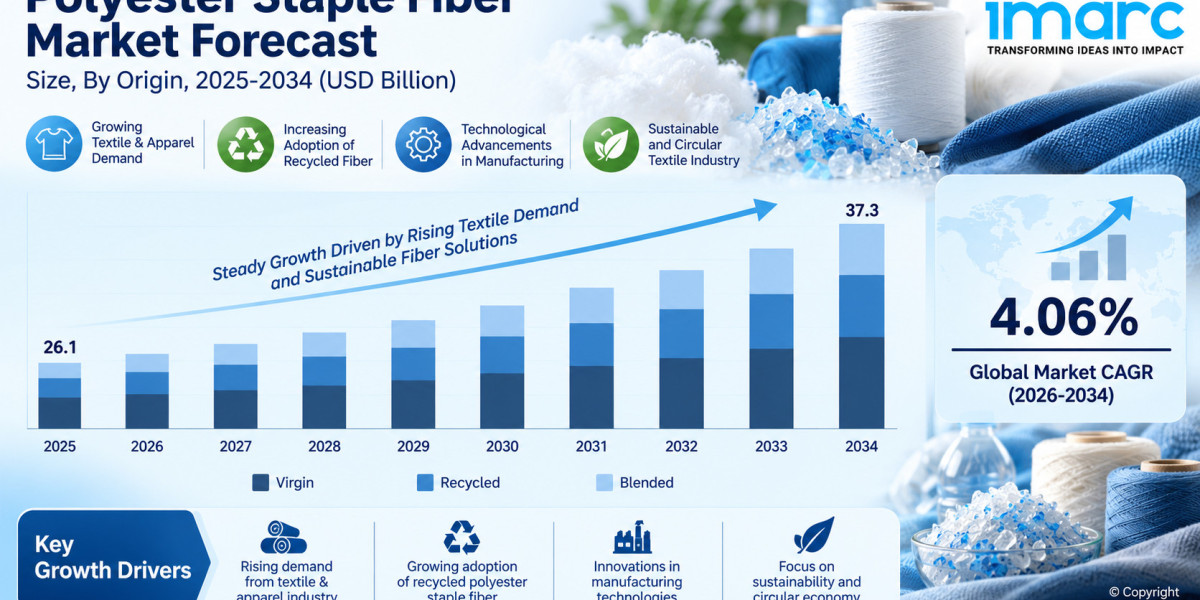
According to a research report by IMARC Group, the global polyester staple fiber market size was valued at USD 26.1 Billion in 2025. Looking forward, IMARC Group expects the market to reach USD 37.3 Billion by 2034, exhibiting a growth rate (CAGR) of 4.06% during 2026-2034. Asia-Pacific currently dominates the regional landscape, accounting for over 77.6% of the market share in 2025. Market growth is primarily driven by rising textile demand, particularly in fast fashion and activewear, expanding non-woven applications across automotive, construction, and hygiene products, increasing urbanization, and the cost and performance advantages of polyester staple fiber over natural fibers.
Market Drivers, Challenges & Opportunities
Major Market Drivers
Rising Textile and Apparel Demand: Increasing demand for affordable, durable, and versatile clothing is supporting the use of polyester staple fiber in fast fashion, activewear, uniforms, and blended fabrics.
Expanding Industrial Applications: Growing use in automotive textiles, construction materials, filtration, home furnishings, and non-woven products is broadening the market's application base.
Urbanization and Rising Disposable Incomes: Increasing urban populations and changing consumer spending patterns in emerging economies are supporting textile and apparel consumption.
Cost and Performance Advantages: Polyester staple fiber offers durability, affordability, and processing versatility, making it attractive across numerous applications.
Key Challenges
Sustainability Concerns: The environmental implications of synthetic fiber production and waste create pressure on manufacturers to improve material efficiency and recycling practices.
Recycling Costs and Technology Limitations: Cost pressures and limitations in recycling technology can constrain the adoption of recycled polyester staple fiber.
Dependence on Competitive Pricing: Manufacturers must balance product quality, production costs, and performance requirements in a competitive global market.
Emerging Opportunities
Recycled Polyester Production: Advancements in recycling processes and improved access to recycled feedstocks can create opportunities for more sustainable fiber products.
Technical and Non-Woven Applications: Growing demand from automotive, construction, filtration, and hygiene applications is creating opportunities beyond traditional apparel markets.
Advanced Fiber Engineering: Innovations in fiber blending, finishing, and manufacturing can improve product performance and expand the range of end uses.
Construction and Home Furnishing Demand: Urbanization, real estate development, and demand for durable interior products can support additional polyester staple fiber consumption.
Request for a Sample Report for Detailed Evaluation: https://www.imarcgroup.com/polyester-staple-fiber-market/requestsample
Polyester Staple Fiber Market Report: Key Highlights
Market Size & Growth: The global polyester staple fiber market share was valued at USD 26.1 Billion in 2025 and is projected to reach USD 37.3 Billion by 2034, registering a CAGR of 4.06% during 2026–2034, according to IMARC Group.
Regional Leadership: Asia-Pacific represents the largest regional market, holding over 77.6% of the market share in 2025, supported by extensive textile manufacturing, competitive production costs, and strong demand across apparel and industrial applications.
By Origin: The market is segmented into virgin, recycled, and blended polyester staple fibers, with virgin fiber accounting for the largest share at approximately 42.2% in 2025.
By Product: The market covers solid and hollow polyester staple fibers, with solid fiber holding the leading share of around 64.2% in 2025.
By Application: The market spans automotive, home furnishing, apparel, filtration, and other applications, with apparel accounting for approximately 45.8% of the market in 2025.
Key Market Drivers: Rising textile consumption, expanding fast-fashion and activewear industries, growing demand for non-woven materials, increasing urbanization, and the affordability and durability of polyester fibers.
Key Market Trends: Growing demand from the real estate and construction sectors, rising disposable incomes, increasing automotive applications, and advancements in recycled polyester production.
Key Market Challenges: Sustainability concerns associated with synthetic fibers, cost pressures affecting recycled polyester, and the need to improve recycling technologies and infrastructure.
Emerging Opportunities: Expansion of industrial applications, development of sustainable fiber production processes, innovations in fiber blending, and increasing demand for recycled polyester staple fiber.
What Is Driving Polyester Staple Fiber Market Growth in 2026?
Rising Demand from the Textile and Apparel Industry
The increasing utilization of polyester staple fiber across the textile and apparel industry represents one of the key factors positively influencing the market. Polyester staple fiber is widely used in clothing and textile products because of its affordability, durability, versatility, and ease of processing. The growing popularity of fast fashion and activewear is further supporting demand, as manufacturers seek cost-effective materials that can accommodate changing consumer preferences and high-volume production requirements.
The shift toward synthetic fibers is also supported by their performance advantages over natural fibers in several applications. Polyester offers properties such as wrinkle resistance, durability, and easy maintenance, making it suitable for casual wear, uniforms, home textiles, and blended fabrics. Rising population levels, urbanization, and increasing disposable incomes in emerging economies are further contributing to textile consumption and supporting the expansion of the polyester staple fiber market.
Expanding Non-Woven and Industrial Applications
The growing use of polyester staple fiber in non-woven and industrial applications is creating additional opportunities for market growth. Beyond apparel, PSF is used in automotive textiles, filtration materials, geotextiles, home furnishings, hygiene products, sound insulation, and construction-related applications. Its durability, affordability, and adaptability make it suitable for a wide range of manufacturing processes and end uses.
The expansion of construction, automotive manufacturing, and infrastructure development is increasing the need for reliable synthetic fibers in technical and non-woven products. Polyester staple fiber is also used in applications such as concrete reinforcement, insulation, upholstery, and filtration. As industrial requirements become more diverse, continued innovations in fiber engineering and blending techniques are helping manufacturers address specialized performance requirements.
Technological Advancements and Sustainable Fiber Production
Technological advancements in fiber manufacturing and recycling are influencing the development of the polyester staple fiber market. Manufacturers are exploring improved recycling processes and more efficient production technologies to respond to sustainability objectives and evolving environmental requirements. Recycled polyester staple fiber offers opportunities to utilize post-consumer and post-industrial materials, supporting resource efficiency and circular economy initiatives.
However, the economics of recycled fiber production remain challenging in some markets because of cost pressures and limitations in recycling technology. According to the information provided in the report material, global production of virgin synthetic fibers increased from 67 million to 75 million tonnes in 2023, with low-cost polyester accounting for 57% of total fiber production. Meanwhile, recycled polyester's share declined to 12.5%. These developments highlight the continued importance of production efficiency, technological innovation, and improved recycling infrastructure in shaping the industry's long-term outlook.
Real Estate Expansion Boosting Demand for Polyester Staple Fiber
Growth in the real estate and construction industries is positively influencing demand for polyester staple fiber. The material is used in construction-related applications to improve the durability and performance of products such as concrete, walls, tiles, blocks, tanks, and maintenance hole covers. It is also widely used in home furnishings, carpets, curtains, upholstery, and other interior textile products.
India recorded institutional real estate investments of USD 8.9 Billion across 78 deals in 2024, representing a 51% increase compared with 2023, according to JLL. The expansion of real estate investment and construction activity is creating additional demand for durable and cost-effective materials. As urbanization accelerates and investment in residential and commercial infrastructure expands, the use of polyester staple fiber in construction and furnishing applications is expected to provide further growth opportunities.
Rapid Automotive Industry Expansion
The automotive sector represents another important growth avenue for the polyester staple fiber market. PSF is used in automotive textiles and components, including roof liners, trunk liners, carpet backing, glove boxes, door panels, safety belts, and sound insulation materials. Its durability, versatility, and cost-effectiveness make it suitable for a variety of vehicle interior and technical applications.
Increasing vehicle production and the expansion of light commercial vehicle manufacturing are supporting demand for automotive materials. In India, demand for light commercial vehicles was projected in the supplied report material to reach 858.61 thousand units by 2025 and 970.05 thousand units by 2030. As automotive production expands, the demand for lightweight, durable, and cost-efficient materials such as polyester staple fiber is creating further opportunities for manufacturers.
Polyester Staple Fiber Market Segmentation Analysis
IMARC Group provides an analysis of the key trends in each segment of the global polyester staple fiber market, along with forecasts at the global, regional, and country levels from 2026–2034. The market is categorized based on origin, product, and application.
By Origin
Virgin
Recycled
Blended
Virgin polyester staple fiber leads the market by origin, accounting for approximately 42.2% of the market share in 2025. Its leading position is supported by its consistent quality, strength, and performance across textile and industrial applications. Virgin fiber offers uniformity and dyeability, making it suitable for apparel, home textiles, and technical fabrics that require dependable material characteristics.
Demand from the automotive, construction, and filtration industries is also supporting the consumption of virgin polyester staple fiber. Established production infrastructure and manufacturing efficiencies in major producing regions further reinforce its market position. Although sustainability initiatives are encouraging the adoption of recycled polyester, virgin fiber continues to play an important role in applications requiring consistent material properties and mechanical performance.
Recycled polyester staple fiber is gaining attention as manufacturers explore ways to reduce waste and improve material efficiency. Blended polyester staple fiber also serves applications that require a combination of properties from different fiber types.
By Product
Solid
Hollow
Solid polyester staple fiber dominates the market, accounting for around 64.2% of the market share in 2025. Its versatility and widespread application across textiles, apparel, home furnishings, and industrial products support its leading position. Solid fiber offers strength, durability, and processing consistency, making it suitable for high-volume manufacturing.
Its use in automotive upholstery, filtration materials, and other technical applications is further contributing to demand. The growth of fast fashion and technical textiles is also supporting consumption, while its compatibility with blended fabrics, including polyester-cotton and polyester-wool combinations, enhances its appeal to manufacturers.
Hollow polyester staple fiber serves applications in which its structure is advantageous, including selected filling and insulation products. Continued advancements in fiber engineering are helping manufacturers tailor polyester fibers to different performance and end-use requirements.
By Application
Automotive
Home Furnishing
Apparel
Filtration
Others
Apparel represents the largest application segment, accounting for approximately 45.8% of the market share in 2025. The segment benefits from the widespread use of polyester staple fiber in affordable, durable, and versatile clothing. The fast-fashion industry relies on polyester because of its cost efficiency, processing versatility, and suitability for high-volume production.
Its wrinkle-resistant, easy-care, and moisture-management properties make polyester suitable for activewear, casual clothing, uniforms, and blended fabrics. Growing apparel consumption in emerging economies, supported by urbanization and increasing disposable incomes, is further contributing to demand. Innovations in fiber technology and finishing techniques are also expanding the range of applications in apparel and other textile products.
The automotive segment is supported by the use of polyester staple fiber in vehicle interiors and sound insulation. Home furnishing applications include carpets, curtains, upholstery, and related textile products, while filtration applications benefit from the material's versatility and suitability for industrial uses.
Polyester Staple Fiber Market Regional Analysis
North America
United States
Canada
Asia-Pacific
China
Japan
India
South Korea
Australia
Indonesia
Others
Europe
Germany
France
United Kingdom
Italy
Spain
Russia
Others
Latin America
Brazil
Mexico
Others
Middle East and Africa
Asia-Pacific holds the largest share of the global polyester staple fiber market, accounting for over 77.6% in 2025. The region's leadership is supported by extensive textile manufacturing, competitive production costs, strong domestic demand, and established supply chains. Countries such as China and India play important roles in textile production and consumption, while expanding apparel manufacturing and export-oriented garment industries support demand for polyester staple fiber.
Rapid urbanization, rising disposable incomes, and the popularity of fast fashion are further strengthening regional consumption. The expansion of automotive, construction, and other industrial sectors is also supporting demand beyond traditional textile applications. Investments in manufacturing capacity and recycling infrastructure are contributing to the region's continued importance in global polyester staple fiber production and consumption.
North America represents another important market, supported by demand from construction, filtration, automotive, and home furnishing applications. Europe is witnessing increasing interest in recycled polyester and circular economy practices, while Latin America is benefiting from developments in PET recycling. The Middle East and Africa are seeing additional opportunities associated with construction activity and demand for durable furnishing materials.
Key Regional Insight: Asia-Pacific's Strategic Position
Asia-Pacific's dominant position in the global polyester staple fiber market is anchored in its large textile manufacturing base, competitive production environment, and substantial domestic and export demand. The region benefits from established supply chains, manufacturing expertise, and the availability of production infrastructure serving apparel and industrial applications.
Growing urbanization and rising disposable incomes are supporting textile consumption, while the expansion of automotive and construction industries is creating additional demand for non-textile uses. Continued capacity expansion and developments in fiber manufacturing and recycling technologies are also shaping the region's competitive position.
United States Polyester Staple Fiber Market Analysis
The United States represents a key regional market, supported by demand from construction, filtration, automotive, and home furnishing applications. Polyester staple fiber is used in insulation, geotextiles, automotive interiors, and other industrial products. The growing focus on recycled materials and circular economy initiatives is also encouraging interest in recycled PSF.
The supplied report material notes that the United States implemented a Section 201 safeguard concerning fine-denier polyester staple fiber, with a zero-import quota beginning on November 23, 2024, followed by annual increments of one million pounds for four years. Imports from Canada, Mexico, and certain free trade agreement and Generalized System of Preferences countries are exempted. This measure was intended to protect domestic producers while accounting for the needs of downstream industries.
Asia-Pacific Polyester Staple Fiber Market Analysis
Asia-Pacific benefits from the expansion of textile manufacturing units, competitive labor and production costs, and rising domestic and export demand. India, China, and other manufacturing economies have substantial textile industries that use polyester staple fiber in apparel, non-woven products, and industrial fabrics.
The supplied report material indicates that more than 100,000 textile manufacturing units operate in India. The continued development of textile production clusters and modernization of processing technologies are supporting the use of synthetic fibers. Polyester staple fiber's affordability, performance, and adaptability across multiple end uses further contribute to its adoption in the region.
Europe Polyester Staple Fiber Market Analysis
Europe's polyester staple fiber market is increasingly influenced by recycling and circular economy initiatives. The supplied material reports that recycled materials accounted for 11.8% of materials used in the European Union in 2023. As businesses focus on resource efficiency and the management of textile and plastic waste, recycled polyester staple fiber is gaining attention across fashion, automotive, and home furnishing applications.
Manufacturers are increasingly exploring recycled feedstocks and more sustainable sourcing practices. The availability of recycling infrastructure and the ability to maintain fiber quality are important considerations in this transition. These developments are creating opportunities for suppliers that can offer reliable recycled polyester products.
Latin America Polyester Staple Fiber Market Analysis
Latin America is benefiting from the increasing availability and use of recycled polyethylene terephthalate (PET) bottle flakes. According to the supplied material, Brazil's PET packaging recycling rate reached 56.4% in 2021, an increase of 15.4% compared with 2019.
The expanding supply of recycled PET materials creates opportunities for manufacturers producing recycled polyester staple fiber. The use of recycled feedstocks can support material efficiency and provide an alternative source of raw materials for fiber production. Continued development of recycling initiatives is therefore an important factor shaping the regional market outlook.
Middle East and Africa Polyester Staple Fiber Market Analysis
The Middle East and Africa are witnessing opportunities associated with construction and real estate development. The supplied material highlights Saudi Arabia's construction sector, with more than 5,200 projects valued at USD 819 Billion. Construction activity can support demand for polyester-based materials used in carpets, upholstery, wall fabrics, and other furnishing applications.
The affordability and durability of polyester staple fiber make it suitable for a variety of interior and construction-related products. As residential and commercial development expands, demand for furnishing and related textile materials can provide additional opportunities for regional suppliers.
Competitive Landscape in the Polyester Staple Fiber Industry
The competitive landscape of the global polyester staple fiber market is characterized by competition among established fiber manufacturers and synthetic textile material suppliers. Market participants are focusing on capacity expansion, technological advancements, product quality, cost optimization, and sustainability initiatives to strengthen their market positions.
Research and development activities are helping manufacturers improve fiber properties and develop products for specialized applications. Some companies are also expanding their production facilities to meet growing demand, particularly in emerging economies. Strategic collaborations and broader product portfolios can help suppliers reach new markets and address changing customer requirements.
Sustainability is becoming an important consideration, with manufacturers exploring recycled polyester and improved production processes. At the same time, cost efficiency and reliable supply chains remain important in this price-sensitive market.
Key Polyester Staple Fiber Market Players Include:
Alpek Polyester
Bombay Dyeing
Diyou Fibre (M) Sdn Bhd.
Huvis Corp.
Indorama Corporation
Reliance Industries Limited
Thai Polyester Co., Ltd.
Toray Industries, Inc.
Vnpolyfiber
William Barnet and Son, LLC
Xin Da Spinning Technology Sdn. Bhd.
Recent Developments in the Polyester Staple Fiber Industry
April 2025: Ganesha Ecosphere invested INR 2 crore in its associate company, Ganesha Recycling Chain (GRCPL), through a rights issue. The investment was aimed at strengthening the supply chain for PET waste, including materials used in staple fiber production.
March 2025: Toray Industries, Inc. adopted a mass balance approach for manufacturing its TORAYLON™ acrylic staple fiber. The method combines characteristics associated with biomass and plastic waste and received ISCC PLUS certification.
February 2025: Barmag announced plans to introduce sustainable and efficient solutions for Vietnam's textile industry, including the Oerlikon Neumag EvoSteam staple fiber process, which was described as bluesign® verified. The company highlighted solutions across its Oerlikon Neumag, Oerlikon Barmag, and Oerlikon Nonwoven brands.
January 2025: SHEIN developed a polyester recycling process in collaboration with Donghua University, with the aim of improving sustainability in fashion. Testing reportedly indicated that the recycled polyester used to create staple fibers could be repeatedly recycled without a decline in material quality, with large-scale production scheduled to begin in June 2025.
January 2025: Ambercycle and Benma announced a strategic partnership to advance polyester fiber circularity and the production of Cycora staple fibers.
Polyester Staple Fiber Market FAQs
1. What is the current size of the polyester staple fiber market?
The global polyester staple fiber market was valued at USD 26.1 Billion in 2025 and is expected to reach USD 37.3 Billion by 2034, growing at a CAGR of 4.06% during 2026–2034.
2. What is driving the growth of the polyester staple fiber market?
The market is driven by rising textile and apparel demand, expansion of fast fashion and activewear, growing use in automotive and construction applications, increasing urbanization, and the affordability and durability of polyester staple fiber. Advances in recycling and fiber manufacturing technologies are also influencing market development.
3. Which region dominates the polyester staple fiber market?
Asia-Pacific dominates the global polyester staple fiber market, accounting for over 77.6% of the market share in 2025. Its leadership is supported by extensive textile manufacturing, competitive production costs, and strong demand across apparel and industrial applications.
4. Which segment holds the largest share in the polyester staple fiber market?
By origin, virgin polyester staple fiber leads with approximately 42.2% of the market in 2025. Solid polyester staple fiber leads by product type with around 64.2%, while apparel represents the largest application segment with approximately 45.8% of the market.
5. What are the key trends in the polyester staple fiber market?
Key trends include rising demand for synthetic fibers in fast fashion and activewear, expanding industrial and non-woven applications, increasing use in automotive and construction products, and growing interest in recycled polyester. Innovations in fiber engineering and recycling processes are also shaping the market's future.
Conclusion: Polyester Staple Fiber Market Outlook to 2034
The global polyester staple fiber market is poised for steady growth through 2034, supported by rising textile consumption, expanding fast-fashion and activewear industries, and increasing applications across automotive, construction, filtration, and home furnishing sectors. The material's affordability, durability, and versatility continue to support its use across both traditional textile markets and specialized industrial applications.
While sustainability concerns and limitations in recycling technology present ongoing challenges, developments in fiber engineering, recycled feedstocks, and production processes are creating new opportunities. With Asia-Pacific maintaining its position as the leading regional market and other regions contributing through textile manufacturing, industrial demand, and recycling initiatives, the outlook through 2034 remains positive. Companies investing in manufacturing efficiency, advanced fiber technologies, and sustainable production solutions will be well positioned to respond to evolving market requirements.
About the Author:
IMARC Group is a leading global market research company providing data-driven insights and expert consulting services to businesses seeking to achieve their strategic objectives. With a multi-disciplinary team of industry experts, IMARC delivers thorough, reliable market intelligence across sectors including Energy and Mining, Construction and Manufacturing, Automotive, Chemicals and Materials, and more.
Media & Sales Contact:
IMARC Group
United States: +1-201-971-6302
India: +91-120-433-0800
United Kingdom: +44-753-714-6104