
Market Overview
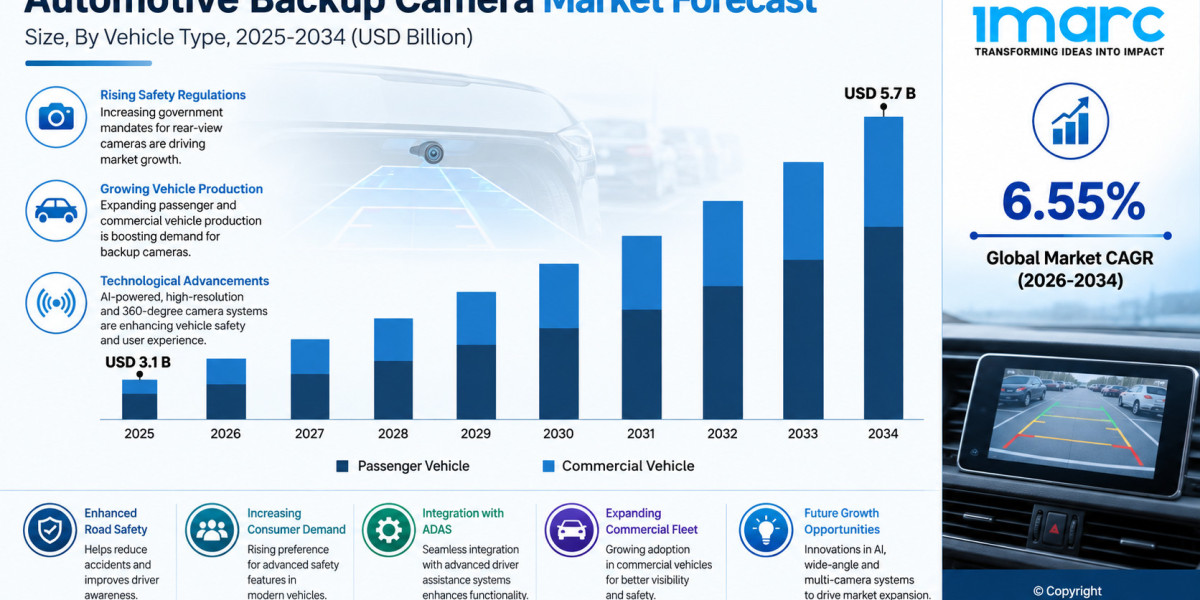
The global automotive backup camera market size was valued at USD 3.1 Billion in 2025. Looking forward, IMARC Group estimates the market to reach USD 5.7 Billion by 2034, exhibiting a growth rate (CAGR) of 6.55% during 2026-2034. North America currently dominates the market, holding a significant market share of 36.7% in 2025. The market is primarily driven by stringent safety regulations, including mandatory backup cameras in new vehicles, robust demand for advanced safety features, growing vehicle production, increasing adoption of advanced driver-assistance systems (ADAS), and rising consumer awareness regarding vehicle safety.
Automotive Backup Camera Market Key At a Glance
Base Year: 2025
Historical Period: 2020–2025
Forecast Period: 2026–2034
Market Size (2025): USD 3.1 Billion
Market Forecast (2034): USD 5.7 Billion
CAGR (2026–2034): 6.55%
Leading Region: North America
North America Market Share (2025): 36.7%
Request for a Sample Report for Detailed Evaluation: https://www.imarcgroup.com/automotive-backup-camera-market/requestsample
Automotive Backup Camera Market Report: Key Highlights
Market Size & Growth: The global automotive backup camera market was valued at USD 3.1 Billion in 2025 and is projected to reach USD 5.7 Billion by 2034, expanding at a CAGR of 6.55% during 2026–2034.
Regional Leadership: North America represents the leading regional market, accounting for 36.7% of the global market in 2025, supported by stringent safety regulations, a strong automotive industry, and widespread adoption of advanced safety technologies.
Major Market Drivers: Increasing vehicle production, mandatory installation of backup cameras in new vehicles, rising preference for ADAS, growing demand for advanced safety features, and increasing consumer awareness are supporting market expansion.
Key Market Trends: Rising vehicle sales, growing applications in commercial vehicles, increasing integration with ADAS, and growing demand for enhanced safety and visibility are shaping the market.
Vehicle Type: Passenger vehicles dominate the market, accounting for 76.3% of the market share in 2025.
Position: Surface-mounted backup cameras lead the market, holding a 48.7% market share in 2025.
Sales Channel: Original Equipment Manufacturers (OEMs) dominate the market, accounting for 78.2% of the market share in 2025.
Key Challenges: The market faces challenges associated with installation requirements, technology costs, and the need to maintain reliable camera performance across varying driving and weather conditions.
Emerging Opportunities: Expanding vehicle production, increasing EV and autonomous vehicle adoption, growing commercial vehicle applications, and integration with advanced safety systems are creating new opportunities for market participants.
What Is Driving Automotive Backup Camera Market Growth in 2026?
Increasing Adoption by Automakers
The increasing integration of backup cameras by automakers represents one of the major factors driving market growth. Many manufacturers are now offering backup cameras as standard features in new vehicle models in response to growing customer preferences for enhanced safety and convenience.
Government regulations requiring backup cameras in new vehicles are further accelerating their integration into production models. As automotive manufacturers increasingly focus on improving vehicle safety, backup cameras have become an important component of modern vehicle safety systems.
The widespread adoption of backup cameras is also improving economies of scale, helping reduce the cost per unit and making these systems increasingly accessible across mass-market vehicles. Furthermore, the integration of backup cameras enhances vehicle appeal and competitiveness by providing drivers with improved visibility while parking and reversing.
Growing Vehicle Production in the United States
The growth in vehicle production is driving demand for automotive backup cameras in the United States. As automakers increase production volumes, backup cameras are being integrated into a larger number of vehicle models, supporting overall market adoption.
The strong US automotive industry and increasing sales of passenger vehicles, particularly SUVs and sedans, are contributing to the expansion of the market. Many newly manufactured vehicles now include backup cameras as standard safety features.
Government regulations mandating backup cameras in new vehicles have further accelerated their integration into production models. At the same time, the increasing adoption of electric and autonomous vehicles is creating additional demand for advanced visual assistance systems.
For instance, in January 2025, Tesla introduced a new Model Y in the US. The long-range all-wheel-drive variant included supervised full self-driving software as a standard feature and featured redesigned exterior and interior elements along with a slightly extended range of 320 miles (515 km).
Rising Preference for Advanced Safety Technologies
The growing preference for advanced driver-assistance systems (ADAS) is another important factor supporting market growth. Backup cameras play an important role in improving rear visibility and supporting safer parking and reversing operations.
Consumers are increasingly prioritizing vehicle safety features, encouraging automakers to integrate backup cameras into ADAS packages and make them standard equipment across a wider range of models. The growing development of autonomous driving technologies is also increasing the importance of visual assistance systems.
Furthermore, governments are introducing regulations aimed at improving vehicle safety, while insurance companies may offer incentives for vehicles equipped with advanced safety technologies. These factors are contributing to the wider adoption of backup camera systems.
Automotive Backup Camera Market Trends
Increasing Vehicle Sales
The increasing sales of vehicles worldwide are supporting demand for automotive backup cameras. As more passenger and commercial vehicles enter the market, manufacturers are incorporating advanced safety technologies to meet consumer expectations and regulatory requirements.
Backup camera applications are also expanding across commercial vehicles such as tow trucks and trailers. These vehicles cover larger areas and often require additional assistance while parking and reversing.
In 2023, commercial vehicle sales in the United States totaled USD 35.5 Billion, with France, Italy, and Germany following in the rankings. Growing vehicle sales, increasing awareness of road safety, and government regulations mandating backup cameras are collectively contributing to market expansion.
Rising Preference for Advanced Driver-Assistance Systems (ADAS)
The growing adoption of ADAS is strengthening demand for backup camera systems. Backup cameras provide drivers with enhanced rear visibility and can help reduce blind spots during reversing and parking.
By fiscal 2028, utility vehicles are projected to account for around 55–60% of total passenger vehicle sales with ADAS features. The increasing integration of advanced safety technologies into vehicles is encouraging manufacturers to develop innovative camera systems capable of supporting broader safety applications.
In addition, the growth of autonomous driving technologies is increasing demand for high-quality visual systems. Backup cameras can form part of increasingly sophisticated vehicle safety architectures, supporting the broader transition toward smarter and safer vehicles.
Growing Demand for Safety Features
Growing consumer awareness of road safety is driving demand for automotive backup cameras. These systems provide enhanced rear visibility and help drivers identify obstacles and reduce blind spots while reversing.
The trend is particularly relevant in urban areas where parking spaces are often limited and congested. Automakers are responding by incorporating backup cameras into a wider range of vehicle models.
For instance, in September 2024, Hyundai launched the Alcazar facelift with upgraded features including dual-zone climate control and a digital key. The vehicle retained its 1.5L turbo-petrol and diesel engine options and incorporated advanced technologies such as a 360-degree camera and ADAS across four variants.
The growing availability of advanced safety features, combined with increasing customer expectations, is encouraging manufacturers to equip new vehicles with backup cameras and related visual assistance technologies.
Automotive Backup Camera Market Segmentation Analysis
IMARC Group provides an analysis of the key trends in each segment of the global automotive backup camera market, along with forecasts at the global, regional, and country levels from 2026-2034. The market has been categorized based on vehicle type, position, and sales channel.
By Vehicle Type
Passenger Vehicle
Commercial Vehicle
Passenger vehicles represent the largest segment, accounting for 76.3% of the market share in 2025.
The passenger vehicle segment is driven by the widespread adoption of backup cameras across cars and SUVs. Consumers are increasingly prioritizing safety technologies, while governments in several countries are mandating backup cameras in new passenger vehicles.
Automakers are responding by integrating backup cameras as standard equipment across a growing number of models. Increasing urbanization and limited parking availability are further supporting demand for technologies that improve rear visibility.
Moreover, higher passenger vehicle production volumes compared with commercial vehicles and rising disposable incomes in emerging markets are supporting the continued expansion of this segment.
By Position
Surface Mounted
Flush Mounted
License Mounted
Surface-mounted backup cameras lead the market, accounting for 48.7% of the market share in 2025.
Surface-mounted systems are gaining widespread adoption due to their cost-effective nature and relatively straightforward installation. These cameras are generally positioned on the rear surface of a vehicle, often above the license plate, and provide a wide-angle view to reduce blind spots while reversing.
Their ease of installation allows them to be incorporated into both new and existing vehicles. This makes surface-mounted systems particularly attractive for aftermarket applications and older vehicle fleets.
Surface-mounted cameras are also compatible with other safety technologies such as parking sensors and automatic emergency braking systems. Their affordability, versatility, and retrofit potential are supporting continued demand across different vehicle categories.
By Sales Channel
Original Equipment Manufacturers (OEMs)
Aftermarket
Original Equipment Manufacturers (OEMs) dominate the market, accounting for 78.2% of the market share in 2025.
OEMs benefit from the increasing integration of backup cameras into newly manufactured vehicles as standard safety features. Government regulations mandating backup cameras in new vehicles are further strengthening the position of OEMs.
Their large-scale production capabilities and established relationships with automakers allow OEMs to efficiently meet growing demand. These companies collaborate closely with vehicle manufacturers to design and integrate camera systems tailored to specific vehicle models.
OEM systems also benefit from economies of scale and are generally designed to comply with applicable safety requirements. The ability to integrate backup cameras seamlessly into vehicle displays and overall vehicle design provides OEM solutions with an additional advantage.
Automotive Backup Camera Market Regional Analysis
North America
United States
Canada
Asia Pacific
China
Japan
India
South Korea
Australia
Indonesia
Others
Europe
Germany
France
United Kingdom
Italy
Spain
Russia
Others
Latin America
Brazil
Mexico
Others
Middle East and Africa
North America
North America accounted for the largest market share of 36.7% in 2025, supported by stringent safety regulations, strong automotive manufacturing capabilities, widespread adoption of advanced safety technologies, and increasing consumer awareness.
In December 2024, Canada amended its Motor Vehicle Safety Regulations concerning school buses, introducing requirements for better driver visibility systems and image recording systems to monitor passing vehicles. Compliance is allowed by November 2027.
The region's strong presence of major automakers and increasing vehicle sales are further supporting market growth. The rising adoption of electric vehicles equipped with advanced safety systems is also contributing to demand for backup cameras.
Asia Pacific
The Asia Pacific market is driven by the rapid expansion of the automotive industry and increasing investment in automotive production. China, Japan, and India represent important markets, with growing demand for vehicles equipped with enhanced safety technologies.
Investment in manufacturing facilities and research is supporting the development of cost-effective and durable backup camera systems. Growing consumer awareness and increasing demand for parking and reversing assistance are further encouraging adoption.
Europe
The European market is supported by increasing vehicle ownership, growing vehicle sales, and rising demand for advanced safety technologies. The registration of approximately 10.6 million new cars across the 27 EU Member States in 2023, representing a 14% increase compared with 2022, reflects the region's expanding vehicle market.
As consumers increasingly prioritize safety, convenience, and enhanced visibility, automakers are incorporating backup cameras into a broader range of vehicles. Compact camera designs are also facilitating seamless integration into different vehicle models.
Latin America
The Latin American market is benefiting from increasing disposable income and rising demand for passenger vehicles equipped with advanced safety technologies.
Total disposable income in Latin America is projected to increase by nearly 60% in real terms from 2021 to 2040. Higher spending power is encouraging consumers to prioritize convenience and safety when purchasing vehicles.
Backup cameras provide enhanced rear visibility and parking assistance, making them increasingly attractive to consumers seeking value-added safety features. Automotive manufacturers are responding by incorporating these systems into a wider range of models.
Middle East and Africa
The Middle East and Africa market is supported by expanding logistics services and rising demand for commercial vehicles equipped with advanced safety features.
The logistics sector accounts for approximately 6% of Saudi Arabia's GDP and is expected to contribute 10% by 2030, equivalent to approximately USD 5.36 Billion. The increasing use of tow trucks, trailers, and other large commercial vehicles is creating greater demand for systems that improve rear visibility.
Backup cameras can help reduce blind spots and improve maneuverability in congested and confined environments, supporting safer parking and reversing operations.
Key Regional Insight: North America's Market Leadership
North America's leading position in the automotive backup camera market is primarily supported by stringent safety regulations and widespread adoption of advanced vehicle safety technologies.
The United States accounts for 95.80% of the North American market, reflecting the country's strong automotive manufacturing base and high adoption of advanced safety systems.
Since the start of 2021, auto manufacturers have announced investments of more than USD 75 Billion in the United States. Increasing investment in automobile production and advancements in manufacturing techniques are supporting the integration of backup cameras across vehicle categories.
Improved camera resolution, wider fields of view, and seamless integration with vehicle displays are further enhancing the value of these systems. The combination of regulatory requirements, consumer safety awareness, vehicle production, and technological advancements is expected to sustain North America's market leadership.
Competitive Landscape in the Automotive Backup Camera Industry
Major companies in the automotive backup camera industry are focusing on technological advancements and product innovation to strengthen their market positions. Manufacturers are developing advanced backup camera systems featuring capabilities such as object detection and night vision.
Leading suppliers are investing in research and development (R&D) to improve image quality, visibility, reliability, and system integration. They are also working closely with automakers to develop customized solutions designed for specific vehicle models and safety architectures.
Strategic collaborations between technology suppliers and vehicle manufacturers are facilitating the broader adoption of advanced vision systems. Companies are also expanding their product portfolios to include aftermarket backup camera systems, allowing owners of older vehicles to upgrade their safety capabilities.
For instance, in January 2024, Valeo partnered with Teledyne FLIR LLC to launch thermal imaging camera technology for the automotive industry. The collaboration aims to enhance road safety through advanced vision systems capable of improving the detection of obstacles and risks in low-visibility conditions.
Key Automotive Backup Camera Market Players Include
Continental AG
EchoMaster
Gentex Corporation
HELLA GmbH & Co. KGaA
Magna International Inc.
OmniVision Technologies
Rear View Safety, Inc.
Robert Bosch GmbH
Stonkam Co. Ltd.
Valeo Service
ZF Friedrichshafen AG
Latest News and Developments
In April 2024, Peterbilt introduced its Digital Vision System-Mirrors (DVS-M), a rear-view camera system for Model 579 and Model 567 trucks. The system incorporates three HDR cameras with hydrophobic lenses to provide clear visibility in challenging conditions. It includes joystick-controlled cameras and two HD monitors, along with features such as night vision, trailer tracking, and enhanced weather visibility.
In March 2024, Phillips Industries announced plans to release its Rear-Vu trailer back-up camera for Class 8 trucks and trailers. The system provides a 170-degree rear view with real-time visibility and 0.25-second latency. Installation takes approximately 10 minutes and enables drivers to view the rear bumper, doors, and an area extending up to 20 feet behind the trailer.
Market Drivers, Challenges & Opportunities
Major Market Drivers
Stringent Safety Regulations: Government mandates requiring backup cameras in new vehicles are accelerating their integration across the automotive industry.
Growing Vehicle Production: Increasing vehicle manufacturing and sales are expanding the installed base of vehicles requiring advanced safety systems.
Rising ADAS Adoption: The growing integration of advanced driver-assistance systems is increasing demand for visual technologies such as backup cameras.
Growing Consumer Safety Awareness: Consumers increasingly prefer vehicles equipped with technologies that improve visibility and reduce blind spots.
Vehicle Electrification and Autonomous Driving: The expansion of electric and autonomous vehicles is creating additional opportunities for advanced camera and vision systems.
Key Challenges
Technology and Installation Costs: Advanced camera systems can involve additional technology and integration costs, particularly when combined with other vehicle safety systems.
Performance Requirements: Backup cameras must maintain reliable visibility and image quality across varying environmental and driving conditions.
Integration Complexity: Increasing integration with broader ADAS and vehicle electronics architectures can create additional design and engineering requirements.
Emerging Opportunities
Commercial Vehicle Applications: Increasing use of backup cameras in tow trucks, trailers, and other large commercial vehicles represents an important growth opportunity.
Advanced Vision Systems: Development of object detection, night vision, thermal imaging, and other advanced capabilities can expand the functionality of backup cameras.
Electric and Autonomous Vehicles: The growing adoption of EVs and autonomous vehicles is creating additional demand for sophisticated visual assistance technologies.
Aftermarket Adoption: Retrofit solutions provide opportunities to equip older vehicles with modern rear-visibility and safety technologies.
Automotive Backup Camera Market FAQs
1. What is the current size of the automotive backup camera market?
The global automotive backup camera market was valued at USD 3.1 Billion in 2025 and is expected to reach USD 5.7 Billion by 2034, expanding at a CAGR of 6.55% during 2026–2034.
2. What is driving the growth of the automotive backup camera market?
The market is driven by stringent safety regulations, increasing vehicle production, growing consumer demand for advanced safety features, rising ADAS adoption, increasing vehicle sales, and the expansion of electric and autonomous vehicles.
3. Which region dominates the automotive backup camera market?
North America dominates the global automotive backup camera market, accounting for 36.7% of the market share in 2025. The region benefits from stringent safety regulations, a strong automotive industry, and widespread adoption of advanced vehicle safety technologies.
4. Which vehicle type holds the largest market share?
Passenger vehicles represent the largest vehicle type segment, accounting for 76.3% of the market share in 2025.
5. Which backup camera position leads the market?
Surface-mounted backup cameras lead the market, accounting for 48.7% of the market share in 2025, supported by their cost-effectiveness, easy installation, broad compatibility, and suitability for both OEM and aftermarket applications.
About the Author
IMARC Group is a leading global market research company providing data-driven insights and strategic consulting services across diverse industries. The company delivers comprehensive research reports covering automotive, technology, healthcare, chemicals, packaging, food & beverages, consumer goods, and industrial sectors, helping organizations make informed business decisions and identify emerging growth opportunities.
Media & Sales Contact
IMARC Group
United States: +1-201-971-6302
India: +91-120-433-0800
United Kingdom: +44-753-714-6104