
Market Overview
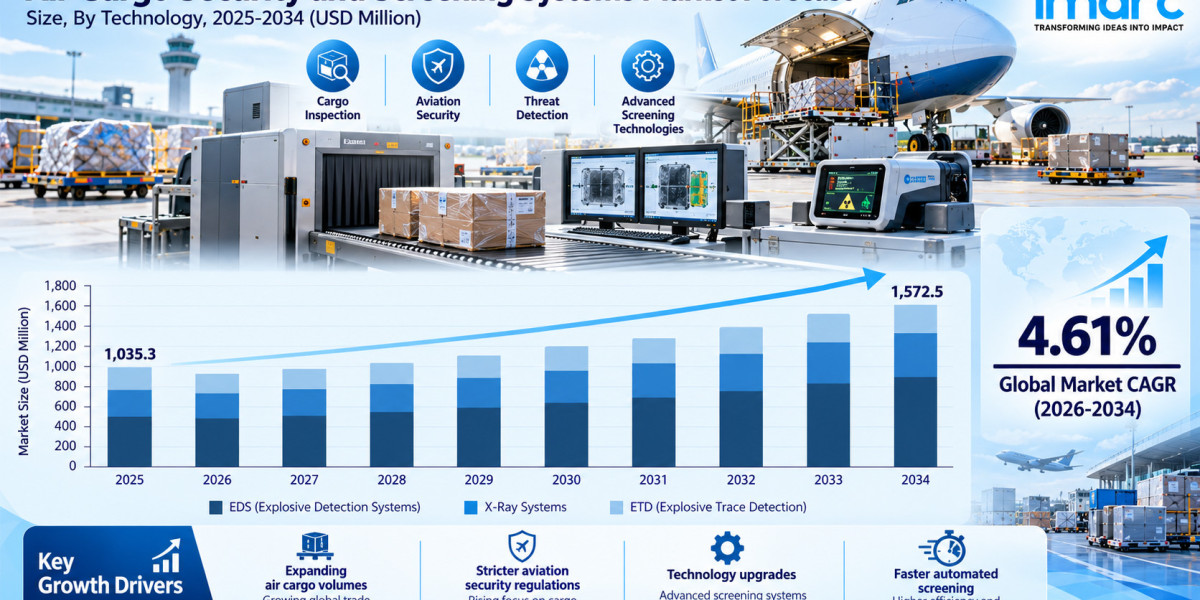
The global air cargo security and screening systems market size is experiencing steady growth as international trade expands and aviation authorities increasingly prioritize cargo safety, supply chain integrity, and regulatory compliance. The market reached USD 1,035.3 Million in 2025 and is projected to reach USD 1,572.5 Million by 2034, expanding at a CAGR of 4.61% during 2026–2034. Asia Pacific dominated the market in 2025, accounting for 35.0% of the global market share.
The industry is being influenced by rising air freight volumes, increasing security threats, stricter aviation regulations, technological advancements, and growing demand for efficient cargo inspection. Advanced X-ray systems, explosive detection systems (EDS), explosive trace detection (ETD), automated screening technologies, and artificial intelligence are helping airports and cargo operators improve threat detection while maintaining operational efficiency.
Air Cargo Security and Screening Systems Market Snapshot
Base Year: 2025
Historical Period: 2020–2025
Forecast Period: 2026–2034
Market Size (2025): USD 1,035.3 Million
Market Forecast (2034): USD 1,572.5 Million
CAGR (2026–2034): 4.61%
Leading Region: Asia Pacific
Dominant Technology Segment: Explosive Detection Systems (EDS)
Leading Technology Segment Share: 45.7% in 2025
Dominant Screening System Size Segment: Break and Pallet Cargo
Leading Application Segment: Explosive Detection
Asia Pacific accounted for 35.0% of the global air cargo security and screening systems market in 2025, supported by expanding international trade, increasing air freight activity, investments in airport infrastructure, and the adoption of advanced cargo screening technologies.
Request a Sample Report for Detailed Evaluation: https://www.imarcgroup.com/air-cargo-security-screening-systems-market/requestsample
What Is Driving Air Cargo Security and Screening Systems Market Growth?
Rising Global Trade and Air Cargo Volumes
The expansion of international trade and air freight transportation is creating significant demand for advanced cargo security and screening systems. Air cargo plays an important role in the rapid movement of goods across international markets, supporting industries such as e-commerce, pharmaceuticals, electronics, manufacturing, and logistics.
As shipment volumes increase, airports and cargo handling facilities require screening technologies that can inspect large quantities of goods without creating unnecessary delays. Conventional inspection methods are increasingly being supplemented by automated screening systems capable of processing shipments efficiently while identifying potentially dangerous materials.
In December 2024, the International Air Transport Association (IATA) initiated the Air Cargo Device Assessment Program to authenticate tracking devices, data loggers, and sensors according to industry safety standards. This initiative highlights the growing importance of cargo integrity and reliable monitoring throughout the air freight supply chain.
The expansion of global commerce, combined with the need for secure and efficient shipment handling, is encouraging investments in modern screening infrastructure and advanced detection equipment.
Increasing Security Threats and Regulatory Requirements
The growing risk of terrorism, smuggling, explosives transportation, narcotics trafficking, and other illicit activities is strengthening demand for reliable air cargo security solutions. Governments and aviation authorities are implementing increasingly comprehensive security measures to protect aircraft, airports, cargo facilities, and international supply chains.
Organizations such as the International Civil Aviation Organization (ICAO) establish international aviation security standards that influence screening procedures and technology adoption across markets.
Advanced X-ray systems, explosive detection systems, and explosive trace detection technologies help security personnel identify prohibited materials before shipments enter the aviation network. These solutions are particularly important at high-volume airports and international cargo terminals, where large quantities of goods must be inspected within limited timeframes.
The growing emphasis on compliance, risk management, and supply chain protection is encouraging airport operators, airlines, and logistics companies to invest in screening technologies that support both security and operational efficiency.
Technological Advancements in Screening and Threat Detection
Technological innovation is transforming the air cargo security and screening systems market. Modern screening equipment increasingly incorporates advanced imaging, automated inspection, computed tomography (CT), artificial intelligence, and machine learning to improve detection accuracy and processing speed.
Three-dimensional imaging and advanced X-ray systems enable security personnel to examine cargo more effectively, while automated threat recognition can help identify suspicious objects and reduce reliance on manual interpretation.
Explosive detection systems and explosive trace detection technologies are also becoming increasingly important in identifying potentially dangerous materials. These systems support security operations by enabling more accurate inspections and helping operators process large cargo volumes.
Real-time monitoring and cargo tracking technologies further strengthen supply chain security by improving shipment visibility and helping identify potential irregularities during transportation.
As airports modernize their infrastructure and cargo volumes continue to increase, investments in advanced screening technologies are expected to remain an important factor shaping market development.
Air Cargo Security and Screening Systems Market Trends to Watch
Three major trends are shaping the future of the global air cargo security and screening systems industry.
Rising security threats driving screening demand: Increasing concerns about explosives, weapons, narcotics, and other prohibited materials are encouraging aviation authorities and cargo operators to strengthen inspection procedures. Advanced detection technologies are becoming essential to maintaining secure air freight operations.
Managing increased cargo volumes with automated solutions: The expansion of international e-commerce and global supply chains is increasing pressure on airports to process shipments quickly. Automated inspection equipment, advanced imaging, and integrated cargo handling systems help balance screening accuracy with throughput requirements.
Technological innovation enhancing detection capabilities: Artificial intelligence, computed tomography, advanced X-ray imaging, and automated threat recognition are improving the ability of screening systems to identify suspicious materials. These developments are helping security operators improve consistency, reduce inspection bottlenecks, and strengthen cargo protection.
The International Air Transport Association reported that global air cargo demand increased by 11.3% in 2024, highlighting the growing importance of efficient cargo handling and security infrastructure.
In addition, the integration of screening equipment with cargo tracking and monitoring systems is creating opportunities for more comprehensive supply chain protection. These developments are encouraging manufacturers to develop solutions that combine detection capabilities, automation, and operational efficiency.
Air Cargo Security and Screening Systems Market Segmentation
The global air cargo security and screening systems market is analyzed by technology, size of screening systems, and application. Each segment addresses specific cargo inspection requirements and contributes to improving the security of international air freight operations.
By Technology
X-Ray Systems
ETD (Explosive Trace Detection)
EDS (Explosive Detection Systems)
Explosive Detection Systems (EDS) dominated the technology segment in 2025, accounting for approximately 45.7% of the market. The segment's leading position is supported by increasing security concerns, regulatory requirements, and the need to identify explosives in air cargo shipments.
EDS technologies use advanced detection methods, including computed tomography and sophisticated imaging techniques, to identify potentially dangerous materials with greater accuracy and speed.
Airports and cargo terminals are increasingly deploying these systems to strengthen security procedures and support compliance with aviation regulations. Their ability to inspect cargo efficiently makes them particularly valuable in high-volume freight facilities.
The expansion of international trade and the growing need for reliable cargo inspection are expected to support continued demand for explosive detection systems. Improvements in detection accuracy, automation, and screening throughput are also creating opportunities for manufacturers to enhance their product offerings.
X-ray systems remain important for inspecting cargo packages and identifying suspicious objects through imaging. Their versatility makes them suitable for different shipment sizes and inspection environments.
Explosive Trace Detection (ETD) systems identify trace amounts of explosive substances and can complement other screening technologies. Their use supports additional inspection procedures and strengthens the overall security framework at airports and cargo facilities.
By Size of Screening Systems
For Small Cargo
For Break and Pallet Cargo
For Oversized Cargo
Screening systems for break and pallet cargo accounted for approximately 47.9% of the market in 2025. This segment addresses the inspection requirements of larger shipments and consolidated cargo loads that can present complex screening challenges.
Break and pallet cargo often contains goods of different shapes, sizes, and materials. Inspecting these shipments requires equipment capable of accommodating substantial cargo volumes while maintaining detection accuracy and compliance with security requirements.
Advanced X-ray scanners, explosive detection systems, and automated inspection equipment are helping cargo operators process larger shipments more efficiently. These technologies support the identification of explosives, contraband, and other prohibited materials without unnecessarily disrupting cargo movement.
The growth of international trade and e-commerce is increasing the need for screening solutions capable of handling consolidated shipments and palletized freight. Consequently, investment in high-throughput screening equipment is creating opportunities for manufacturers serving major airports, freight terminals, and logistics hubs.
Small cargo screening systems are designed to inspect individual packages and smaller shipments. These systems are important for parcel handling, e-commerce logistics, and facilities processing large numbers of relatively small consignments.
Oversized cargo screening systems address the inspection needs of unusually large or bulky shipments that cannot easily pass through conventional screening equipment. Their deployment supports security requirements across specialized cargo operations.
By Application
Narcotics Detection
Explosive Detection
Metal and Contraband Detection
Explosive detection accounted for a projected market share of 44.2% in 2025, according to the supplied market data. Its importance is driven by the need to identify potentially dangerous materials before cargo enters aircraft or moves through sensitive aviation facilities.
Explosive detection applications incorporate technologies such as X-ray imaging, computed tomography, and explosive trace detection to support the identification of prohibited materials.
These solutions help aviation operators address security risks while meeting applicable international inspection requirements. As air cargo volumes increase, airports and cargo handling facilities require systems that can identify threats efficiently without significantly slowing shipment processing.
Narcotics detection is another important application, particularly as authorities seek to prevent the transportation of illegal drugs through international logistics networks. Advanced screening technologies can assist security personnel in identifying suspicious shipments and supporting additional inspections.
Metal and contraband detection focuses on identifying prohibited objects and other potentially dangerous materials. These systems contribute to cargo security by supporting the inspection of diverse shipments across airports and freight terminals.
The growing need for comprehensive cargo protection is encouraging operators to combine different screening technologies to address a wider range of threats.
Regional Air Cargo Security and Screening Systems Market Outlook
Asia Pacific
Asia Pacific accounted for 35.0% of the global air cargo security and screening systems market in 2025, making it the leading regional market. Growth is supported by expanding international trade, rising air freight volumes, investments in airport infrastructure, and increasing emphasis on aviation security.
China, India, and Japan are important markets within the region, supported by their substantial economic activity, growing logistics networks, and expanding international trade relationships.
The increasing volume of cargo handled at major airports and freight centers is creating demand for screening systems capable of processing large shipments efficiently. Governments and airport operators are also strengthening security infrastructure to address risks associated with smuggling, explosives, narcotics, and other prohibited materials.
According to IATA, airlines in Asia Pacific recorded a 14.5% year-over-year increase in air freight demand in 2024, while air freight capacity increased by 11.3%.
These developments highlight the importance of advanced screening infrastructure in supporting regional logistics growth. As Asia Pacific strengthens its position as a major international trade and transportation hub, demand for X-ray systems, explosive detection technologies, and automated screening equipment is expected to remain important.
North America
North America represents a significant market for air cargo security and screening systems, supported by extensive aviation infrastructure, stringent security requirements, and substantial international trade activity.
The region's major airports and logistics centers handle large quantities of domestic and international shipments, creating demand for reliable screening solutions. Regulatory requirements and the need to protect critical supply chains are encouraging investment in advanced inspection equipment.
The United States is a particularly important market because of its large air cargo network and emphasis on aviation security. The Transportation Security Administration (TSA) oversees cargo security measures and has established programs intended to strengthen the screening process and protect shipments throughout the supply chain.
In August 2023, the TSA enhanced its Certified Cargo Screening Program to enable more air cargo shippers to participate in the secure supply chain. The program supports shipment security while helping streamline processing and reduce the need for additional screening in certain circumstances.
The growth of e-commerce, increasing freight volumes, and continued technological innovation are encouraging demand for X-ray equipment, explosive detection systems, and automated inspection solutions across North America.
Europe
Europe's air cargo security and screening systems market is supported by its established logistics infrastructure, extensive international trade relationships, and emphasis on harmonized aviation security standards.
The European Union accounts for approximately 14% of international commerce trade, according to the supplied report. The region's role in global commerce creates demand for screening technologies that can protect shipments while maintaining efficient cargo movement.
In 2024, air freight demand in Europe increased by 11.2% year over year, reflecting the importance of cargo transportation to regional and international supply chains.
The expansion of e-commerce, changing security threats, and increasing cargo volumes are encouraging airports to invest in advanced inspection equipment. Technologies such as high-performance X-ray scanners, explosive trace detection, and automated screening systems are helping operators strengthen inspection capabilities.
European aviation authorities' focus on security standards and operational consistency is also supporting investments in modern cargo inspection infrastructure. As airports seek to improve throughput and maintain compliance, demand for efficient and reliable screening technologies continues to create opportunities across the region.
Latin America
Latin America's air cargo security and screening systems market is benefiting from expanding trade activity, increasing air freight volumes, and the need to strengthen aviation security infrastructure.
According to IATA, air freight demand in Latin America increased by 12.6% year over year in 2024, while air cargo capacity expanded by 7.9%.
The growth of international trade and the region's integration into global supply chains are increasing the need for efficient screening procedures. Airports and logistics operators require systems that can inspect shipments reliably while supporting the movement of goods across international markets.
Security requirements and cooperation with international aviation organizations are encouraging the adoption of advanced screening technologies. X-ray systems, explosive detection equipment, and automated inspection solutions can help cargo operators address security risks while maintaining operational efficiency.
Continued investment in logistics infrastructure and improved cargo handling capabilities is creating additional opportunities for screening equipment providers throughout Latin America.
Middle East and Africa
The Middle East and Africa region presents opportunities for air cargo security and screening systems through growing air freight traffic, airport infrastructure development, and increasing demand for secure international logistics.
The Middle East serves as an important transit region for global commerce, connecting markets across Asia, Europe, and Africa. According to the supplied industry data, air freight demand in the Middle East increased by 13% year over year in 2024.
The expansion of e-commerce is also contributing to regional cargo activity. The supplied report estimates that the Middle East e-commerce market reached USD 1,888 Billion in 2024 and projects a CAGR of 21.58% during 2025–2033.
These developments are encouraging investment in cargo handling facilities and screening infrastructure. Airport construction, modernization programs, and the expansion of international logistics networks are creating demand for advanced inspection technologies.
Security systems capable of handling high cargo volumes while detecting explosives, narcotics, and other prohibited materials are particularly relevant to major regional transit hubs. As the region continues to strengthen its role in international logistics, screening technology providers may benefit from infrastructure investment and evolving security requirements.
Competitive Landscape
The air cargo security and screening systems market is characterized by competition among manufacturers offering advanced inspection equipment, detection technologies, and integrated security solutions.
Companies are focusing on product innovation, detection accuracy, screening speed, regulatory compliance, and operational reliability to strengthen their competitive positions. Advanced X-ray systems, explosive detection systems, explosive trace detection technologies, and automated screening solutions are important areas of product development.
Manufacturers are also integrating technologies such as computed tomography, automation, and advanced imaging to improve screening efficiency and address the challenges associated with increasing cargo volumes.
Strategic partnerships with airports, airlines, logistics companies, and security authorities can help companies expand their market presence and adapt products to regional requirements. Customer support, equipment reliability, system integration, and compliance with applicable security standards are additional factors influencing competition.
Major companies identified in the global air cargo security and screening systems market include:
3DX-RAY
American Science and Engineering
L-3 Communications Security and Detection Systems, Inc.
Morpho Detection, LLC
Rapiscan Systems
Armstrong Monitoring
Astrophysics, Inc.
CEIA
Autoclear LLC
Gilardoni
Recent Industry Developments
October 2024: The International Air Transport Association introduced the IATA Security Management System (SeMS) to support aviation security across airports, airlines, and air cargo management facilities. The framework provides organizations with structured processes for managing security risks, identifying vulnerabilities, and improving security performance.
April 2024: Smiths Detection launched the SDX 10060 XDi, an X-ray diffraction technology scanner designed to detect illicit drugs. The system analyzes the chemical composition of materials, supporting the identification of contraband without requiring packages to be opened. The technology is intended to improve detection capabilities and reduce the time required for manual inspections.
January 2024: OSI Systems Inc. reported receiving an order worth nearly USD 4 Million from a major international air cargo logistics provider for security screening equipment. The order included Rapiscan Orion 927DX and 935DX systems for large packages, the Orion 920CX for smaller packages, and the RTT110 CT-based explosives identification system.
November 2023: GMR Hyderabad Air Cargo opened a new import shipment facility designed to accelerate import cargo inspection and customs clearance. The 300-square-meter facility operates around the clock and includes logistics equipment and security screening infrastructure.
March 2023: Rapiscan Systems introduced the Orion 935DX, expanding its range of X-ray screening equipment. The system was developed for screening applications involving palletized shipments and air cargo.
Where Are the Biggest Air Cargo Security and Screening Systems Market Opportunities?
The global air cargo security and screening systems industry presents opportunities across several areas:
Advanced explosive detection: Growing security requirements are encouraging investment in technologies capable of identifying explosives accurately and efficiently.
Automated cargo screening: Automation can help airports process higher shipment volumes while maintaining inspection standards.
AI-powered threat detection: Artificial intelligence and advanced imaging can support threat identification and improve screening workflows.
Break and pallet cargo inspection: Increasing international freight volumes are creating demand for equipment capable of handling large and consolidated shipments.
E-commerce logistics security: The expansion of parcel shipments is increasing the need for efficient screening across air cargo networks.
Integrated cargo monitoring: Combining screening technologies with tracking and monitoring systems can improve supply chain visibility and security.
Airport infrastructure modernization: Investments in new terminals, cargo facilities, and airport upgrades are creating opportunities for screening equipment manufacturers.
Regulatory compliance solutions: Operators require technologies that support aviation security requirements and help maintain reliable inspection procedures.
Narcotics and contraband detection: Increasing efforts to prevent illicit trafficking are supporting demand for advanced detection capabilities.
These opportunities are particularly important as the air cargo industry seeks to balance security, speed, and operational efficiency. Companies that provide reliable screening systems with high throughput, advanced detection capabilities, and effective integration into cargo handling operations can strengthen their competitive position.
Get Detailed Air Cargo Security and Screening Systems Market Intelligence
The headline market figures provide a useful overview of the industry's direction, but businesses evaluating market entry, technology development, investment opportunities, competitive positioning, or regional expansion may require more detailed market intelligence.
A comprehensive market report can help businesses assess:
Market size and growth forecasts
Technology-wise market segmentation
Screening system size analysis
Application-wise market assessment
Regional and country-level market performance
Key market drivers and emerging trends
Competitive landscape and company profiles
Airport security requirements and technology adoption
Advances in automated screening and threat detection
International trade and air cargo growth opportunities
Recent industry developments
Detailed market insights can support strategic decisions involving product development, equipment investment, airport infrastructure projects, and expansion into high-potential markets.
Request a Sample Report for Detailed Evaluation: https://www.imarcgroup.com/air-cargo-security-screening-systems-market/requestsample
Air Cargo Security and Screening Systems Market FAQs
What is the current size of the global air cargo security and screening systems market?
The global air cargo security and screening systems market reached USD 1,035.3 Million in 2025. It is projected to reach USD 1,572.5 Million by 2034.
What is the expected CAGR of the air cargo security and screening systems market?
The market is projected to grow at a CAGR of 4.61% during 2026–2034.
Which region leads the air cargo security and screening systems market?
Asia Pacific led the global market in 2025, accounting for 35.0% of the market share. Growth is supported by expanding international trade, rising air freight volumes, airport infrastructure investments, and increasing adoption of advanced screening technologies.
Which technology segment dominates the market?
Explosive Detection Systems (EDS) represented the largest technology segment in 2025, accounting for approximately 45.7% of the market. Demand is supported by the need to identify explosives and comply with aviation security requirements.
Which screening system size segment holds the largest market share?
The segment for break and pallet cargo screening systems accounted for approximately 47.9% of the market in 2025. These systems support the inspection of large and consolidated shipments moving through major cargo facilities.
Which application dominates the air cargo security and screening systems market?
Explosive detection accounted for a projected market share of 44.2% in 2025, according to the supplied market data. The segment plays an important role in identifying potentially dangerous materials and strengthening aviation security.
What are the major trends in the air cargo security and screening systems market?
Key trends include advanced X-ray imaging, automated cargo inspection, AI-powered threat detection, computed tomography, explosive trace detection, real-time cargo monitoring, and growing investment in airport security infrastructure.
Who are the major companies in the air cargo security and screening systems market?
Major companies include 3DX-RAY, American Science and Engineering, L-3 Communications Security and Detection Systems, Morpho Detection, Rapiscan Systems, Armstrong Monitoring, Astrophysics, CEIA, Autoclear, and Gilardoni.
Conclusion
The global air cargo security and screening systems market is evolving as international trade expands and aviation authorities place greater emphasis on cargo safety, supply chain integrity, and regulatory compliance. Valued at USD 1,035.3 Million in 2025, the market is projected to reach USD 1,572.5 Million by 2034, registering a CAGR of 4.61% during 2026–2034.
Growth opportunities are emerging across explosive detection systems, automated cargo inspection, advanced X-ray technologies, AI-powered threat detection, and screening solutions for large shipments. Asia Pacific maintains its leading position, supported by expanding trade networks, increasing air freight activity, and investments in aviation infrastructure.
Companies that invest in reliable detection technologies, efficient screening workflows, and solutions aligned with evolving security requirements can strengthen their competitive positioning in the global air cargo security and screening systems industry.
About the Author
IMARC Group is a global market research company providing data-driven insights and expert consulting services to businesses seeking to achieve their strategic objectives. With a multidisciplinary team of industry experts, IMARC delivers market intelligence across sectors including aviation, transportation, logistics, energy and mining, construction and manufacturing, automotive, chemicals and materials, and more.
Media & Sales Contact
IMARC Group
United States: +1-201-971-6302
India: +91-120-433-0800
United Kingdom: +44-753-714-6104