
Market Overview
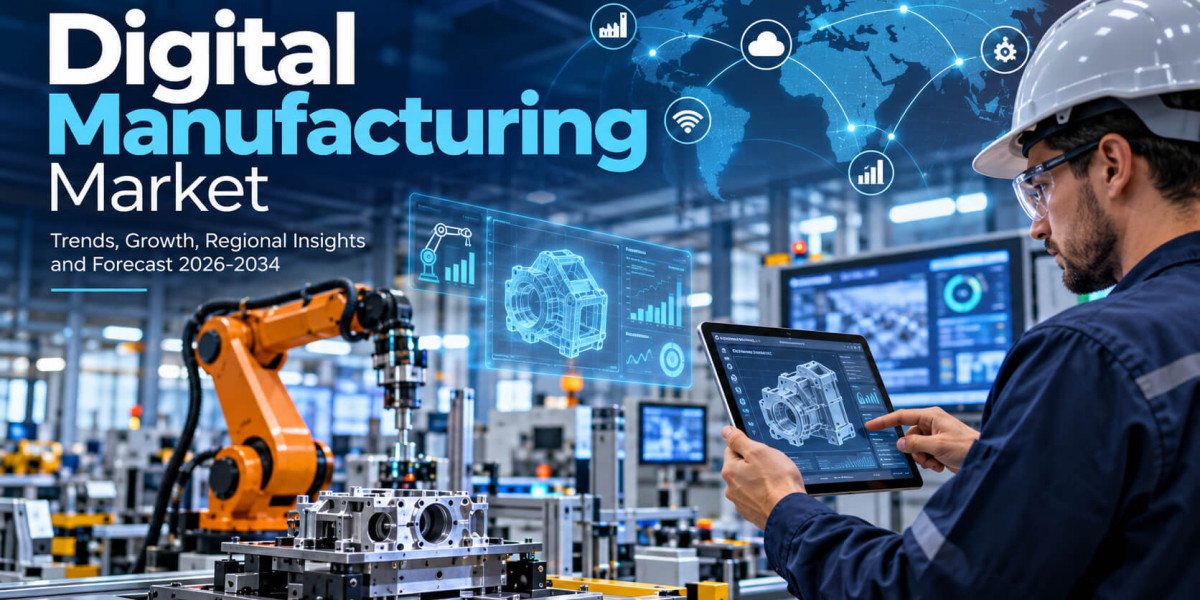
The global digital manufacturing market size is experiencing significant growth as manufacturers increasingly adopt advanced digital technologies to improve productivity, optimize operations, and enhance product quality. The market reached USD 649.34 Billion in 2025 and is projected to reach USD 2,215.22 Billion by 2034, expanding at a CAGR of 12.67% during 2026–2034. North America dominated the market in 2025, accounting for 36.5% of the global market share.
The industry is being influenced by the growing adoption of Industry 4.0 technologies, industrial Internet of Things (IoT), artificial intelligence (AI), advanced analytics, cloud computing, and digital twin solutions. Increasing demand for real-time production monitoring, shorter product development cycles, customized manufacturing, and energy-efficient operations is encouraging companies to accelerate their digital transformation initiatives.
Market Snapshot
Base Year: 2025
Historical Period: 2020–2025
Forecast Period: 2026–2034
Market Size (2025): USD 649.34 Billion
Market Forecast (2034): USD 2,215.22 Billion
CAGR (2026–2034): 12.67%
Leading Region: North America
Dominant Component Segment: Software
Leading Component Segment Share: 62.5%
Dominant Process Type: Computer-Based Simulation
Leading Process Type Share: 30.0%
Dominant Application Segment: Industrial Machinery
Leading Application Segment Share: 38.0%
North America accounted for 36.5% of the global digital manufacturing market in 2025, supported by substantial investments in advanced manufacturing technologies, established industrial software providers, widespread automation adoption, and government initiatives promoting smart factories and domestic manufacturing.
Request a Sample Report: https://www.imarcgroup.com/digital-manufacturing-market/requestsample
Digital Manufacturing Market Trends to Watch
Three major trends are shaping the future of the global digital manufacturing industry.
Growth of Integrated Digital Platforms for Rapid Manufacturing Workflows
As manufacturing businesses increasingly embrace digital transformation, specialized marketing services are becoming essential for communicating technical capabilities, attracting industrial buyers, and building long-term customer relationships. A digital marketing agency for manufacturers can help businesses leverage search engine optimization (SEO), content marketing, paid advertising, and lead-generation strategies to improve online visibility and expand their customer base. Consequently, demand for a manufacturing digital marketing agency is growing as companies seek targeted digital strategies to strengthen brand awareness, increase qualified inquiries, and support sustainable business growth.
Integration of Model-Based Metrology for Enhanced Quality Control
The increasing adoption of model-based metrology is strengthening quality control across digital manufacturing environments. Manufacturers are integrating inspection and measurement processes directly into digital production workflows to improve accuracy, detect deviations earlier, and maintain consistent product quality.
Model-based metrology connects engineering designs with measurement systems, allowing manufacturers to compare physical components against digital specifications. Automated inspection routines and real-time feedback mechanisms help identify production inconsistencies and improve process control.
In 2025, Verisurf Software released Verisurf 2026, an upgraded model-based metrology platform designed to improve inspection, measurement, and analysis in digital manufacturing environments. The platform integrates design information with production workflows to support part verification and quality monitoring.
These developments highlight the growing importance of connected quality assurance systems in modern manufacturing. By improving measurement accuracy and reducing inspection inefficiencies, digital metrology solutions help manufacturers strengthen productivity and maintain reliable production standards.
Expansion of Collaborative Industry 4.0 Innovation Centers
The development of specialized innovation centers and collaborative research facilities is accelerating the adoption of digital manufacturing technologies. These centers bring together expertise in AI, industrial IoT, digital engineering, automation, and advanced production systems to develop and test solutions for industrial applications.
Innovation centers enable companies to evaluate emerging technologies, conduct experiments, and develop prototypes before introducing solutions across large-scale manufacturing operations. Collaboration between technology providers, engineering companies, and manufacturers also supports knowledge exchange and faster technology deployment.
In 2024, Tata Consultancy Services launched the Bringing Life to Things IoT Engineering Lab in Cincinnati, Ohio. The facility was designed to accelerate the development of AI, generative AI, and IoT-driven industrial solutions and included the TCS Digital Manufacturing Platform alongside connected manufacturing and engineering technologies.
Such facilities are helping organizations explore new production models, improve manufacturing intelligence, and accelerate the implementation of Industry 4.0 technologies across industries.
Digital Manufacturing Market Segmentation
The global digital manufacturing market is analyzed by component, process type, and application, with each segment reflecting different technological requirements and industrial applications.
By Component
Software
Services
Software dominated the component segment, accounting for 62.5% of the market share. Software solutions support the digitalization of manufacturing operations through computer-aided design, manufacturing execution systems, product lifecycle management platforms, and enterprise resource planning applications.
These solutions connect design, engineering, production, and business management functions, enabling manufacturers to improve collaboration, shorten product development cycles, and strengthen quality control. Integrated software platforms also help organizations coordinate production activities and maintain greater visibility across manufacturing operations.
The growing adoption of cloud-based and subscription-based software models is making advanced manufacturing tools more accessible to organizations of different sizes. These models can support flexible deployment, remote collaboration, and integration with other digital systems.
In March 2025, Siemens completed the acquisition of Altair Engineering Inc. to strengthen its portfolio of AI-powered industrial and simulation software. The acquisition supported the development of integrated digital engineering and manufacturing capabilities, enabling companies to design, simulate, test, and optimize complex industrial systems more efficiently.
As manufacturers continue to adopt connected production environments, software is expected to remain an important component of digital manufacturing investment.
By Process Type
Computer-Based Designing
Computer-Based Simulation
Computer 3D Visualization
Analytics
Others
Computer-based simulation held a leading position in the process-type segment, accounting for 30.0% of the market. Simulation technologies enable manufacturers to create virtual representations of products, equipment, and production processes, allowing engineers to evaluate performance before physical implementation.
These tools support applications such as structural analysis, thermal modeling, computational fluid dynamics, and electromagnetic simulation. By testing different operating conditions virtually, manufacturers can identify design weaknesses, reduce development costs, and improve production efficiency.
Simulation technologies are also becoming increasingly important in digital twin applications, where virtual models can support monitoring, analysis, and optimization of physical manufacturing systems.
In 2025, Virtualware announced that it would present its industrial simulation and extended reality (XR) solutions at Hannover Messe 2025. These included the Simumatik platform, designed to simulate and test industrial systems in virtual environments before implementation.
Integrated with the VIROO XR platform, these technologies support immersive interaction with digital twins and automation systems. Such solutions can improve engineering training, strengthen system design, and help manufacturers evaluate production configurations before making costly physical changes.
The increasing use of simulation-driven engineering is reinforcing its importance in digital manufacturing strategies.
By Application
Automation and Transportation
Aerospace and Defense
Consumer Electronics
Utilities and Processes
Industrial Machinery
Others
Industrial machinery dominated the application segment, accounting for 38.0% of the market share. The segment benefits from increasing demand for advanced production technologies that improve equipment reliability, manufacturing precision, and operational efficiency.
Digital manufacturing applications in this sector include the design, production, monitoring, and lifecycle management of heavy equipment, machine tools, and automated industrial systems. Manufacturers are adopting digital tools to streamline assembly operations, optimize machining processes, and shorten product development cycles.
The integration of IoT sensors, connected equipment, and advanced analytics allows manufacturers to monitor machine performance in real time and identify potential faults before they lead to equipment failure. Predictive maintenance systems help reduce unplanned downtime, improve equipment utilization, and extend machinery lifespan.
Digital simulation also enables manufacturers to evaluate production layouts, validate equipment configurations, and improve manufacturing processes before implementation. These capabilities are particularly valuable in industries where operational disruptions and equipment failures can result in substantial costs.
As industrial organizations continue to prioritize automation, quality assurance, and cost efficiency, digital manufacturing technologies are becoming increasingly important to industrial machinery production and maintenance.
Competitive Landscape
The digital manufacturing market is characterized by technological innovation, strategic partnerships, acquisitions, and continued investment in research and development. Leading companies are expanding their product portfolios to provide integrated solutions covering product design, engineering, simulation, production management, and industrial analytics.
Acquisitions are helping technology providers strengthen their capabilities in AI, digital twins, and advanced simulation. Meanwhile, the growing adoption of cloud-based and subscription-based software models is changing how manufacturing technologies are delivered and accessed.
About the Author
IMARC Group is a global market research company providing data-driven insights and expert consulting services to businesses seeking to achieve their strategic objectives. With a multidisciplinary team of industry experts, IMARC delivers market intelligence across sectors including manufacturing, energy and mining, construction, automotive, chemicals and materials, and more.
Media & Sales Contact
IMARC Group
United States: +1-201-971-6302
India: +91-120-433-0800
United Kingdom: +44-753-714-6104