
Market Overview
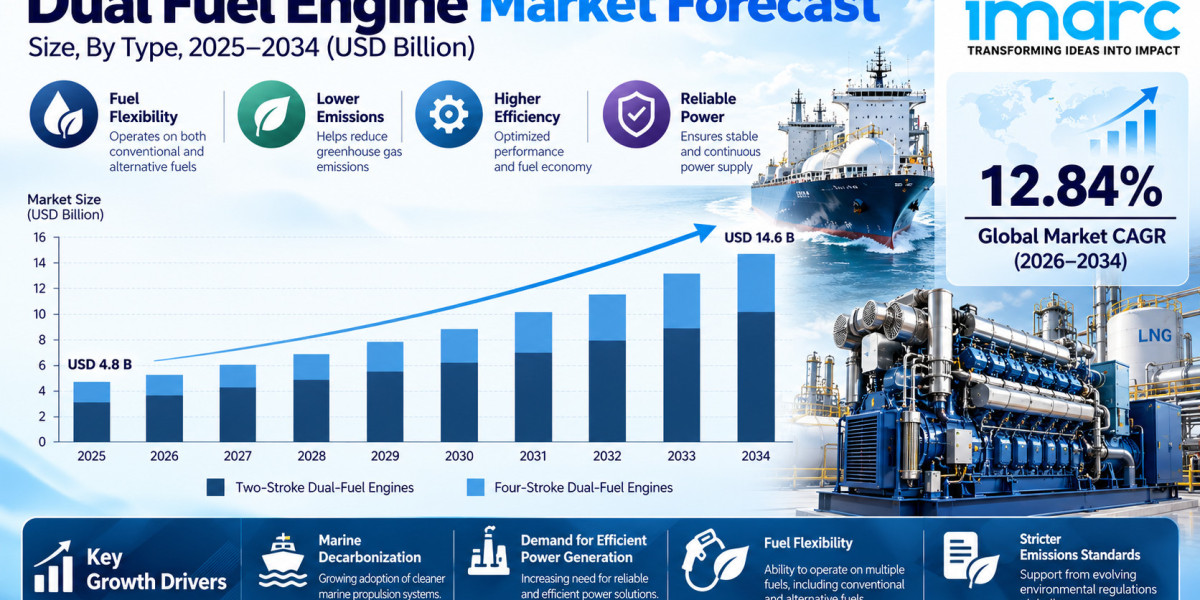
The global dual fuel engine market size is experiencing rapid growth as industries increasingly prioritize fuel flexibility, energy efficiency, and environmentally responsible power solutions. The market reached USD 4.8 Billion in 2025 and is estimated at USD 5.6 Billion in 2026. According to the market assessment, it is projected to reach USD 14.6 Billion by 2034, expanding at a CAGR of 12.84% during 2026–2034.
The industry is being influenced by stringent environmental regulations, rising concerns about energy security, increasing demand for cost-effective fuel alternatives, technological advancements, and growing applications across marine transportation and power generation. The expansion of liquefied natural gas (LNG) infrastructure and the development of advanced engine technologies are also creating new opportunities for market participants.
Dual Fuel Engine Market Snapshot
Base Year: 2025
Historical Period: 2020–2025
Forecast Period: 2026–2034
Market Size (2025): USD 4.8 Billion
Market Size (2026): USD 5.6 Billion
Market Forecast (2034): USD 14.6 Billion
CAGR (2026–2034): 12.84%
Leading Region: Asia Pacific
Dominant Engine Type: Two-Stroke Dual-Fuel Engines
Leading End-User Segment: Marine
Asia Pacific accounted for the largest share of the global dual fuel engine market, supported by rapid industrialization, expanding maritime trade, strong shipbuilding activity, and increasing investments in power generation infrastructure.
Request a Sample Report for Detailed Evaluation: https://www.imarcgroup.com/dual-fuel-engine-market/requestsample
What Is Driving Dual Fuel Engine Market Growth?
Stringent Environmental Regulations Are Encouraging Cleaner Engine Technologies
Governments and international regulatory bodies are introducing increasingly stringent environmental standards to reduce greenhouse gas emissions and improve air quality. These regulations are encouraging industries to adopt technologies that offer improved fuel efficiency and lower emissions.
Dual fuel engines can operate using conventional fuels, such as diesel, alongside alternative fuels, including natural gas. This flexibility allows operators to select appropriate fuel combinations according to operating conditions, fuel availability, and applicable environmental requirements.
Compared with conventional diesel-only operation, natural gas-based dual fuel systems can reduce certain emissions, including nitrogen oxides (NOx), sulfur oxides (SOx), and particulate matter, depending on engine design, operating conditions, and fuel composition. These characteristics make dual fuel technology particularly relevant to the marine industry, where vessel operators face increasing pressure to reduce their environmental footprint.
The growing emphasis on emissions compliance is encouraging manufacturers to develop engines with improved combustion systems, advanced electronic controls, and greater operational efficiency. These developments are supporting the adoption of dual fuel engines across marine transportation, industrial operations, and power generation.
Fuel Flexibility and Cost-Effectiveness Are Strengthening Demand
Fuel flexibility is one of the principal advantages of dual fuel engines. These systems allow operators to use different fuels depending on availability, operating requirements, and relative prices.
For industries such as shipping, transportation, and power generation, fuel represents a significant portion of operating expenditure. The ability to switch between conventional fuels and alternative options, such as natural gas, can help operators manage fuel procurement costs and respond to market fluctuations.
Dual fuel engines can also provide operational flexibility when fuel supply conditions change. For example, operators may use natural gas when it is economically attractive and available, while retaining the ability to operate on conventional fuel when necessary, subject to the engine's specifications.
This flexibility is particularly valuable for large marine vessels and power generation facilities that require reliable performance over extended operating periods. As businesses seek to improve operating efficiency and control energy expenditure, demand for dual fuel engine technologies is expected to benefit.
Rising Energy Security Concerns Are Supporting Market Expansion
Energy security has become an important consideration for governments, utilities, and industrial operators seeking reliable energy supplies. Dependence on a single fuel source can expose businesses and economies to supply disruptions, geopolitical uncertainty, and fluctuations in international energy prices.
Dual fuel engines can help mitigate some of these risks by enabling the use of multiple fuel sources. In markets with established natural gas resources and infrastructure, these engines can provide an additional option for reducing reliance on imported oil-based fuels.
The ability to switch between compatible fuels also allows operators to respond to changes in supply availability and energy costs. This capability is especially relevant to power generation facilities and industrial installations that require dependable energy supplies.
Furthermore, the development of domestic natural gas resources and expanding LNG infrastructure is creating favorable conditions for dual fuel engine adoption in several markets. As countries pursue more resilient energy systems, flexible engine technologies are gaining attention as part of broader energy diversification strategies.
Technological Advancements Are Improving Engine Performance
Continuous technological development is strengthening the performance, efficiency, and reliability of dual fuel engines. Manufacturers are investing in advanced fuel injection systems, electronic engine controls, combustion optimization, and improved engine materials.
Modern control systems help regulate fuel delivery and combustion conditions, supporting efficient engine operation across different loads. Advances in fuel injection technology also improve the mixing of fuel and air, which can contribute to better combustion performance and lower emissions.
Manufacturers are additionally developing engines capable of accommodating a broader range of fuel options, subject to technical requirements and system compatibility. Research into alternative fuels and renewable energy carriers is creating further opportunities for future engine development.
Digital monitoring, automation, and predictive maintenance technologies are also becoming increasingly relevant. These systems can help operators monitor engine performance, identify potential maintenance requirements, and reduce unplanned downtime.
Together, these developments are encouraging the adoption of advanced dual fuel engines across marine transportation, power generation, and other industrial applications.
Marine and Power Generation Applications Are Expanding
The marine and power generation sectors represent important sources of demand for dual fuel engines. Both industries require dependable engine performance while increasingly prioritizing fuel efficiency, operating flexibility, and emissions management.
In marine transportation, dual fuel engines are used in vessels that require substantial propulsion power and the flexibility to operate on compatible conventional and alternative fuels. LNG-powered and LNG-capable vessels are particularly relevant as shipping companies evaluate ways to comply with environmental requirements and manage fuel costs.
Dual fuel technology is used across various vessel categories, including cargo ships, tankers, and other large commercial vessels. Its suitability depends on vessel design, operating conditions, fuel availability, and the applicable regulatory framework.
In power generation, dual fuel engines can provide reliable electricity while allowing operators to select between available fuel sources. This flexibility is valuable in locations where energy demand fluctuates or fuel supply conditions are uncertain.
As investment in reliable power infrastructure and cleaner energy solutions continues, both sectors are expected to remain important contributors to the dual fuel engine market.
Dual Fuel Engine Market Trends to Watch
Three major trends are shaping the global dual fuel engine industry.
Increasing adoption of alternative fuels: Growing interest in natural gas and other alternative fuels is encouraging operators to evaluate dual fuel technologies. The expansion of LNG infrastructure is particularly important for marine applications, where fuel availability and emissions requirements influence engine selection.
Advanced engine controls and digitalization: Improvements in electronic control systems, fuel injection, monitoring technologies, and automation are helping manufacturers enhance engine efficiency and reliability. Artificial intelligence (AI) and the Internet of Things (IoT) may also support predictive maintenance and engine optimization where suitable systems are implemented.
Demand for energy-efficient and environmentally responsible solutions: Environmental regulations and operating cost considerations are encouraging businesses to adopt technologies that balance performance with emissions management. Dual fuel engines offer an option for improving fuel flexibility while supporting the transition toward lower-emission operations in appropriate applications.
The growing emphasis on energy resilience is also creating opportunities for dual fuel engines in power generation and industrial facilities. Operators increasingly value equipment that can accommodate changes in fuel availability and energy prices without compromising operational reliability.
At the same time, the development of alternative fuels and supporting infrastructure is influencing long-term investment decisions. Manufacturers that improve fuel compatibility, operational efficiency, and environmental performance may strengthen their competitive positions.
Dual Fuel Engine Market Segmentation
The global dual fuel engine market is analyzed by engine type and end user. Each segment serves distinct operating requirements across marine transportation, power generation, and other applications.
By Type
Four-Stroke Dual-Fuel Engines
Two-Stroke Dual-Fuel Engines
Two-stroke dual-fuel engines represented the largest segment of the market. Their leading position is primarily supported by their widespread use in marine transportation, particularly in large commercial vessels requiring substantial propulsion power.
Two-stroke engines complete their power cycle through two piston movements, enabling a comparatively simple operating cycle and making them suitable for applications involving high power output and continuous operation.
These engines are widely used in large vessels, including container ships and tankers, where propulsion efficiency and reliable performance are essential. Their ability to operate using compatible fuels such as diesel and natural gas provides operators with flexibility in fuel selection and potential operating cost advantages.
The development of advanced two-stroke dual fuel systems is also supporting their use in modern marine applications. Improvements in combustion control, fuel injection, and engine management are helping manufacturers address evolving operational and environmental requirements.
Four-stroke dual-fuel engines serve a broader range of applications, including stationary power generation, heavy-duty transportation, and certain marine operations. They are valued for their versatility, operational stability, and suitability for applications requiring flexible power delivery.
These engines can operate using different compatible fuels, allowing businesses to balance fuel availability, operating expenditure, and performance requirements. Their application in distributed power generation and industrial facilities creates opportunities across markets seeking dependable energy solutions.
By End User
Marine
Power Generation
The marine segment accounted for the largest share of the dual fuel engine market. Demand is supported by the shipping industry's need for efficient propulsion systems and technologies that help address increasingly stringent environmental requirements.
Dual fuel engines can operate using conventional fuels alongside alternatives such as LNG, depending on engine configuration. This flexibility allows vessel operators to evaluate fuel options according to price, availability, vessel requirements, and applicable emissions standards.
The technology is used across various commercial vessel categories, including cargo ships, tankers, cruise ships, and bulk carriers. As shipping companies invest in fleet modernization and evaluate alternative marine fuels, dual fuel propulsion systems remain an important option within the marine engine market.
The power generation segment is also gaining importance because of the operational flexibility and fuel diversity offered by dual fuel engines. These systems can provide electricity while allowing operators to use available compatible fuels according to operating conditions.
Dual fuel engines are particularly relevant to installations requiring reliable power supplies, including industrial facilities and locations experiencing variable energy demand. Their ability to operate on alternative fuels can also support efforts to diversify energy sources and manage fuel procurement risks.
As electricity demand increases and energy infrastructure develops, power generation applications are expected to provide additional opportunities for dual fuel engine manufacturers.
Regional Dual Fuel Engine Market Outlook
Asia Pacific
Asia Pacific accounted for the largest share of the global dual fuel engine market, supported by rapid industrialization, expanding maritime trade, and significant investment in shipbuilding and power generation.
The region includes major manufacturing and maritime economies such as China, Japan, South Korea, India, Australia, and Indonesia. Strong commercial shipping activity and the presence of established shipbuilding industries support demand for advanced marine propulsion systems.
The expansion of port infrastructure, international trade, and commercial vessel fleets is encouraging investment in efficient engine technologies. Dual fuel engines offer ship operators an option to balance fuel costs and emissions considerations while maintaining the performance required for large-scale maritime operations.
Power generation is another important source of demand. Growing electricity consumption, industrial development, and investments in energy infrastructure are creating opportunities for engines that can operate with different compatible fuel sources.
The availability of natural gas in certain markets and government initiatives supporting cleaner energy technologies are also contributing to regional development. As manufacturers continue to improve engine performance and fuel flexibility, Asia Pacific is expected to remain an important market.
North America
The North American dual fuel engine market is supported by industrial activity, established marine transportation networks, and increasing interest in fuel flexibility and emissions management.
The United States and Canada have developed energy and transportation infrastructure, while the availability of natural gas in the region creates opportunities for applications that can use this fuel efficiently.
In the power generation sector, dual fuel engines can provide operational flexibility by allowing facilities to use different compatible fuels depending on supply conditions and cost considerations. This capability is relevant to installations seeking reliable power generation and greater resilience against fuel disruptions.
Marine operators are also evaluating engine technologies that support environmental compliance and operational efficiency. Improvements in engine controls, fuel systems, and monitoring technologies are helping expand the potential applications of dual fuel systems.
Continued investment in energy infrastructure and industrial modernization is expected to create opportunities for market participants across the region.
Europe
Europe's dual fuel engine market is influenced by its strong emphasis on environmental sustainability, energy efficiency, and emissions reduction.
Regulatory requirements affecting maritime transportation and industrial operations are encouraging companies to evaluate technologies that offer improved fuel flexibility and environmental performance. Dual fuel engines can support these objectives in appropriate applications, particularly when operating with cleaner-burning alternative fuels.
The region's established shipping industry and extensive international trade networks provide opportunities for marine engine manufacturers. Operators are increasingly assessing fuel-efficient propulsion systems and alternative fuel options as part of long-term fleet planning.
Technological innovation is another important factor shaping the market. Manufacturers are investing in advanced combustion systems, electronic controls, and digital monitoring to improve reliability and operational performance.
The development of alternative fuel infrastructure and continued investment in modern engine technologies may further support the adoption of dual fuel engines across European marine and power generation applications.
Latin America
Latin America's dual fuel engine market is supported by growing energy requirements, natural gas resource development, and investment in energy infrastructure.
Countries such as Brazil and Mexico offer opportunities for engine technologies that provide operational flexibility and support reliable power generation. The development of natural gas resources can improve the potential for dual fuel systems in applications where compatible fuel supplies are available.
Power generation is an important area of opportunity, particularly in locations seeking to diversify fuel sources and improve energy reliability. Dual fuel engines can provide operators with flexibility when managing changing fuel prices and supply conditions.
The region's maritime activities and industrial development may also support demand for advanced engine technologies. As investment in infrastructure and energy diversification continues, dual fuel engines can play a role in meeting operational requirements across selected applications.
Middle East and Africa
The Middle East and Africa region presents opportunities for dual fuel engine adoption because of its natural gas resources, expanding energy requirements, and ongoing infrastructure development.
Several countries in the Middle East possess substantial natural gas reserves, creating opportunities for power generation systems capable of using gas alongside conventional fuels. Dual fuel engines can help operators manage fuel availability and maintain reliable operations in suitable installations.
Power generation and industrial applications are particularly relevant in areas where energy demand is increasing or fuel supply conditions require greater flexibility. These engines may also be used in applications supporting industrial facilities and water infrastructure, subject to operational requirements.
Across Africa, growing electricity demand and efforts to improve energy access are creating opportunities for dependable and adaptable power generation technologies. The availability of suitable fuels and supporting infrastructure will remain important factors influencing adoption.
As regional energy systems develop, dual fuel engines may offer additional options for improving fuel diversity and operational resilience.
Competitive Landscape
Companies operating in the global dual fuel engine market are focusing on technological innovation, product development, strategic partnerships, and geographic expansion to strengthen their competitive positions.
Manufacturers are investing in research and development to improve fuel efficiency, enhance combustion performance, reduce emissions, and increase engine reliability. Another important focus is the development of systems that can operate with a wider range of compatible fuels, including selected alternative and renewable fuel options.
Strategic collaborations with fuel suppliers, shipbuilders, technology providers, and end users are helping companies develop integrated solutions for marine transportation and power generation. Manufacturers are also expanding their service networks, technical support capabilities, and regional operations to serve customers across international markets.
Compliance with environmental requirements remains an important consideration. Companies are developing engine systems that help customers address applicable standards while maintaining operating performance and managing fuel costs.
Major companies identified in the global dual fuel engine market include:
Anglo Belgian Corporation
Caterpillar Inc.
Cummins Inc.
Daihatsu Diesel Manufacturing Co. Ltd.
Heinzmann GmbH and Co. KG
Hyundai Motor Company
Kawasaki Heavy Industries Ltd.
MAN Energy Solutions SE
Wärtsilä Corporation
Yanmar Co. Ltd.
Recent Industry Developments
August 2023: Anglo Belgian Corporation signed a contract with HAV Design for the development of a service operation vessel featuring dual fuel methanol engines. The agreement highlighted industry interest in alternative fuels and advanced propulsion technologies for marine applications.
September 2022: Caterpillar unveiled a new methanol dual-fuel engine designed to reduce carbon emissions. The development reflected ongoing efforts to expand alternative fuel options and improve engine environmental performance.
September 2021: Cummins introduced the QSK50 Tier dual fuel engine for the oil and gas industry, expanding its offering of engine technologies for applications requiring operational flexibility and dependable performance.
Where Are the Biggest Dual Fuel Engine Market Opportunities?
The dual fuel engine industry presents opportunities across several areas:
Marine propulsion: Demand for efficient propulsion systems and greater fuel flexibility is creating opportunities for advanced dual fuel engines in commercial shipping.
Power generation: Facilities requiring reliable electricity and the ability to use multiple compatible fuels represent an important application area.
Alternative fuel development: Advances in natural gas, methanol, and other potential fuel options are encouraging manufacturers to develop more adaptable engine technologies.
Advanced combustion systems: Improvements in fuel injection, combustion control, and engine management can enhance operating efficiency and reliability.
Digital monitoring and predictive maintenance: Connected sensors, automation, and analytics can help operators monitor engine performance and reduce unplanned downtime.
Energy security: The ability to use multiple fuel sources can help operators manage supply disruptions and changes in fuel prices.
Industrial applications: Industries requiring dependable mechanical power and operational flexibility may benefit from dual fuel engine systems where suitable infrastructure is available.
Infrastructure development: Expansion of LNG and other alternative fuel infrastructure can improve the feasibility of adopting compatible dual fuel technologies.
These opportunities are particularly relevant as businesses seek to balance environmental requirements, operating costs, and energy reliability. Manufacturers that develop efficient, reliable, and adaptable engines may be better positioned to respond to changing industry needs.
Get Detailed Dual Fuel Engine Market Intelligence
The headline market figures provide a useful overview of the industry's direction, but businesses evaluating market entry, product development, technology investment, or regional expansion may require more detailed market intelligence.
A comprehensive dual fuel engine market report can help businesses assess:
Market size and growth forecasts
Four-stroke and two-stroke engine segments
Marine and power generation applications
Regional and country-level market performance
Environmental regulations and market drivers
Fuel flexibility and cost-effectiveness trends
Technological advancements in engine design
Competitive landscape and key company profiles
Alternative fuel adoption and infrastructure development
Recent industry developments and emerging opportunities
Detailed market intelligence can support strategic decisions related to manufacturing investments, product innovation, geographic expansion, and customer targeting across the global dual fuel engine industry.
Request a Sample Report: https://www.imarcgroup.com/dual-fuel-engine-market/requestsample
Dual Fuel Engine Market FAQs
What is the current size of the global dual fuel engine market?
The global dual fuel engine market reached USD 4.8 Billion in 2025 and is estimated at USD 5.6 Billion in 2026. It is projected to reach USD 14.6 Billion by 2034.
What is the expected CAGR of the dual fuel engine market?
The global dual fuel engine market is projected to grow at a CAGR of 12.84% during 2026–2034, according to the market assessment.
Which region leads the dual fuel engine market?
Asia Pacific accounted for the largest market share, supported by rapid industrialization, expanding maritime trade, strong shipbuilding activity, and growing investments in power generation infrastructure.
Which engine type dominates the dual fuel engine market?
Two-stroke dual-fuel engines represent the largest type segment. Their widespread use in large commercial vessels, including container ships and tankers, supports their leading position.
Which end-user segment holds the largest market share?
The marine segment accounts for the largest share of the dual fuel engine market. Demand is supported by the need for efficient vessel propulsion, fuel flexibility, and compliance with applicable environmental regulations.
What are the major drivers of the dual fuel engine market?
Major growth drivers include stringent environmental regulations, increasing demand for fuel flexibility, rising energy security concerns, technological advancements, expanding LNG infrastructure, and growing applications in marine transportation and power generation.
Who are the major companies in the dual fuel engine market?
Major companies include Anglo Belgian Corporation, Caterpillar Inc., Cummins Inc., Daihatsu Diesel Manufacturing Co. Ltd., Heinzmann GmbH and Co. KG, Hyundai Motor Company, Kawasaki Heavy Industries Ltd., MAN Energy Solutions SE, Wärtsilä Corporation, and Yanmar Co. Ltd.
Conclusion
The global dual fuel engine market is expanding as industries increasingly seek fuel flexibility, operational reliability, and more environmentally responsible engine technologies. Valued at USD 4.8 Billion in 2025, the market is projected to reach USD 14.6 Billion by 2034, registering a CAGR of 12.84% during 2026–2034.
Growth opportunities are emerging across marine propulsion, power generation, advanced engine controls, and alternative fuel technologies. Asia Pacific maintains its leading position, supported by strong maritime activity, industrial development, and investments in energy infrastructure.
Companies that prioritize technological innovation, fuel compatibility, emissions management, and reliable customer support can strengthen their competitive positions in the evolving dual fuel engine industry.
About the Author
IMARC Group is a global market research company providing data-driven insights and expert consulting services to businesses seeking to achieve their strategic objectives. With a multidisciplinary team of industry experts, IMARC delivers market intelligence across sectors including energy and mining, construction and manufacturing, automotive, chemicals and materials, hospitality, and more.
Media & Sales Contact
IMARC Group
United States: +1-201-971-6302
India: +91-120-433-0800
United Kingdom: +44-753-714-6104