
Market Overview
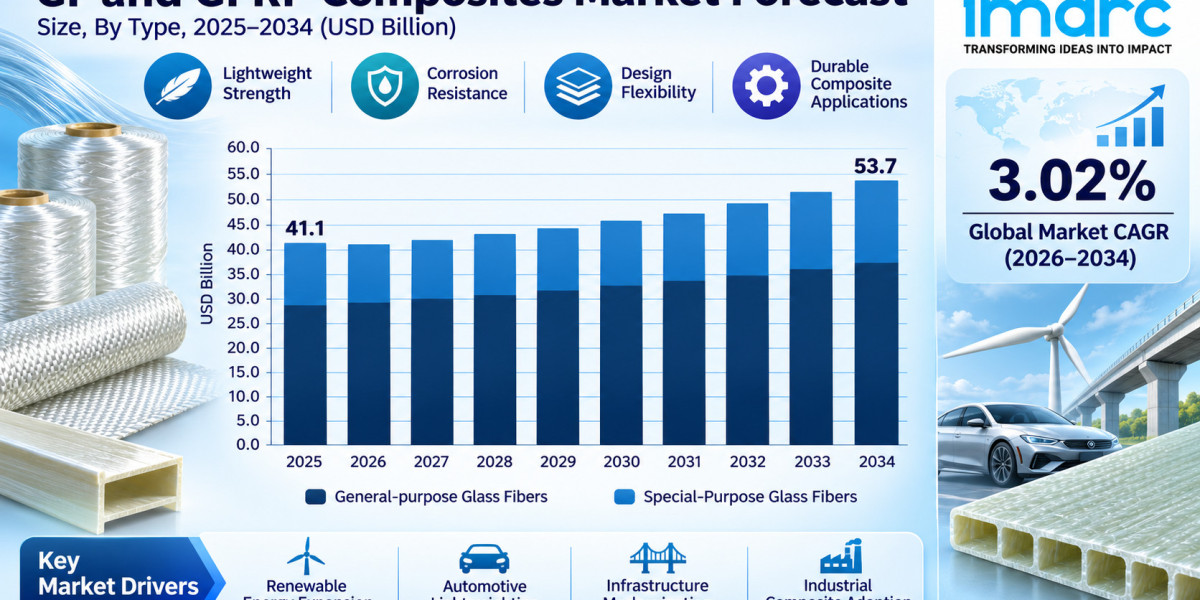
The global GF and GFRP composites market size is experiencing steady growth as industries increasingly adopt lightweight, durable, and high-performance materials for various applications. The market reached USD 41.1 Billion in 2025 and is estimated at USD 42.3 Billion in 2026. According to IMARC Group, the market is projected to reach USD 53.7 Billion by 2034, expanding at a CAGR of 3.02% during 2026–2034.
The industry is being influenced by increasing product adoption in the automotive sector, rising demand from the construction industry, continuous material innovations, and growing research and development (R&D) activities. The superior strength-to-weight ratio, corrosion resistance, electrical insulation, and design flexibility of glass fiber and glass fiber reinforced polymer composites are further supporting their adoption across automotive, aerospace, marine, electrical, electronics, and construction applications.
GF and GFRP Composites Market Snapshot
Base Year: 2025
Historical Period: 2020–2025
Forecast Period: 2026–2034
Market Size (2025): USD 41.1 Billion
Market Size (2026): USD 42.3 Billion
Market Forecast (2034): USD 53.7 Billion
CAGR (2026–2034): 3.02%
Leading Type Segment: General-purpose Glass Fibers
Glass fiber (GF) and glass fiber reinforced polymer (GFRP) composites are manufactured using glass fibers combined with a polymer matrix, typically epoxy or polyester. These materials offer excellent mechanical strength, lightweight properties, corrosion resistance, thermal stability, and electrical insulation. Their ability to deliver high strength-to-weight ratios makes them suitable for applications requiring durability, dimensional stability, and reduced structural weight.
GF composites are commonly manufactured using silica-based materials, including fiberglass and E-glass, while GFRP composites utilize glass fibers as the primary reinforcement within a polymer matrix. These materials are increasingly used in structural components such as beams, columns, rebars, panels, and pipes, creating opportunities across multiple industrial sectors.
Request a Sample Report to access detailed market insights and evaluate opportunities across the global GF and GFRP composites industry.
https://www.imarcgroup.com/gf-gfrp-composites-market/requestsample
What Is Driving GF and GFRP Composites Market Growth?
Increasing Adoption in the Automotive Industry
The growing adoption of GF and GFRP composites in the automotive industry represents one of the primary factors driving market growth. Automotive manufacturers are increasingly incorporating lightweight materials into vehicle components to improve fuel efficiency, reduce emissions, and enhance overall performance.
GF and GFRP composites are widely utilized in manufacturing body panels, hoods, doors, bumpers, and interior components. Their excellent strength-to-weight ratio allows manufacturers to reduce vehicle weight without compromising structural integrity and durability.
Furthermore, their design flexibility enables engineers to develop complex shapes and customized automotive components. This capability supports innovative vehicle designs while improving manufacturing efficiency and component functionality.
The increasing focus on vehicle electrification is also creating opportunities for advanced composite materials. Lightweight components and electrical insulation properties make GF and GFRP composites suitable for various automotive applications, supporting their growing importance in next-generation vehicle manufacturing.
Growing Demand from the Construction Industry
The expanding construction industry is another significant factor supporting the global GF and GFRP composites market. These materials are increasingly being utilized in infrastructure projects and building applications because of their lightweight characteristics, corrosion resistance, durability, and ability to withstand challenging environmental conditions.
GFRP composites are used in manufacturing structural components such as reinforcement bars, beams, columns, pipes, panels, facades, and architectural elements. Their corrosion-resistant properties make them particularly suitable for bridges, marine infrastructure, industrial facilities, and structures exposed to moisture and chemicals.
Additionally, the lightweight nature of composite materials can simplify transportation, handling, and installation processes, potentially reducing construction time and associated costs.
The growing emphasis on durable infrastructure, modern architectural designs, and advanced construction materials is encouraging manufacturers to develop innovative GF and GFRP composite solutions for residential, commercial, and industrial projects.
Technological Advancements and Increasing R&D Activities
Continuous technological advancements and extensive research and development activities are contributing significantly to market expansion. Manufacturers are focusing on improving the mechanical strength, thermal performance, durability, and versatility of GF and GFRP composites to meet evolving industrial requirements.
Innovations in fiber manufacturing, resin formulations, composite processing, and material engineering are helping improve product performance and expand potential applications.
Furthermore, increasing investments in R&D are encouraging the development of advanced glass fiber materials with enhanced properties for demanding applications across aerospace, automotive, construction, marine, and electrical industries.
Manufacturers are also exploring bio-based resins and fibers as alternatives to conventional petroleum-based materials. These developments are supporting efforts to improve the sustainability profile of composite products while maintaining their functional performance.
GF and GFRP Composites Market Trends to Watch
Three major trends are shaping the future of the global GF and GFRP composites industry.
Lightweight material adoption: Industries such as automotive, aerospace, and transportation are increasingly adopting lightweight composite materials to improve efficiency, reduce structural weight, and enhance product performance. GF and GFRP composites offer a combination of strength, durability, and design flexibility that supports these requirements.
Sustainable composite development: Growing environmental awareness is encouraging manufacturers to explore bio-based resins, sustainable fibers, and environmentally conscious production processes. The development of more sustainable composite solutions is creating opportunities for innovation across the industry.
Advanced material innovation: Continuous improvements in fiber technology, polymer formulations, and composite manufacturing processes are expanding the application potential of GF and GFRP materials. Enhanced mechanical properties, corrosion resistance, and manufacturing flexibility are supporting adoption across increasingly demanding industrial applications.
The increasing utilization of composite materials in electrical and electronic applications is also creating new growth opportunities. Their electrical insulation properties, dimensional stability, and resistance to environmental conditions make them suitable for various electrical components and infrastructure requirements.
Furthermore, the expanding aerospace industry is encouraging the development of advanced composite materials that combine structural strength with reduced weight. These developments are supporting innovation and broadening the industrial applications of GF and GFRP composites.
GF and GFRP Composites Market Segmentation
The global GF and GFRP composites market is analyzed by type and application, with each segment reflecting different material characteristics and industrial requirements.
By Type
General-purpose Glass Fibers
Special-purpose Glass Fibers
General-purpose glass fibers dominated the type segment in the global GF and GFRP composites market. These materials are widely utilized across industrial applications because of their versatility, mechanical strength, durability, and cost-effectiveness.
General-purpose glass fibers are commonly used in automotive components, construction materials, consumer products, electrical applications, and various industrial components. Their favorable performance characteristics and suitability for different manufacturing processes make them an important material category within the composite industry.
Special-purpose glass fibers, meanwhile, are developed to meet specific performance requirements. They can offer specialized properties for applications requiring enhanced mechanical performance, thermal resistance, electrical characteristics, or other technical capabilities.
The increasing demand for advanced materials across aerospace, automotive, electronics, and infrastructure applications is creating opportunities for both general-purpose and special-purpose glass fiber manufacturers.
By Application
Building and Construction
Electronics
Transportation
Others
The application segment reflects the increasing utilization of GF and GFRP composites across industries requiring lightweight, durable, corrosion-resistant, and high-performance materials.
Building and construction represents an important application area, supported by the use of composite materials in reinforcement bars, structural components, bridges, facades, pipes, and architectural elements. Their corrosion resistance and lightweight properties make them suitable for infrastructure projects and structures exposed to challenging environmental conditions.
Electronics represents another important application segment. GF and GFRP composites are utilized in electrical and electronic components because of their insulation properties, dimensional stability, and resistance to heat and environmental conditions. These characteristics support their use in applications requiring reliable electrical performance.
Transportation is witnessing increasing adoption of glass fiber composites for manufacturing automotive body panels, doors, bumpers, interior components, and other structural parts. Their lightweight nature helps improve vehicle efficiency while maintaining strength and durability. Growing demand for advanced transportation solutions is further supporting their application.
Other applications include aerospace, marine, consumer goods, and various industrial products. The versatility of GF and GFRP composites allows manufacturers to develop customized components for applications requiring specific combinations of mechanical, thermal, and electrical properties.
Regional GF and GFRP Composites Market Outlook
North America
North America represents an important market for GF and GFRP composites, supported by established automotive, aerospace, construction, and electrical industries. The United States and Canada have developed industrial manufacturing capabilities and increasing demand for advanced materials across multiple sectors.
The automotive industry is contributing to product adoption through the growing utilization of lightweight composite components designed to improve vehicle efficiency and performance. Additionally, the region’s established aerospace sector is supporting demand for materials offering high strength-to-weight ratios and specialized mechanical properties.
The construction industry also provides opportunities through infrastructure development and the increasing use of corrosion-resistant composite materials in bridges, buildings, and industrial facilities.
Furthermore, continuous investments in material innovation, manufacturing technologies, and R&D activities are supporting the development of advanced GF and GFRP composite solutions across North America.
Asia Pacific
Asia Pacific offers significant opportunities for the GF and GFRP composites market, supported by expanding manufacturing industries, infrastructure development, and increasing automotive production.
Countries such as China, India, Japan, South Korea, Australia, and Indonesia are contributing to regional demand through their growing industrial and construction activities.
The expanding automotive industry is encouraging manufacturers to adopt lightweight composite components to improve vehicle efficiency and performance. At the same time, rapid urbanization and infrastructure development are creating demand for durable construction materials, including GFRP reinforcement bars, pipes, panels, and structural components.
The region’s growing electronics manufacturing sector is also supporting the utilization of glass fiber materials because of their electrical insulation and dimensional stability.
Moreover, increasing investments in industrial manufacturing capabilities and technological development are encouraging local producers to expand their composite material portfolios and improve production efficiency.
Europe
Europe represents an established market for GF and GFRP composites, supported by its automotive, aerospace, construction, and industrial manufacturing sectors.
Countries such as Germany, France, the United Kingdom, Italy, Spain, and Russia contribute to regional demand through their diverse industrial activities and advanced manufacturing capabilities.
The automotive industry is an important source of demand, as manufacturers increasingly focus on lightweight materials to improve vehicle performance and efficiency. Similarly, the aerospace sector utilizes advanced composite materials for applications requiring structural strength and reduced weight.
The construction industry is also creating opportunities through the adoption of corrosion-resistant composite materials in infrastructure projects and architectural applications.
Additionally, increasing attention toward sustainable manufacturing and material innovation is encouraging companies to explore improved resin systems, bio-based alternatives, and advanced composite processing technologies.
Latin America
The Latin American GF and GFRP composites market is supported by developing construction activities, expanding industrial manufacturing, and increasing demand for advanced materials across transportation and infrastructure applications.
Brazil and Mexico represent important markets within the region, with their automotive, construction, and industrial sectors creating opportunities for composite material manufacturers.
The use of GFRP composites in infrastructure components, pipes, reinforcement materials, and structural applications is contributing to market development. Their resistance to corrosion and environmental degradation makes them suitable for various industrial and construction requirements.
Furthermore, the growing emphasis on manufacturing efficiency and durable materials is encouraging industries to explore composite solutions for applications traditionally served by conventional materials.
Middle East and Africa
The Middle East and Africa region presents opportunities for GF and GFRP composites through infrastructure development, construction activities, and increasing industrial diversification.
The expanding construction sector is creating demand for lightweight and corrosion-resistant materials used in buildings, bridges, pipes, facades, and industrial infrastructure.
GFRP composites are particularly relevant for applications exposed to moisture, chemicals, and challenging environmental conditions because of their durability and corrosion resistance.
Additionally, investments in industrial infrastructure, energy-related projects, and manufacturing capabilities are creating opportunities for composite material suppliers.
As regional industries increasingly focus on durable construction materials and advanced manufacturing technologies, the demand for GF and GFRP composites is expected to benefit from expanding application opportunities.
Competitive Landscape
GF and GFRP composite manufacturers are increasingly competing through product innovation, manufacturing efficiency, technological development, and the expansion of their industrial application portfolios.
Leading companies are investing in research and development to improve the mechanical properties, durability, thermal performance, and sustainability of glass fiber materials. These initiatives are helping manufacturers address evolving requirements across automotive, construction, aerospace, electrical, and transportation industries.
Companies are also focusing on developing specialized glass fiber products and improving manufacturing processes to strengthen product quality and operational efficiency. Strategic collaborations, capacity expansions, and investments in advanced production technologies are further supporting competitive positioning.
Sustainability is another important area of focus, with manufacturers exploring bio-based resins, alternative materials, and more environmentally conscious production practices.
Major companies identified in the global GF and GFRP composites market include:
3B - The Fibreglass Company
China Beihai Fiberglass Co. Ltd.
China Jushi Co. Ltd.
Compagnie de Saint-Gobain S.A.
Johns Manville Corporation (Berkshire Hathaway Inc.)
Nippon Electric Glass Co. Ltd.
Nitto Boseki Co. Ltd.
Owens Corning
Taishan Fiberglass Inc. (CTG) (Sinoma Science & Technology Co. Ltd.)
These companies are focusing on technological innovation, product development, and expanding their presence across major end-use industries to strengthen their positions in the global market.
Where Are the Biggest GF and GFRP Composites Market Opportunities?
The global GF and GFRP composites industry presents opportunities across several areas:
Automotive lightweighting: Increasing demand for lightweight vehicle components is creating opportunities for composite materials that improve efficiency while maintaining structural strength.
Infrastructure development: The utilization of GFRP reinforcement bars, beams, pipes, and structural panels is creating opportunities in construction and infrastructure projects.
Sustainable composite materials: The development of bio-based resins and more environmentally conscious production processes is creating new opportunities for material manufacturers.
Electrical and electronics applications: The electrical insulation and dimensional stability of glass fiber composites support their use in various electrical components and electronic products.
Aerospace applications: Demand for lightweight, high-strength materials is encouraging the development of advanced composite solutions for aerospace components.
Advanced material innovation: Investments in R&D and manufacturing technologies are creating opportunities to improve product performance, versatility, and application potential.
Marine and industrial applications: Corrosion-resistant composite materials offer opportunities in marine structures, industrial pipes, and equipment exposed to challenging environmental conditions.
These opportunities are particularly relevant as industries increasingly seek materials that combine mechanical strength, reduced weight, durability, and design flexibility. Manufacturers that continue to improve material performance and develop sustainable composite solutions can strengthen their competitive positioning.
Get Detailed GF and GFRP Composites Market Intelligence
The headline market figures provide a useful overview of the industry’s direction, but businesses evaluating market entry, product development, manufacturing investments, competitive positioning, or regional expansion may require more detailed market intelligence.
The detailed market report provides insights into:
Market size and forecasts
Type-wise market analysis
Application-wise market assessment
Regional and country-level market performance
Market trends and growth drivers
Automotive and construction industry demand
Technological developments and R&D activities
Sustainable composite material innovations
Competitive landscape
Key company profiles
Emerging industrial applications
Industry developments and growth opportunities
Businesses can use these insights to evaluate market opportunities, understand changing industrial requirements, identify potential growth areas, and develop strategies for expanding their presence in the global GF and GFRP composites industry.
Request a Sample Report to access detailed market insights and evaluate opportunities across the global GF and GFRP composites industry.
https://www.imarcgroup.com/gf-gfrp-composites-market/requestsample
GF and GFRP Composites Market FAQs
What is the current size of the global GF and GFRP composites market?
The global GF and GFRP composites market reached USD 41.1 Billion in 2025 and is estimated to reach USD 42.3 Billion in 2026. It is projected to reach USD 53.7 Billion by 2034.
What is the expected CAGR of the GF and GFRP composites market?
The global GF and GFRP composites market is expected to grow at a CAGR of 3.02% during 2026–2034.
What are GF and GFRP composites?
GF and GFRP composites are materials manufactured by combining glass fibers with a polymer matrix, typically epoxy or polyester. They offer lightweight characteristics, high mechanical strength, corrosion resistance, electrical insulation, and dimensional stability.
Which type segment dominates the GF and GFRP composites market?
General-purpose glass fibers represented the largest type segment in the global GF and GFRP composites market, supported by their versatility, mechanical strength, durability, and widespread industrial applications.
What are the major applications of GF and GFRP composites?
Major applications include building and construction, electronics, transportation, and other industrial uses. These materials are also utilized in automotive, aerospace, marine, and consumer goods manufacturing.
What are the major factors driving the GF and GFRP composites market?
Key growth drivers include increasing automotive adoption, expanding construction activities, continuous product innovation, growing R&D investments, and rising demand for lightweight, durable, and corrosion-resistant materials.
Who are the major companies in the GF and GFRP composites market?
Major companies include 3B - The Fibreglass Company, China Beihai Fiberglass Co. Ltd., China Jushi Co. Ltd., Saint-Gobain, Johns Manville Corporation, Nippon Electric Glass Co. Ltd., Nitto Boseki Co. Ltd., Owens Corning, and Taishan Fiberglass Inc.
Conclusion
The global GF and GFRP composites market is evolving as industries increasingly prioritize lightweight, durable, corrosion-resistant, and high-performance materials. Valued at USD 41.1 Billion in 2025, the market is estimated to reach USD 42.3 Billion in 2026 and is projected to expand to USD 53.7 Billion by 2034, registering a CAGR of 3.02% during 2026–2034.
Growth opportunities are emerging across automotive, construction, transportation, electronics, aerospace, and marine applications. The increasing adoption of lightweight materials, advancements in composite manufacturing technologies, and growing focus on sustainable material development are further supporting industry expansion.
Companies that invest in R&D, product innovation, manufacturing efficiency, and advanced composite solutions can strengthen their competitive positioning and capitalize on the evolving requirements of the global GF and GFRP composites industry.
About the Author
IMARC Group is a leading global market research company providing data-driven insights and expert consulting services to businesses seeking to achieve their strategic objectives. With a multidisciplinary team of industry experts, IMARC delivers thorough, reliable market intelligence across sectors including Energy and Mining, Construction and Manufacturing, Automotive, Chemicals and Materials, and more.
Media & Sales Contact
IMARC Group
United States: +1-201-971-6302
India: +91-120-433-0800
United Kingdom: +44-753-714-6104